
全球铁缺乏症的负担和不平等:1990-2017 年全球疾病负担数据集的研究结果。
Global burden and inequality of iron deficiency: findings from the Global Burden of Disease datasets 1990-2017.
机构信息
Department of Nutrition and Food Hygiene, School of Public Health, Zhejiang University School of Medicine, Hangzhou, China.
Department of Big Data in Health Science School of Public Health, and Center of Clinical Big Data and Analytics of The Second Affiliated Hospital, Zhejiang University School of Medicine, Hangzhou, China.
出版信息
Nutr J. 2022 Mar 18;21(1):16. doi: 10.1186/s12937-022-00771-3.
BACKGROUND
Iron deficiency (ID) impairs patient physical activity, recognition and life quality, which is difficult to perceive but should not be underestimated. Worldwide efforts have been made to lower ID burden, however, whether it decreased equally in different regions and sexes is unclear. This study is to examine regional and sex inequalities in global ID from 1990 to 2017.
METHODS
We conducted a longitudinal, comparative burden-of-disease study. Disability-adjusted life-years (DALYs) of ID were obtained from Global Burden of Disease Report 2017. Human Development Index (HDI) data were obtained from Human Development Report 2017. Gini coefficient and the concentration index were calculated to assess the equities in global burden of ID.
RESULTS
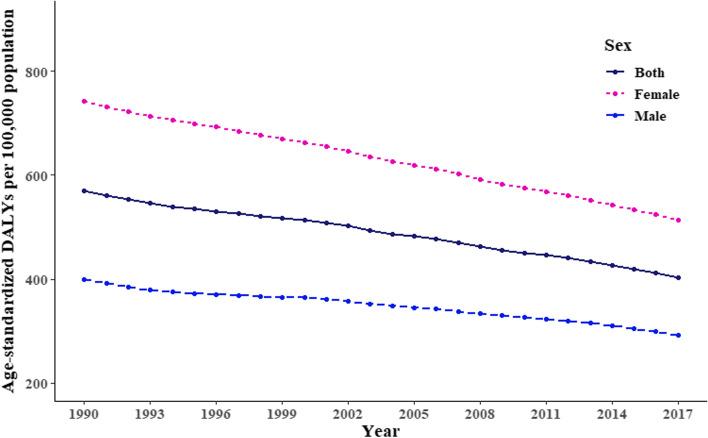
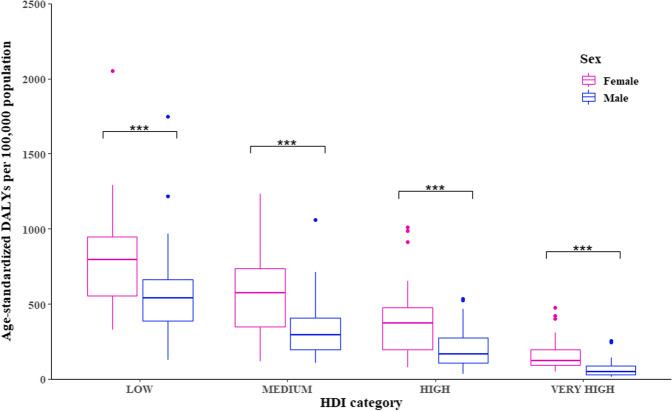
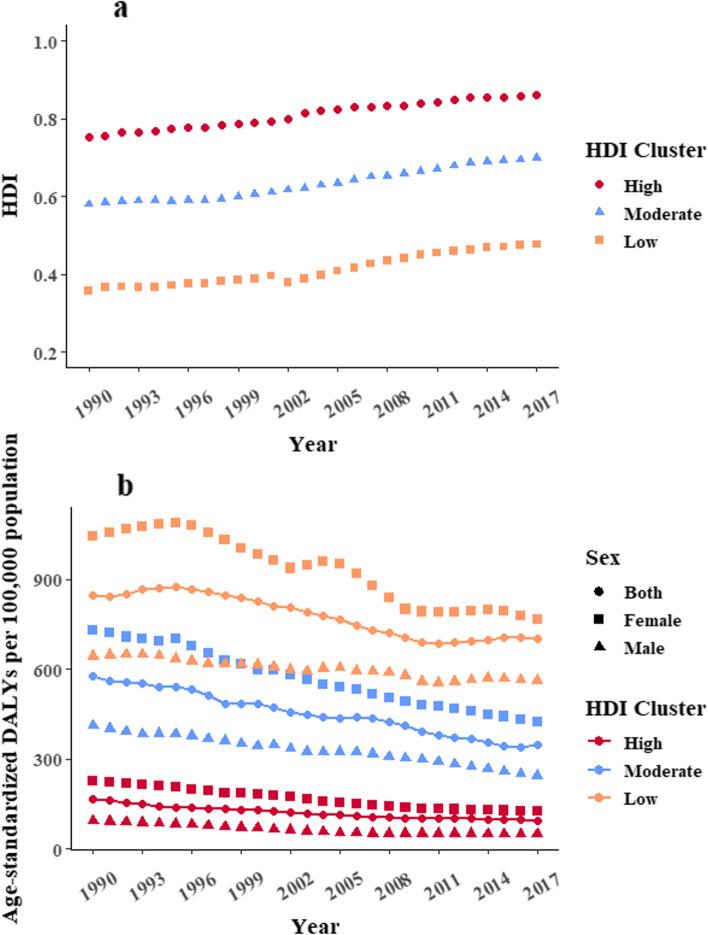
A downward trend of global ID burden (from 569.3 (95% Uncertainty Interval [UI]: 387.8-815.6) to 403.0 (95% UI: 272.4-586.6), p < 0.001), age-adjusted DALYs per 100,000 population) but an uptrend of its inequalities (from 0.366 to 0.431, p < 0.001, Gini coefficients) was observed between 1990 and 2017. ID burden was heavier in women than that in men ([age-adjusted DALYs per 100,000 population from 742.2 to 514.3] vs [from 398.5 to 291.9]), but its inequalities were higher in men since 1990. The between-sex gap of ID burden was narrowed with higher HDI (β = - 364.11, p < 0.001). East Asia & Pacific and South Asia regions made a big stride for ID control in both sexes over decades [age-adjusted DALYs per 100,000 population from 378.7 (95% UI: 255.8-551.7) in 1990 to 138.9 (95%UI: 91.8-206.5) in 2017], while a heavy burden among Sub-Saharan African men was persistent[age-adjusted DALYs per 100,000 population, 572.5 (95% UI: 385.3-815) in 1990 and 562.6 (95% UI: 367.9-833.3) in 2017].
CONCLUSIONS
Redistributing attention and resources to help countries with low HDI, especially take care of women with low socioeconomic status (SES) and men under high ID burden may help hold back the expanding ID inequality.
背景
缺铁(ID)会影响患者的身体活动、认知和生活质量,尽管不易察觉,但不容忽视。全球已在努力降低 ID 负担,但不同地区和性别的负担是否平等降低尚不清楚。本研究旨在调查 1990 年至 2017 年全球 ID 地区和性别不平等情况。
方法
我们进行了一项纵向、比较疾病负担研究。从 2017 年全球疾病负担报告中获得 ID 的残疾调整生命年(DALYs)。人类发展指数(HDI)数据来自 2017 年人类发展报告。计算基尼系数和集中指数,以评估全球 ID 负担的公平性。
结果
1990 年至 2017 年,全球 ID 负担呈下降趋势(从 569.3(95%不确定区间[UI]:387.8-815.6)降至 403.0(95%UI:272.4-586.6),p<0.001),每 100,000 人口的年龄调整 DALY),但其不平等程度呈上升趋势(从 0.366 到 0.431,p<0.001,基尼系数)。1990 年至 2017 年,女性的 ID 负担比男性重(每 100,000 人口的年龄调整 DALY 从 742.2 增加到 514.3),但男性的不平等程度更高。自 1990 年以来,ID 负担的性别差距随着更高的人类发展指数(HDI)而缩小(β= -364.11,p<0.001)。东亚及太平洋地区和南亚地区在数十年间在两性中均取得了重大进展[每 100,000 人口的年龄调整 DALY 从 1990 年的 378.7(95%UI:255.8-551.7)降至 2017 年的 138.9(95%UI:91.8-206.5)],而撒哈拉以南非洲男性的沉重负担则持续存在[每 100,000 人口的年龄调整 DALY 为 572.5(95%UI:385.3-815)在 1990 年和 562.6(95%UI:367.9-833.3)在 2017 年]。
结论
重新分配注意力和资源,帮助人类发展指数较低的国家,特别是关注社会经济地位较低的女性和 ID 负担较重的男性,可能有助于遏制 ID 不平等的扩大。

 Zotero 插件