
利用经验创造证据:布基纳法索新计划生育免费政策的混合方法过程评估。
Using experience to create evidence: a mixed methods process evaluation of the new free family planning policy in Burkina Faso.
机构信息
School of Public Health, University of Montreal, C.P 6128, Succursale Centre-Ville, Montreal, QC, H3C 3J7, Canada.
Société d'Études et de Recherche en Santé Publique (SERSAP), Ouagadougou, Burkina Faso.
出版信息
Reprod Health. 2022 Mar 18;19(1):67. doi: 10.1186/s12978-022-01375-0.
BACKGROUND
In 2019, Burkina Faso was one of the first countries in Sub-Saharan Africa to introduce a free family planning (FP) policy. This process evaluation aims to identify obstacles and facilitators to its implementation, examine its coverage in the targeted population after six months, and investigate its influence on the perceived quality of FP services.
METHODS
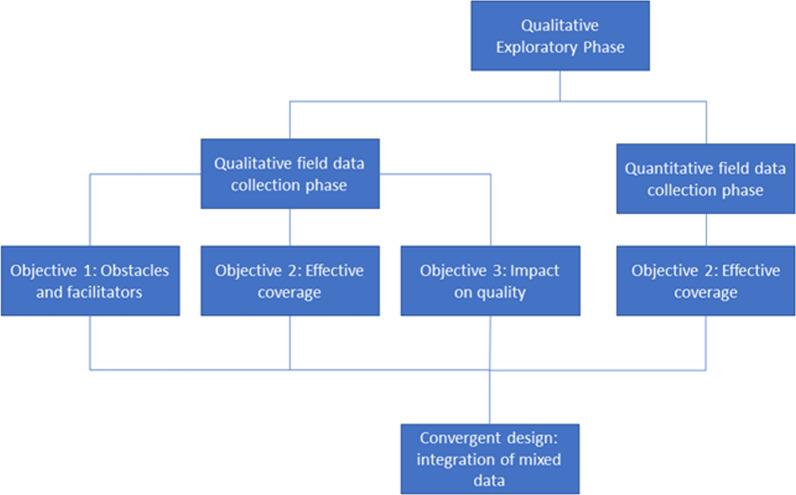
This process evaluation was conducted from November 2019 through March 2020 in the two regions of Burkina Faso where the new policy was introduced as a pilot. Mixed methods were used with a convergent design. Semi-directed interviews were conducted with the Ministry of Health (n = 3), healthcare workers (n = 10), and women aged 15-49 years (n = 10). Surveys were also administered to the female members of 696 households randomly selected from four health districts (n = 901).
RESULTS
Implementation obstacles include insufficient communication, shortages of consumables and contraceptives, and delays in reimbursement from the government. The main facilitators were previous experience with free healthcare policies, good acceptability in the population, and support from local associations. Six months after its introduction, only 50% of the surveyed participants knew about the free FP policy. Higher education level, being sexually active or in a relationship, having recently seen a healthcare professional, and possession of a radio significantly increased the odds of knowing. Of the participants, 39% continued paying for FP services despite the new policy, mainly because of stock shortages forcing them to buy their contraceptive products elsewhere. Increased waiting time and shorter consultations were also reported.
CONCLUSION
Six months after its introduction, the free FP policy still has gaps in its implementation, as women continue to spend money for FP services and have little knowledge of the policy, particularly in the Cascades region. While its use is reportedly increasing, addressing implementation issues could further improve women's access to contraception.
背景
2019 年,布基纳法索是撒哈拉以南非洲地区最早引入免费计划生育(FP)政策的国家之一。本过程评估旨在确定其实施过程中的障碍和促进因素,在实施六个月后评估其在目标人群中的覆盖范围,并调查其对 FP 服务质量的感知的影响。
方法
本过程评估于 2019 年 11 月至 2020 年 3 月在布基纳法索引入新政策的两个地区进行,该地区作为试点。采用混合方法进行收敛设计。对卫生部(n=3)、卫生工作者(n=10)和 15-49 岁的妇女(n=10)进行半定向访谈。还对从四个卫生区随机选择的 696 户家庭中的女性成员进行了调查(n=901)。
结果
实施障碍包括沟通不足、消耗品和避孕药具短缺以及政府报销延迟。主要促进因素包括以前免费医疗政策的经验、人口中的良好可接受性以及当地协会的支持。政策推出六个月后,只有 50%的调查参与者了解免费 FP 政策。较高的教育水平、性活跃或处于恋爱关系中、最近看过医疗保健专业人员以及拥有收音机,显著增加了了解该政策的几率。在参与者中,尽管有新政策,仍有 39%的人继续为 FP 服务付费,主要是因为库存短缺迫使他们在其他地方购买避孕药具。报告还称,等待时间延长和咨询时间缩短。
结论
政策推出六个月后,免费 FP 政策的实施仍存在差距,因为妇女继续为 FP 服务付费,对该政策的了解甚少,特别是在 Cascades 地区。尽管其使用率有所增加,但解决实施问题可以进一步改善妇女获得避孕的机会。

 Zotero 插件