
将免疫检查点抑制联合酪氨酸激酶抑制作为转移性肾细胞癌的一线和后续治疗。
Combining immune checkpoint inhibition plus tyrosine kinase inhibition as first and subsequent treatments for metastatic renal cell carcinoma.
机构信息
Genitourinary Oncology Section, Division of Medical Oncology, The Ohio State University Comprehensive Cancer Center - James Cancer Hospital, Columbus, Ohio, USA.
Department of Urology, University of Washington School of Medicine, Seattle, Washington, USA.
出版信息
Cancer Med. 2022 Aug;11(16):3106-3114. doi: 10.1002/cam4.4679. Epub 2022 Mar 18.
BACKGROUND
Immune checkpoint inhibitor/tyrosine kinase inhibitor (ICI/TKI) combinations are a new standard of care for the initial treatment of metastatic renal cell carcinoma (mRCC). Their efficacy and toxicity beyond the first-line setting remain poorly defined.
METHODS
We retrospectively reviewed charts for 85 adults with mRCC of any histology receiving combination of ICI/TKI in any line of treatment at two academic centers as of 05/01/2020. We collected clinical, pathological, and treatment-related variables. Outcomes including objective response rate (ORR), progression-free survival (PFS), and toxicity were analyzed via descriptive statistics and the Kaplan-Meier method.
RESULTS
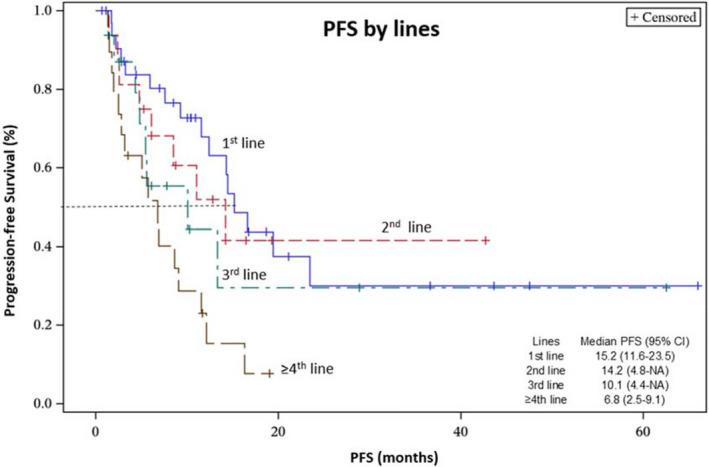
Patients received pembrolizumab, nivolumab, avelumab, or nivolumab-ipilimumab, with concurrent use of sunitinib, axitinib, pazopanib, lenvatinib, or cabozantinib. Thirty-three patients received first-line ICI/TKI therapy, while 52 received ≥ second-line ICI/TKI. The efficacy of ICI/TKI therapy decreased with increasing lines of treatment (ORR: 56.7%, 37.5%, 21.4%, and 21%; median PFS [mPFS]: 15.2, 14.2, 10.1, and 6.8 months, for first, second, third, and ≥ fourth line therapy, respectively). In the ≥ second-line setting, ICI/TKI was most useful in patients who received ICI only, with an ORR of 50% and a mPFS of 9.1 months. Efficacy was limited in patients who received both TKI and ICI previously, with an ORR of 20% and a mPFS of 5.5 months. Overall, ≥ second-line ICI/TKI was tolerable with 25 of 52 (52%) patients developing grade ≥3 adverse events.
CONCLUSIONS
ICI/TKI combination therapy is feasible and safe beyond the first-line setting. Prior treatment history appears to impact efficacy but has a lesser effect on safety/tolerability.
背景
免疫检查点抑制剂/酪氨酸激酶抑制剂(ICI/TKI)联合治疗是转移性肾细胞癌(mRCC)初始治疗的新标准。其在一线治疗以外的疗效和毒性仍未得到明确界定。
方法
我们回顾了截至 2020 年 5 月 1 日,在两个学术中心接受 ICI/TKI 联合治疗的任何组织学 mRCC 患者的 85 名成年人的病历。我们收集了临床、病理和治疗相关的变量。通过描述性统计和 Kaplan-Meier 方法分析了包括客观缓解率(ORR)、无进展生存期(PFS)和毒性在内的结果。
结果
患者接受了 pembrolizumab、nivolumab、avelumab 或 nivolumab-ipilimumab 联合舒尼替尼、axitinib、pazopanib、lenvatinib 或 cabozantinib 的治疗。33 名患者接受了一线 ICI/TKI 治疗,52 名患者接受了≥二线 ICI/TKI 治疗。随着治疗线数的增加,ICI/TKI 治疗的疗效下降(ORR:56.7%、37.5%、21.4%和 21%;中位 PFS [mPFS]:15.2、14.2、10.1 和 6.8 个月,分别用于一线、二线、三线和≥四线治疗)。在≥二线治疗中,ICI 单药治疗的患者获益最大,ORR 为 50%,mPFS 为 9.1 个月。而之前接受过 TKI 和 ICI 联合治疗的患者疗效有限,ORR 为 20%,mPFS 为 5.5 个月。总体而言,52 名接受≥二线 ICI/TKI 治疗的患者中有 25 名(52%)出现≥3 级不良事件。
结论
ICI/TKI 联合治疗在一线治疗以外是可行和安全的。既往治疗史似乎影响疗效,但对安全性/耐受性影响较小。

 Zotero 插件