
有重度抑郁症状个体的枪支拥有率。
Prevalence of Firearm Ownership Among Individuals With Major Depressive Symptoms.
机构信息
Department of Psychiatry and Center for Quantitative Health, Massachusetts General Hospital, Boston.
Department of Psychiatry, Harvard Medical School, Boston, Massachusetts.
出版信息
JAMA Netw Open. 2022 Mar 1;5(3):e223245. doi: 10.1001/jamanetworkopen.2022.3245.
IMPORTANCE
Both major depression and firearm ownership are associated with an increased risk for death by suicide in the United States, but the extent of overlap among these major risk factors is not well characterized.
OBJECTIVE
To assess the prevalence of current and planned firearm ownership among individuals with depression.
DESIGN, SETTING, AND PARTICIPANTS: Cross-sectional survey study using data pooled from 2 waves of a 50-state nonprobability internet survey conducted between May and July 7, 2021. Internet survey respondents were 18 years of age or older and were sampled from all 50 US states and the District of Columbia.
MAIN OUTCOMES AND MEASURES
Self-reported firearm ownership; depressive symptoms as measured by the 9-item Patient Health Questionnaire.
RESULTS
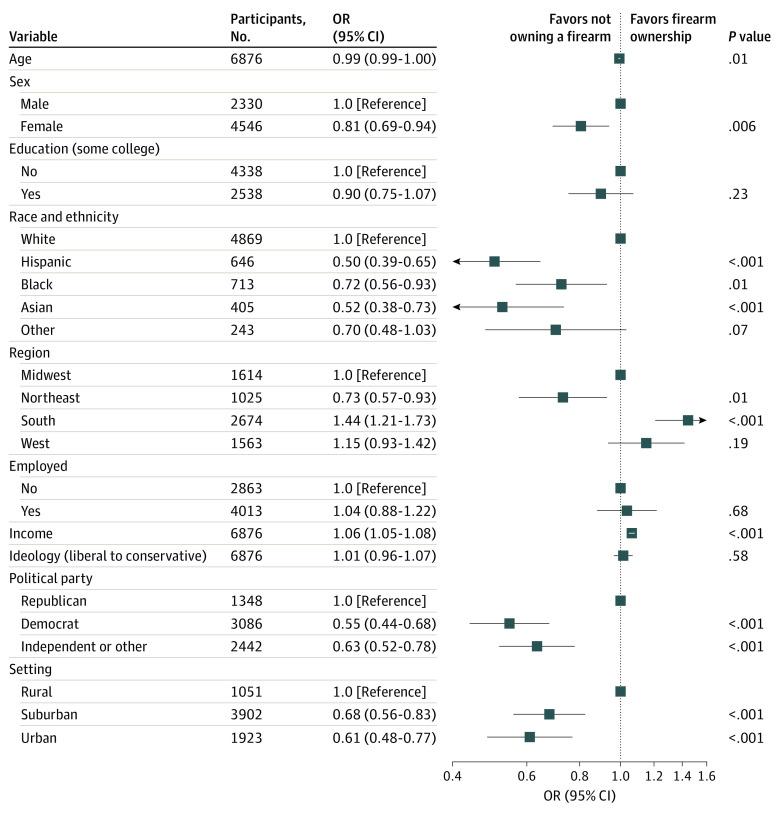
Of 24 770 survey respondents (64.6% women and 35.4% men; 5.0% Asian, 10.8% Black, 7.5% Hispanic, and 74.0% White; mean [SD] age 45.8 [17.5]), 6929 (28.0%) reported moderate or greater depressive symptoms; this group had mean (SD) age of 38.18 (15.19) years, 4587 were female (66.2%), and 406 were Asian (5.9%), 725 were Black (10.5%), 652 were Hispanic (6.8%), and 4902 were White (70.7%). Of those with depression, 31.3% reported firearm ownership (n = 2167), of whom 35.9% (n = 777) reported purchasing a firearm within the past year. In regression models, the presence of moderate or greater depressive symptoms was not significantly associated with firearm ownership (adjusted odds ratio [OR], 1.07; 95% CI, 0.98-1.17) but was associated with greater likelihood of a first-time firearm purchase during the COVID-19 pandemic (adjusted OR, 1.77; 95% CI, 1.56-2.02) and greater likelihood of considering a future firearm purchase (adjusted OR, 1.53; 95% CI, 1.23-1.90).
CONCLUSIONS AND RELEVANCE
In this study, current and planned firearm ownership was common among individuals with major depressive symptoms, suggesting a public health opportunity to address this conjunction of suicide risk factors.
重要性
在美国,重度抑郁症和枪支拥有都是自杀死亡风险增加的因素,但这些主要危险因素之间的重叠程度尚不清楚。
目的
评估有抑郁症状的个体中当前和计划拥有枪支的比例。
设计、地点和参与者:使用 2021 年 5 月至 7 月 7 日期间在 50 个州进行的非概率互联网调查的 2 个波次的数据进行的横断面调查研究。互联网调查的受访者年龄在 18 岁或以上,来自美国 50 个州和哥伦比亚特区。
主要结局和测量指标
自我报告的枪支拥有情况;使用 9 项患者健康问卷测量的抑郁症状。
结果
在 24770 名调查参与者中(64.6%为女性,35.4%为男性;5.0%为亚洲人,10.8%为黑人,7.5%为西班牙裔,74.0%为白人;平均[标准差]年龄为 45.8[17.5]岁),6929 人(28.0%)报告有中度或更严重的抑郁症状;该组的平均(标准差)年龄为 38.18(15.19)岁,4587 人为女性(66.2%),406 人为亚洲人(5.9%),725 人为黑人(10.5%),652 人为西班牙裔(6.8%),4902 人为白人(70.7%)。在有抑郁症状的人群中,31.3%(n=2167)报告拥有枪支,其中 35.9%(n=777)报告在过去一年中购买了枪支。在回归模型中,中度或更严重的抑郁症状与枪支拥有之间没有显著关联(调整后的优势比[OR],1.07;95%CI,0.98-1.17),但与在 COVID-19 大流行期间首次购买枪支的可能性更大(调整后的 OR,1.77;95%CI,1.56-2.02)和考虑未来购买枪支的可能性更大有关(调整后的 OR,1.53;95%CI,1.23-1.90)。
结论和相关性
在这项研究中,有重度抑郁症的个体中当前和计划拥有枪支的情况很常见,这表明有机会解决自杀风险因素的这种结合。

 Zotero 插件