
假信息、信任度与伊维菌素和羟氯喹在 COVID-19 中的应用
Misinformation, Trust, and Use of Ivermectin and Hydroxychloroquine for COVID-19.
机构信息
Department of Psychiatry, Massachusetts General Hospital, Boston.
Department of Psychiatry, Harvard Medical School, Boston, Massachusetts.
出版信息
JAMA Health Forum. 2023 Sep 1;4(9):e233257. doi: 10.1001/jamahealthforum.2023.3257.
IMPORTANCE
The COVID-19 pandemic has been notable for the widespread dissemination of misinformation regarding the virus and appropriate treatment.
OBJECTIVE
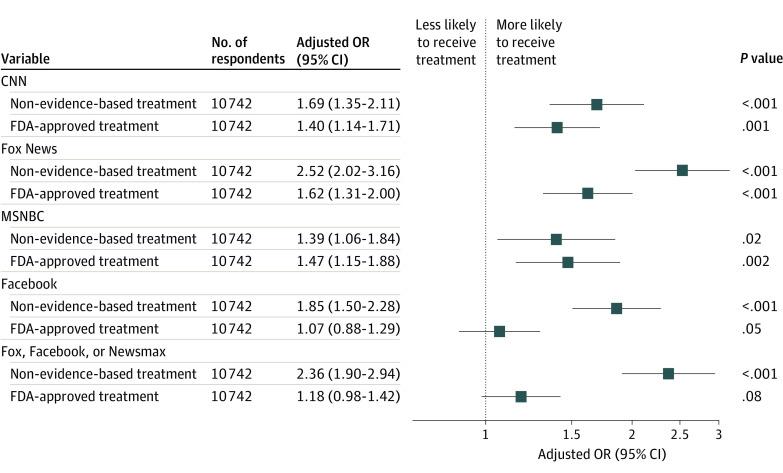
To quantify the prevalence of non-evidence-based treatment for COVID-19 in the US and the association between such treatment and endorsement of misinformation as well as lack of trust in physicians and scientists.
DESIGN, SETTING, AND PARTICIPANTS: This single-wave, population-based, nonprobability internet survey study was conducted between December 22, 2022, and January 16, 2023, in US residents 18 years or older who reported prior COVID-19 infection.
MAIN OUTCOME AND MEASURE
Self-reported use of ivermectin or hydroxychloroquine, endorsing false statements related to COVID-19 vaccination, self-reported trust in various institutions, conspiratorial thinking measured by the American Conspiracy Thinking Scale, and news sources.
RESULTS
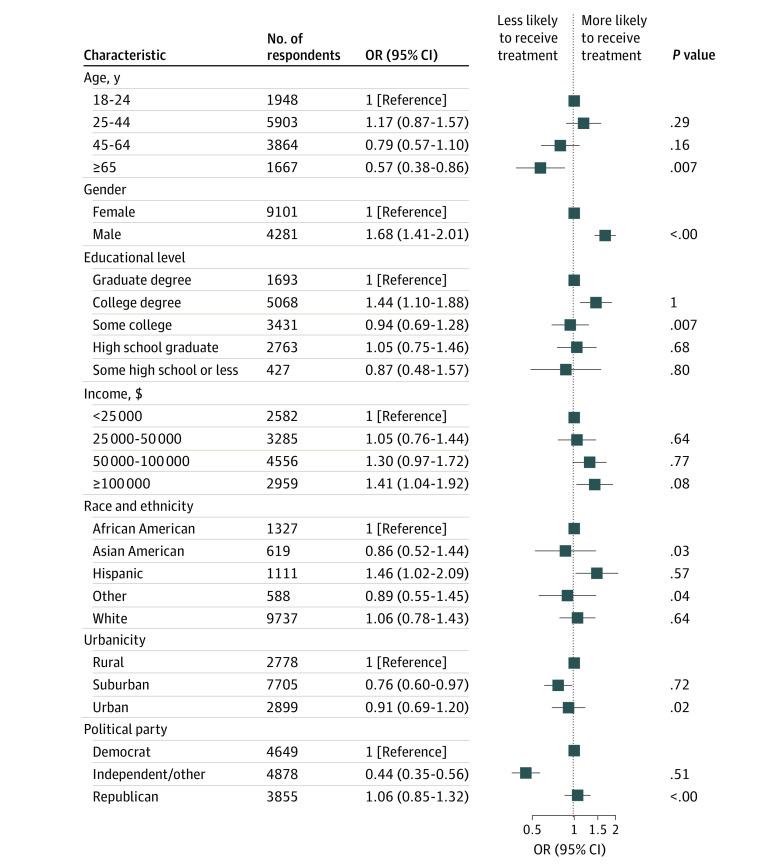
A total of 13 438 individuals (mean [SD] age, 42.7 [16.1] years; 9150 [68.1%] female and 4288 [31.9%] male) who reported prior COVID-19 infection were included in this study. In this cohort, 799 (5.9%) reported prior use of hydroxychloroquine (527 [3.9%]) or ivermectin (440 [3.3%]). In regression models including sociodemographic features as well as political affiliation, those who endorsed at least 1 item of COVID-19 vaccine misinformation were more likely to receive non-evidence-based medication (adjusted odds ratio [OR], 2.86; 95% CI, 2.28-3.58). Those reporting trust in physicians and hospitals (adjusted OR, 0.74; 95% CI, 0.56-0.98) and in scientists (adjusted OR, 0.63; 95% CI, 0.51-0.79) were less likely to receive non-evidence-based medication. Respondents reporting trust in social media (adjusted OR, 2.39; 95% CI, 2.00-2.87) and in Donald Trump (adjusted OR, 2.97; 95% CI, 2.34-3.78) were more likely to have taken non-evidence-based medication. Individuals with greater scores on the American Conspiracy Thinking Scale were more likely to have received non-evidence-based medications (unadjusted OR, 1.09; 95% CI, 1.06-1.11; adjusted OR, 1.10; 95% CI, 1.07-1.13).
CONCLUSIONS AND RELEVANCE
In this survey study of US adults, endorsement of misinformation about the COVID-19 pandemic, lack of trust in physicians or scientists, conspiracy-mindedness, and the nature of news sources were associated with receiving non-evidence-based treatment for COVID-19. These results suggest that the potential harms of misinformation may extend to the use of ineffective and potentially toxic treatments in addition to avoidance of health-promoting behaviors.
重要性
COVID-19 大流行的一个显著特点是广泛传播有关该病毒和适当治疗的错误信息。
目的
量化美国 COVID-19 非循证治疗的流行程度,以及这种治疗与错误信息的认可以及对医生和科学家的信任缺乏之间的关系。
设计、地点和参与者:这项单波、基于人群的、非概率性互联网调查研究于 2023 年 1 月 16 日在美国居民中进行,18 岁或以上,报告有 COVID-19 感染史。
主要结果和测量
自我报告使用伊维菌素或羟氯喹,认可与 COVID-19 疫苗接种相关的虚假声明,自我报告对各种机构的信任,用美国阴谋思维量表衡量的阴谋思维,以及新闻来源。
结果
共纳入 13438 名(平均[标准差]年龄,42.7[16.1]岁;9150[68.1%]为女性,4288[31.9%]为男性)报告有 COVID-19 感染史的成年人。在该队列中,有 799 人(5.9%)报告使用过羟氯喹(527 人[3.9%])或伊维菌素(440 人[3.3%])。在包括社会人口特征和政治派别在内的回归模型中,那些认可至少一项 COVID-19 疫苗错误信息的人更有可能接受非循证药物治疗(调整后的优势比[OR],2.86;95%置信区间[CI],2.28-3.58)。报告信任医生和医院(调整后的 OR,0.74;95% CI,0.56-0.98)和科学家(调整后的 OR,0.63;95% CI,0.51-0.79)的人不太可能接受非循证药物治疗。报告信任社交媒体(调整后的 OR,2.39;95% CI,2.00-2.87)和唐纳德特朗普(调整后的 OR,2.97;95% CI,2.34-3.78)的人更有可能接受非循证药物治疗。美国阴谋思维量表得分较高的个体更有可能接受非循证药物治疗(未调整的 OR,1.09;95% CI,1.06-1.11;调整后的 OR,1.10;95% CI,1.07-1.13)。
结论和相关性
在这项对美国成年人的调查研究中,对 COVID-19 大流行错误信息的认可、对医生或科学家的信任缺失、阴谋思维以及新闻来源的性质与接受 COVID-19 非循证治疗有关。这些结果表明,错误信息的潜在危害可能不仅限于避免促进健康的行为,还可能延伸到使用无效和潜在有毒的治疗方法。

 Zotero 插件