
阴谋论思维、选择性接触保守派媒体与美国对 COVID-19 的反应
Conspiratorial thinking, selective exposure to conservative media, and response to COVID-19 in the US.
机构信息
Annenberg Public Policy Center of the University of Pennsylvania, USA.
Annenberg Public Policy Center of the University of Pennsylvania, USA.
出版信息
Soc Sci Med. 2021 Dec;291:114480. doi: 10.1016/j.socscimed.2021.114480. Epub 2021 Oct 12.
RATIONALE
Previous research has shown that during the early months of the COVID-19 pandemic in the US, users of conservative media were more likely to accept conspiracy theories about the pandemic and less likely to accept pandemic mitigation measures such as mask-wearing and vaccination.
OBJECTIVE
To test the hypothesis that during the first year of the pandemic, viewers who were prone to conspiratorial thinking engaged in selective exposure to conservative media which served to enhance pandemic-related conspiracy beliefs.
METHODS
A national 3-wave longitudinal survey of 883 US respondents running from March to November 2020 assessed media-use habits, belief in COVID-related conspiracies, conspiratorial thinking, mask-wearing, intention to accept a COVID vaccine, and trust in the Centers for Disease Control and Prevention (CDC). Growth curve models were used to analyze changes in conspiracy beliefs and associated public health outcomes.
RESULTS
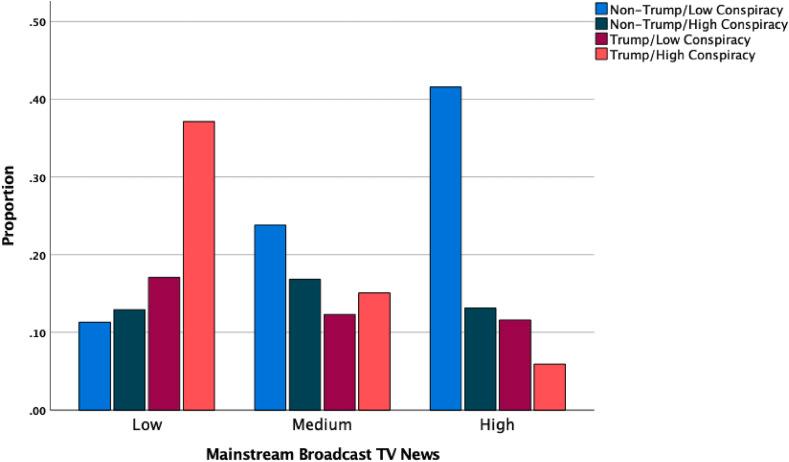
Users of conservative media were disproportionately likely to engage in conspiratorial thinking, to vote for President Trump, and to be ideologically conservative. They were also less likely to use mainstream news sources and displayed increasing belief in pandemic conspiracies. Increases in conspiracy beliefs were associated with reduced support for pandemic prevention. Although users of conservative media supported vaccination and trusted the CDC at the outset of the study, continued exposure to conservative media reduced support for both. Increasing use of mainstream print was associated with less endorsement of pandemic conspiracy beliefs. Viewers of mainstream television news did not exhibit change in pandemic conspiracy beliefs over time.
CONCLUSION
Conservative media in the US have attracted users prone to conspiratorial thinking and conservative political views who are also less exposed to mainstream news. The selective use of these media enhances belief in conspiracies that pose challenges to the country's ability to control a public health crisis such as the COVID pandemic.
背景
之前的研究表明,在美国 COVID-19 大流行的早期,使用保守派媒体的用户更容易接受有关该大流行的阴谋论,而不太可能接受戴口罩和接种疫苗等大流行缓解措施。
目的
检验这样一种假设,即在大流行的第一年,倾向于阴谋论思维的观众会选择性地接触保守派媒体,这有助于增强与大流行相关的阴谋信念。
方法
一项针对 883 名美国受访者的全国性三波纵向调查,从 2020 年 3 月至 11 月进行,评估了媒体使用习惯、对 COVID 相关阴谋的信念、阴谋思维、戴口罩、接受 COVID 疫苗的意愿以及对疾病控制与预防中心(CDC)的信任。使用增长曲线模型分析了阴谋信念的变化及其与相关公共卫生结果的关系。
结果
保守派媒体的用户更倾向于阴谋思维,投票给特朗普总统,并且在意识形态上更为保守。他们也较少使用主流新闻来源,并表现出越来越相信大流行阴谋。阴谋信念的增加与对大流行预防措施的支持减少有关。尽管保守派媒体的使用者在研究开始时支持接种疫苗并信任 CDC,但持续接触保守派媒体会降低对两者的支持。增加主流印刷品的使用与对大流行阴谋信念的支持减少有关。主流电视新闻的观众随着时间的推移,对大流行阴谋信念没有变化。
结论
美国的保守派媒体吸引了倾向于阴谋论思维和保守政治观点的用户,他们也较少接触主流新闻。这些媒体的选择性使用增强了对阴谋的信念,这对美国控制公共卫生危机(如 COVID 大流行)的能力构成了挑战。


 Zotero 插件