
光谱熵监测可加速胸外科手术中七氟烷麻醉后的苏醒:一项随机对照试验。
Spectral Entropy Monitoring Accelerates the Emergence from Sevoflurane Anesthesia in Thoracic Surgery: A Randomized Controlled Trial.
作者信息
Chen Jui-Tai, Wu Yu-Ming, Tiong Tung-Yu, Cata Juan P, Kuo Kuang-Tai, Li Chun-Cheng, Liu Hsin-Yi, Cherng Yih-Giun, Wu Hsiang-Ling, Tai Ying-Hsuan
机构信息
Department of Anesthesiology, Shuang Ho Hospital, Taipei Medical University, New Taipei City 23561, Taiwan.
Department of Anesthesiology, School of Medicine, College of Medicine, Taipei Medical University, Taipei 11031, Taiwan.
出版信息
J Clin Med. 2022 Mar 15;11(6):1631. doi: 10.3390/jcm11061631.
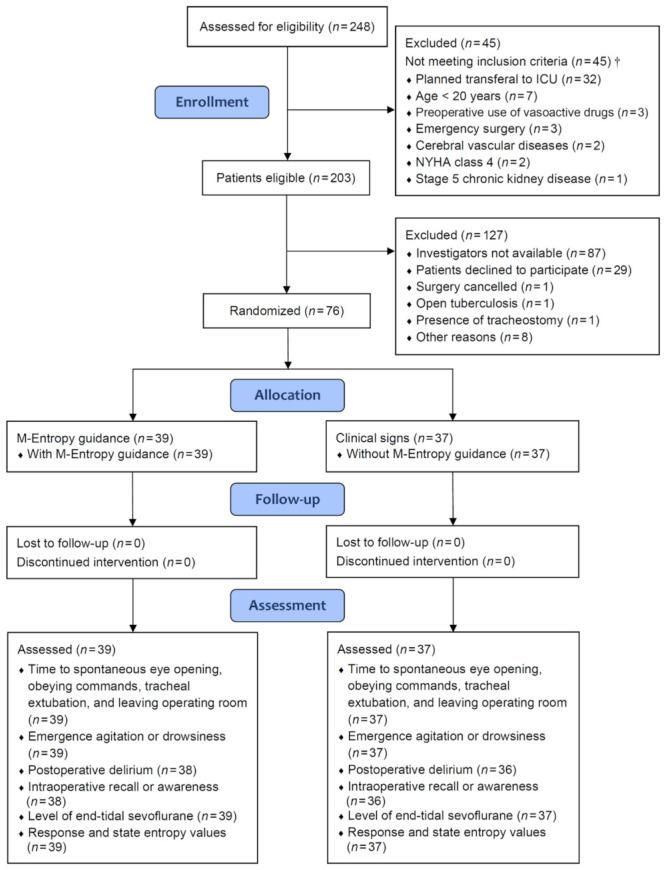
The clinical efficacy of spectral entropy monitoring in improving postoperative recovery remains unclear. This trial aimed to investigate the impact of M-Entropy (GE Healthcare, Helsinki, Finland) guidance on emergence from anesthesia and postoperative delirium in thoracic surgery. Adult patients undergoing video-assisted thoracoscopic surgery for lung resection at a medical center were randomly allocated into the M-Entropy guidance group (n = 39) and the control group (n = 37). In the M-Entropy guidance group, sevoflurane anesthesia was titrated to maintain response and state entropy values between 40 and 60 intraoperatively. In the control group, the dosing of sevoflurane was adjusted based on clinical judgment and vital signs. The primary outcome was time to spontaneous eye opening. M-Entropy guidance significantly reduced the time proportion of deep anesthesia (entropy value <40) during surgery, mean difference: −21.5% (95% confidence interval (CI): −32.7 to −10.3) for response entropy and −24.2% (−36.3 to −12.2) for state entropy. M-Entropy guidance significantly shortened time to spontaneous eye opening compared to clinical signs, mean difference: −154 s (95% CI: −259 to −49). In addition, patients of the M-Entropy group had a lower rate of emergence agitation (absolute risk reduction: 0.166, 95% CI: 0.005−0.328) and delirium (0.245, 0.093−0.396) at the postanesthesia care unit. M-Entropy-guided anesthesia hastened awakening and potentially prevented emergence agitation and delirium after thoracic surgery. These results may provide an implication for facilitating postoperative recovery and reducing the complications associated with delayed emergence and delirium.
光谱熵监测在改善术后恢复方面的临床疗效仍不明确。本试验旨在研究M-熵(通用电气医疗集团,芬兰赫尔辛基)引导对胸外科手术麻醉苏醒及术后谵妄的影响。在某医疗中心接受电视辅助胸腔镜肺切除术的成年患者被随机分为M-熵引导组(n = 39)和对照组(n = 37)。在M-熵引导组中,术中七氟醚麻醉剂量滴定以维持反应熵和状态熵值在40至60之间。在对照组中,七氟醚剂量根据临床判断和生命体征进行调整。主要结局指标为自主睁眼时间。M-熵引导显著降低了手术期间深度麻醉(熵值<40)的时间比例,反应熵的平均差值为−21.5%(95%置信区间(CI):−32.7至−10.3),状态熵为−24.2%(−36.3至−12.2)。与临床体征相比,M-熵引导显著缩短了自主睁眼时间,平均差值为−154秒(95% CI:−259至−49)。此外,M-熵组患者在麻醉后护理单元的苏醒期躁动发生率较低(绝对风险降低:0.166,95% CI:0.005−0.328),谵妄发生率也较低(0.245,0.093−0.396)。M-熵引导的麻醉加速了苏醒,并可能预防胸外科手术后的苏醒期躁动和谵妄。这些结果可能为促进术后恢复以及减少与苏醒延迟和谵妄相关的并发症提供启示。
 Zotero 插件