
罗库溴铵和顺式阿曲库铵在眼科手术中与术中心动过缓发生率的比较——一项回顾性研究
Comparison of Rocuronium and Cisatracurium in Ophthalmic Surgeries in Association with the Incidence of Intraoperative Bradycardia- A Retrospective Study.
作者信息
Wu Shao-Chun, Chin Jo-Chi, Hung Kuo-Chuan, Hsu Chih-Yi, Tsai Yung-Fong, Illias Amina M
机构信息
Department of Anaesthesiology, Kaohsiung Chang Gung Memorial Hospital, Kaohsiung, Taiwan.
Graduate Institute of Clinical Medical Sciences, College of Medicine, Chang Gung University, Taoyuan, Taiwan.
出版信息
Drug Des Devel Ther. 2025 Aug 20;19:7247-7257. doi: 10.2147/DDDT.S532985. eCollection 2025.
PURPOSE
Serious complications may arise during the onset and management of intraoperative bradycardia. This study aimed to investigate several factors that may reduce the incidence of intraoperative bradycardia in adult patients undergoing general anaesthesia for various ophthalmic procedures.
PATIENTS AND METHODS
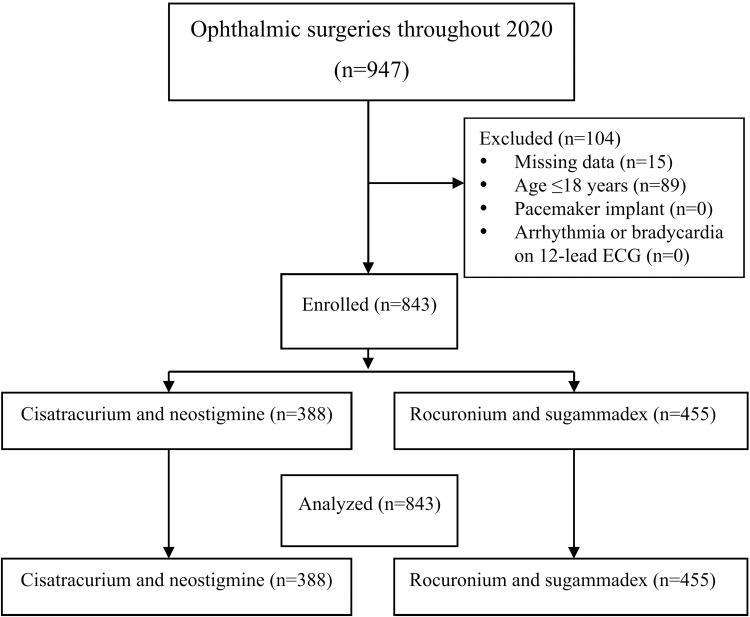
A total of 947 adult patients who underwent general anaesthesia for different ophthalmic surgeries in 2020 were initially included. Following the exclusion of 104 cases, 843 patients were eligible for analysis. Patients received either cisatracurium with neostigmine (n = 388) or rocuronium with sugammadex (n = 455) as neuromuscular blocking and reversal agents, respectively. Quantitative neuromuscular monitoring was applied in all cases, while depth of anaesthesia was monitored using the bispectral index (BIS) in selected cases. The primary outcome was the incidence of intraoperative bradycardia, defined as a heart rate of fewer than 60 beats per minute.
RESULTS
The group receiving rocuronium and sugammadex demonstrated a significantly lower incidence of intraoperative bradycardia (p < 0.001). This reduction was further supported by logistic regression analysis, both in univariate (OR, 0.07; 95% CI, 0.02-0.24; p = 0.001) and multivariate models (OR, 0.08; 95% CI, 0.02-0.94; p = 0.001). Additionally, this group exhibited a significantly higher rate of BIS monitoring during surgery, alongside a significant reduction in total opioid (p = 0.039) and sevoflurane consumption (p < 0.001).
CONCLUSION
The use of rocuronium is associated with a significant reduction in the incidence of intraoperative bradycardia in adult patients undergoing ophthalmic surgery under general anaesthesia.
目的
术中心动过缓的发生及处理过程中可能出现严重并发症。本研究旨在探讨多种可能降低接受各类眼科手术全身麻醉的成年患者术中心动过缓发生率的因素。
患者与方法
最初纳入了2020年接受不同眼科手术全身麻醉的947例成年患者。排除104例后,843例患者符合分析条件。患者分别接受顺式阿曲库铵联合新斯的明(n = 388)或罗库溴铵联合舒更葡糖钠(n = 455)作为神经肌肉阻滞及逆转剂。所有病例均应用定量神经肌肉监测,部分病例使用脑电双频指数(BIS)监测麻醉深度。主要结局为术中心动过缓的发生率,定义为心率低于每分钟60次。
结果
接受罗库溴铵和舒更葡糖钠的组术中心动过缓发生率显著较低(p < 0.001)。单因素(OR,0.07;95%CI,0.02 - 0.24;p = 0.001)和多因素模型(OR,0.08;95%CI,0.02 - 0.94;p = 0.001)的逻辑回归分析进一步支持了这一降低情况。此外,该组手术期间BIS监测率显著更高,同时总阿片类药物用量(p = 0.039)和七氟烷用量显著减少(p < 0.001)。
结论
在接受全身麻醉的眼科手术成年患者中,使用罗库溴铵可显著降低术中心动过缓的发生率。
 Zotero 插件