
中国老年人的体重指数、腰围与认知功能衰退:一项全国性回顾性队列研究
Body Mass Index, Waist Circumference, and Cognitive Decline Among Chinese Older Adults: A Nationwide Retrospective Cohort Study.
作者信息
Liang Fang, Fu Jialin, Moore Justin B, Zhang Xinge, Xu Yijia, Qiu Nan, Wang Yechuang, Li Rui
机构信息
School of Public Health, Wuhan University, Wuhan, China.
Department of Implementation Science, Division of Public Health Sciences, Wake Forest School of Medicine, Winston-Salem, NC, United States.
出版信息
Front Aging Neurosci. 2022 Mar 7;14:737532. doi: 10.3389/fnagi.2022.737532. eCollection 2022.
BACKGROUND
The reported associations between body mass index (BMI), waist circumference (WC), and cognitive decline are not consistent, especially in older adults.
OBJECTIVE
This study aims to investigate the longitudinal associations of BMI, WC, and their change values with cognitive decline among Chinese adults aged 60 years and older and to examine the potential moderating effect of sex on these relationships.
METHODS
The participants in this study were from waves one to four (2011-2018) of the China Health and Retirement Longitudinal Study (CHARLS). Cognition function, BMI, and WC were measured at four examinations over 7 years. The interview-based cognitive assessments of memory, orientation and attention, and visuospatial ability were recorded. Standardized global cognitive scores were generated. BMI and WC were objectively measured. Mixed-effects models were performed to evaluate the associations.
RESULTS
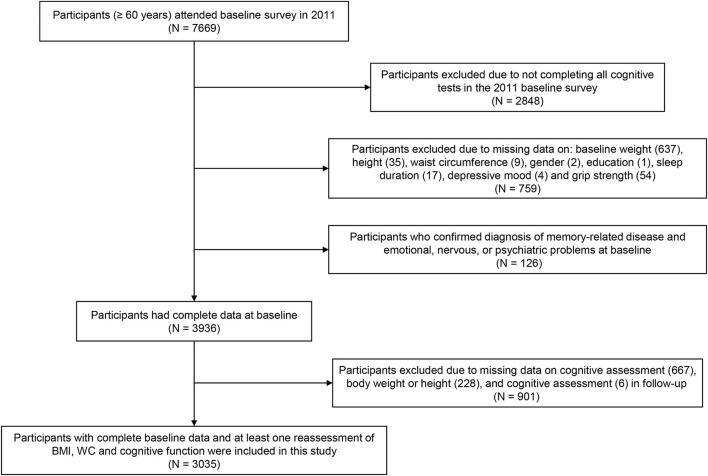
A final sample of 3,035 Chinese older adults [mean (SD) age, 66.94 (5.43) years; 40.16% ( = 1,219) women] were included. Higher BMI (estimate = 0.0107; SE = 0.0024; < 0.0001) and WC (estimate = 0.0019; SE = 0.0006; = 0.0037) were associated with slower cognition score decline over a 7-year follow-up, while greater BMI variability (estimate = -0.0365; SE = 0.0116; = 0.0017) was related to faster cognition score decline. The results were not modified by sex. BMI-defined overweight (estimate = 0.0094; SE = 0.0043; = 0.0298) was associated with a slower cognition score decline, and both large weight gain (estimate = -0.0266; SE = 0.0074; = 0.0003) and large WC loss (estimate = -0.0668; SE = 0.0329; = 0.0426) were associated with faster cognition score decline.
CONCLUSION
Among Chinese older adults, higher BMI, higher WC, and overweight are related to slower cognitive decline, while greater BMI variability, large weight gain, and large WC loss are associated with faster cognitive decline.
背景
体重指数(BMI)、腰围(WC)与认知能力下降之间的关联报道并不一致,尤其是在老年人中。
目的
本研究旨在调查60岁及以上中国成年人中BMI、WC及其变化值与认知能力下降的纵向关联,并检验性别对这些关系的潜在调节作用。
方法
本研究的参与者来自中国健康与养老追踪调查(CHARLS)的第一至四轮(2011 - 2018年)。在7年的4次检查中测量认知功能、BMI和WC。记录基于访谈的记忆、定向和注意力以及视觉空间能力的认知评估。生成标准化的总体认知分数。客观测量BMI和WC。采用混合效应模型评估关联。
结果
最终纳入3035名中国老年人样本[平均(标准差)年龄,66.94(5.43)岁;40.16%(n = 1219)为女性]。在7年的随访中,较高的BMI(估计值 = 0.0107;标准误 = 0.0024;P < 0.0001)和WC(估计值 = 0.0019;标准误 = 0.0006;P = 0.0037)与认知分数下降较慢相关,而较大的BMI变异性(估计值 = -0.0365;标准误 = 0.0116;P = 0.0017)与认知分数下降较快相关。结果不受性别影响。BMI定义的超重(估计值 = 0.0094;标准误 = 0.0043;P = 0.0298)与认知分数下降较慢相关,而大幅体重增加(估计值 = -0.0266;标准误 = 0.0074;P = 0.0003)和大幅腰围减少(估计值 = -0.0668;标准误 = 0.0329;P = 0.0426)均与认知分数下降较快相关。
结论
在中国老年人中,较高的BMI、较高的WC和超重与认知能力下降较慢有关,而较大的BMI变异性、大幅体重增加和大幅腰围减少与认知能力下降较快有关。
 Zotero 插件