
印度米佐拉姆邦钱皮地区米佐部落使用的药用植物民族医学研究。
Ethnomedicinal study of medicinal plants used by Mizo tribes in Champhai district of Mizoram, India.
机构信息
Department of Horticulture, Aromatic and Medicinal Plants, School of Earth Sciences and Natural Resources Management, Mizoram University, Aizawl, 796004, India.
Department of Botany, School of Life Science, Mizoram University, Aizawl, 796004, India.
出版信息
J Ethnobiol Ethnomed. 2022 Mar 24;18(1):22. doi: 10.1186/s13002-022-00520-0.
BACKGROUND
Medicinal plants have been used countless times for curing diseases mainly in developing countries. They are easily available with little to no side effects when compared to modern medicine. This manuscript encompasses information on ethnomedicinal plants in Champhai district, located in the North East Region (NER) of India. The region lies within Indo-Burma biodiversity hotspot. This study will be the first quantitative report on the ethnomedicinal plants used by the local tribes of this region. Knowledge of medicinal plants is mostly acquired by word of mouth, and the knowledge is dying among the local youths with the prevalence of modern medicine. Hence, there is urgency in deciphering and recording such information.
METHODS
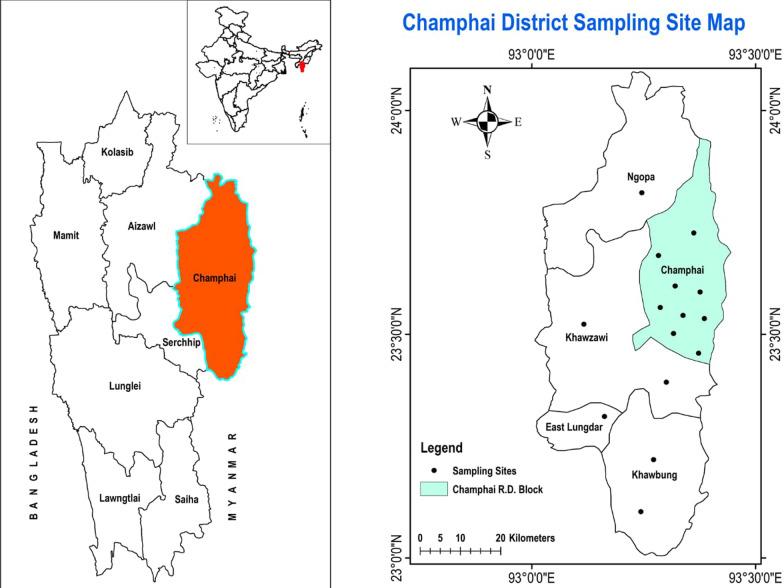
Information was gathered through interviews with 200 informants across 15 villages of the Champhai district. From the data obtained, we evaluate indices such as used report (UR), frequency of citation (FC), informant consensus factor (F), cultural values (CVs) and relative importance (RI) for all the plant species. Secondary data were obtained from scientific databases such as Pubmed, Sci Finder and Science Direct. The scientific name of the plants was matched and arranged in consultation with the working list of all plant species ( http://www.theplantlist.org ).
RESULTS
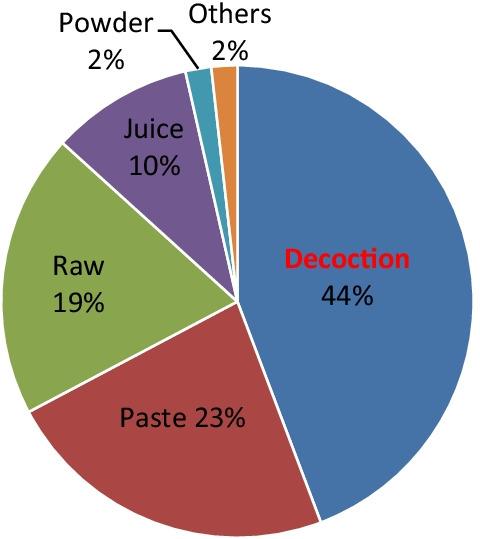
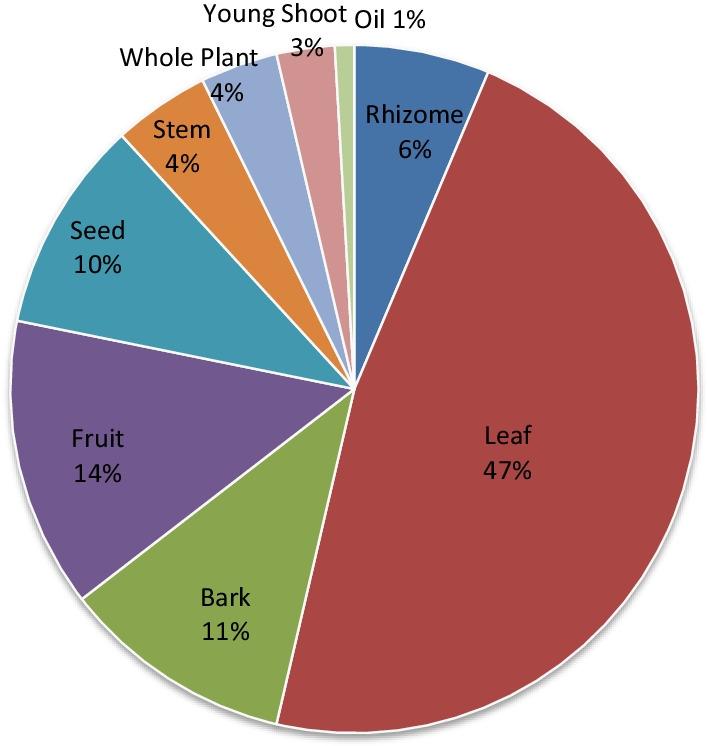
Totally, 93 plant species from 53 families and 85 genera were recorded. The most common families are Euphorbiaceae and Asteraceae with six and five species representatives, respectively. Leaves were the most frequently used part of a plant and were usually used in the form of decoction. Curcuma longa has the most cultural value (27.28 CVs) with the highest used report (136 FC), and the highest RI value was Phyllanthus emblica. The main illness categories as per Frequency of citation were muscle/bone problem (0.962 F), gastro-intestinal disease (0.956 F) and skin care (0.953 F).
CONCLUSION
The people of Mizoram living in the Champhai district have an immense knowledge of ethnomedicinal plants. There were no side effects recorded for consuming ethnomedicinal plants. We observed that there is a scope of scientific validation of 10 plant species for their pharmacological activity and 13 species for the phytochemical characterisation or isolation of the phytochemicals. This might pave the path for developing a scientifically validated botanical or lead to semisyntheic derivatives intended for modern medicine.
背景
药用植物在治疗疾病方面被无数次使用,主要在发展中国家。与现代医学相比,它们易于获得,几乎没有副作用。本文涵盖了印度东北区(NER)昌迈地区的民族药用植物信息。该地区位于印度-缅甸生物多样性热点地区。这将是该地区当地部落使用的民族药用植物的第一份定量报告。药用植物知识主要通过口口相传获得,而随着现代医学的普及,当地年轻人的知识正在消亡。因此,破译和记录这些信息迫在眉睫。
方法
通过对昌迈区 15 个村庄的 200 名受访者进行访谈收集信息。从获得的数据中,我们评估了所有植物物种的使用报告(UR)、引用频率(FC)、信息共识因子(F)、文化价值(CVs)和相对重要性(RI)等指数。通过 Pubmed、Sci Finder 和 Science Direct 等科学数据库获得二次数据。植物的学名与植物所有物种的工作清单(http://www.theplantlist.org)进行匹配和整理。
结果
总共记录了 93 种植物,来自 53 科 85 属。最常见的科是大戟科和菊科,分别有 6 种和 5 种代表植物。叶子是植物最常用的部分,通常以煎剂的形式使用。姜黄具有最高的文化价值(27.28 CVs),使用报告最高(136 FC),相对重要性值最高的是余甘子。根据引用频率,主要疾病类别为肌肉/骨骼问题(0.962 F)、胃肠疾病(0.956 F)和皮肤护理(0.953 F)。
结论
居住在昌迈区的米佐拉姆人民对民族药用植物有着丰富的知识。食用民族药用植物没有记录到任何副作用。我们观察到,有 10 种植物的药理活性和 13 种植物的植物化学特性或植物化学物质分离需要进行科学验证。这可能为开发经过科学验证的植物药或开发用于现代医学的半合成衍生物铺平道路。

 Zotero 插件