
局部进展期直肠癌患者的放射组学:预处理对 CT 成像特征估计的影响
Radiomics of Patients with Locally Advanced Rectal Cancer: Effect of Preprocessing on Features Estimation from Computed Tomography Imaging.
机构信息
Unit of Medical Physics, Pisa University Hospital "Azienda Ospedaliero-Universitaria Pisana", Pisa, Italy.
Radiation Oncology Unit, Pisa University Hospital "Azienda Ospedaliero-Universitaria Pisana", Pisa, Italy.
出版信息
Biomed Res Int. 2022 Mar 20;2022:2003286. doi: 10.1155/2022/2003286. eCollection 2022.
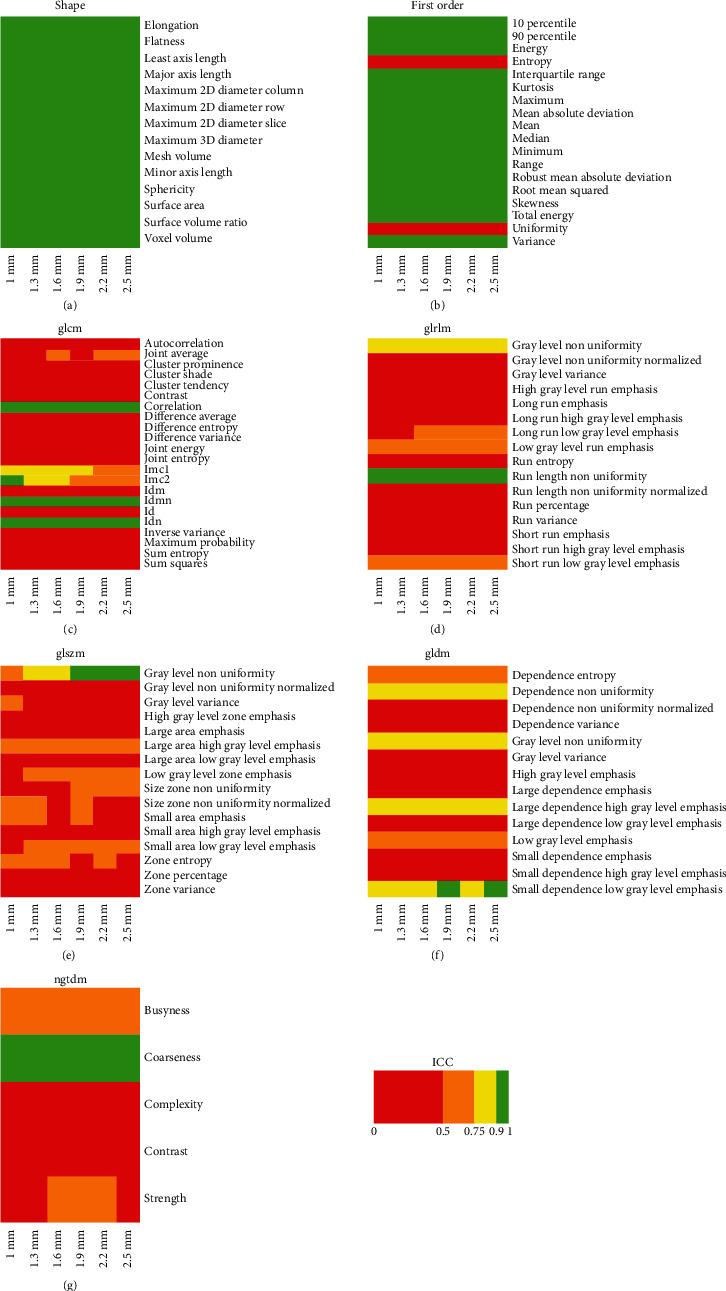
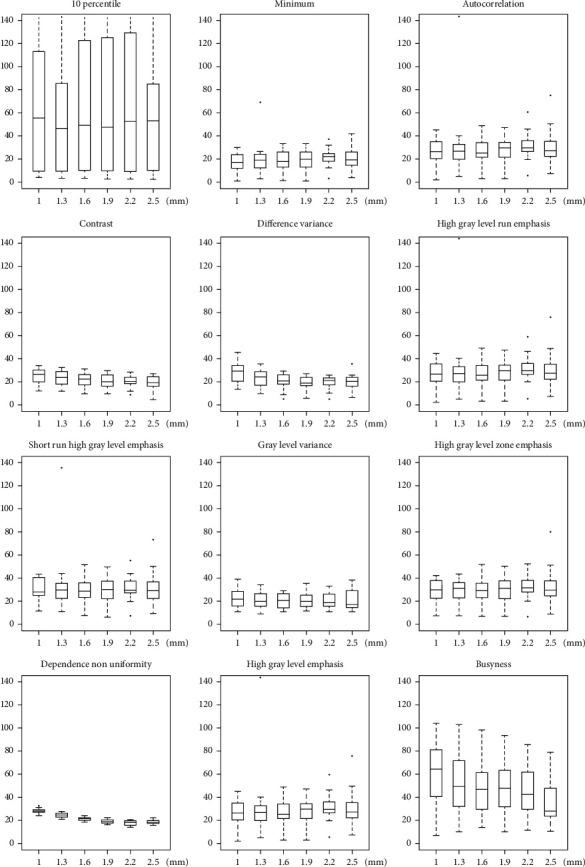
The purpose of this study was to investigate the effect of image preprocessing on radiomic features estimation from computed tomography (CT) imaging of locally advanced rectal cancer (LARC). CT images of 20 patients with LARC were used to estimate 105 radiomic features of 7 classes (shape, first-order, GLCM, GLDM, GLRLM, GLSZM, and NGTDM). Radiomic features were estimated for 6 different isotropic resampling voxel sizes, using 10 interpolation algorithms (at fixed bin width) and 6 different bin widths (at fixed interpolation algorithm). The intraclass correlation coefficient (ICC) and the coefficient of variation (CV) were calculated to assess the variability in radiomic features estimation due to preprocessing. A repeated measures correlation analysis was performed to assess any linear correlation between radiomic feature estimate and resampling voxel size or bin width. Reproducibility of radiomic feature estimate, when assessed through ICC analysis, was nominally excellent (ICC > 0.9) for shape features, good (0.75 < ICC ≤ 0.9) or moderate (0.5 < ICC ≤ 0.75) for first-order features, and moderate or poor (0 ≤ ICC ≤ 0.5) for textural features. A number of radiomic features characterized by good or excellent reproducibility in terms of ICC showed however median CV values greater than 15%. For most textural features, a significant ( < 0.05) correlation between their estimate and resampling voxel size or bin width was found. In CT imaging of patients with LARC, the estimate of textural features, as well as of first-order features to a lesser extent, is appreciably biased by preprocessing. Accordingly, this should be taken into account when planning clinical or research studies, as well as when comparing results from different studies and performing multicenter studies.
本研究旨在探讨影像预处理对局部进展期直肠癌(LARC) CT 成像中放射组学特征估计的影响。使用 20 例 LARC 患者的 CT 图像,对 7 类(形状、一阶、GLCM、GLDM、GLRLM、GLSZM 和 NGTDM)的 105 个放射组学特征进行了估计。对 6 种不同的各向同性重采样体素大小,使用 10 种插值算法(在固定的-bin 宽度)和 6 种不同的-bin 宽度(在固定的插值算法),对放射组学特征进行了估计。使用组内相关系数(ICC)和变异系数(CV)评估预处理引起的放射组学特征估计的可变性。对放射组学特征估计值与重采样体素大小或-bin 宽度之间的任何线性相关性进行重复测量相关分析。通过 ICC 分析评估放射组学特征估计的可重复性,形状特征的可重复性名义上是极好的(ICC>0.9),一阶特征的可重复性是好的(0.75<ICC≤0.9)或中等的(0.5<ICC≤0.75),纹理特征的可重复性是中等或差的(0≤ICC≤0.5)。然而,许多在 ICC 方面具有良好或极好可重复性的放射组学特征的中位数 CV 值大于 15%。对于大多数纹理特征,发现其估计值与重采样体素大小或-bin 宽度之间存在显著相关性(<0.05)。在 LARC 患者的 CT 成像中,纹理特征以及一阶特征的估计受到预处理的显著影响。因此,在规划临床或研究研究时,以及在比较来自不同研究的结果并进行多中心研究时,都应考虑到这一点。






 Zotero 插件