
日本引入 13 价肺炎球菌结合疫苗后儿童肺炎球菌性脑膜炎的临床和细菌学分析。
Clinical and Bacteriological Analysis of Pediatric Pneumococcal Meningitis after 13-Valent Pneumococcal Conjugate Vaccine Introduction in Japan.
机构信息
Department of Pediatrics, Chiba Kaihin Municipal Hospital, Chiba, Japan.
Department of Pediatrics, Chiba University Hospital, Chiba, Japan.
出版信息
Microbiol Spectr. 2022 Apr 27;10(2):e0182221. doi: 10.1128/spectrum.01822-21. Epub 2022 Mar 31.
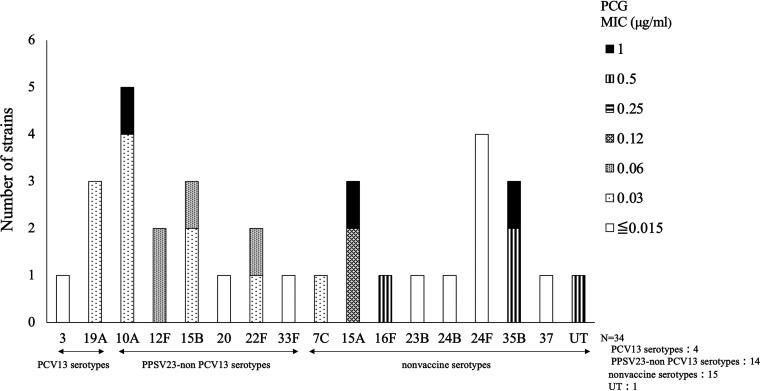
Streptococcus pneumoniae is one of the leading causes of meningitis in children. In Japan, since the introduction of the 13-valent pneumococcal conjugate vaccine (PCV13), the number of pneumococcal meningitis due to non-PCV13 serotypes in children has increased. To clarify the clinical outcomes, serotype distributions, and antimicrobial susceptibility of isolated S. pneumoniae strains from pediatric pneumococcal meningitis, we clinically and bacteriologically analyzed 34 cases of pediatric pneumococcal meningitis that were reported after the PCV13 introduction era in Japan. The median age at diagnosis was 1 year (range: 3 months-13 years). Ten (29.4%) patients had underlying diseases. Twenty-nine (85.3%) patients had received at least one dose of any pneumococcal vaccine. Of the 34 patients with pneumococcal meningitis, 6 had sequelae, and 4 died. Nine (26.5%) strains were resistant to penicillin; five (15%) strains to meropenem, with an MIC of 0.5 μg/mL. All strains were susceptible to vancomycin and linezolid. Daptomycin's MIC was 0.064 μg/mL and MIC was 0.094 μg/mL. Among the tested strains, only four were PCV13 serotypes. Penicillin-resistant S. pneumoniae was isolated from 30.0% of the patients with sequelae and death. Particularly, the proportion of serotype 10A in the sequelae and deceased cases was significantly higher than that in the complete recovery cases. We should carefully monitor the serotype and drug susceptibility of S. pneumoniae strains isolated from patients with meningitis after the PCV13 era and reconsider the treatment strategy to prepare against further drug-resistant pneumococcal strains. We analyzed 34 cases of pediatric pneumococcal meningitis that were reported after the 13-valent pneumococcal conjugate vaccine (PCV13) introduction era in Japan. Our study revealed that pneumococcal meningitis in children was mainly caused by non-PCV13 serotypes; all cases with sequelae and death were caused by non-PCV13 serotypes. Moreover, all serotypes of penicillin resistant Streptococcus pneumoniae strains (26.5%; 9/34) were non-PCV13 serotypes. We also analyzed antimicrobial susceptibilities of glycopeptides, linezolid (LZD), and daptomycin (DAP) of isolated S. pneumoniae strains. All tested strains were susceptible to vancomycin, teicoplanin, LZD, and DAP. Especially. DAP demonstrated the best outcome among the tested antibiotics, with MIC of 0.094 μg/mL. Pneumococcal meningitis in children continues to persist and is difficult to control with the current conjugate vaccines. Therefore, it is important to monitor the serotype and antimicrobial susceptibility of S. pneumoniae strains isolated from patients with meningitis and accordingly reconsider the treatment strategy.
肺炎链球菌是导致儿童脑膜炎的主要原因之一。在日本,自从引入 13 价肺炎球菌结合疫苗(PCV13)以来,儿童中由非 PCV13 血清型引起的肺炎球菌性脑膜炎的数量有所增加。为了阐明临床结果、血清型分布和分离自小儿肺炎球菌性脑膜炎的分离株的抗菌药物敏感性,我们对日本 PCV13 引入后时代报告的 34 例小儿肺炎球菌性脑膜炎进行了临床和细菌学分析。诊断时的中位年龄为 1 岁(范围:3 个月-13 岁)。10 例(29.4%)患者有基础疾病。29 例(85.3%)患者至少接受过一剂任何肺炎球菌疫苗。34 例肺炎球菌性脑膜炎患者中,6 例有后遗症,4 例死亡。9 株(26.5%)对青霉素耐药;5 株(15%)对美罗培南耐药,MIC 为 0.5μg/ml。所有菌株均对万古霉素和利奈唑胺敏感。达托霉素的 MIC 为 0.064μg/ml,MIC 为 0.094μg/ml。在测试的菌株中,只有 4 株是 PCV13 血清型。青霉素耐药肺炎链球菌分离自 30.0%有后遗症和死亡的患者。特别是,10A 血清型在后遗症和死亡病例中的比例明显高于完全恢复病例。我们应密切监测 PCV13 时代后脑膜炎患儿分离株的血清型和药物敏感性,并重新考虑治疗策略,以预防进一步出现耐药肺炎球菌株。我们分析了日本引入 13 价肺炎球菌结合疫苗(PCV13)后报告的 34 例小儿肺炎球菌性脑膜炎病例。我们的研究表明,儿童肺炎球菌性脑膜炎主要由非 PCV13 血清型引起;所有有后遗症和死亡的病例均由非 PCV13 血清型引起。此外,所有青霉素耐药肺炎链球菌株(26.5%;9/34)均为非 PCV13 血清型。我们还分析了分离株对糖肽类、利奈唑胺(LZD)和达托霉素(DAP)的抗菌药物敏感性。所有测试菌株均对万古霉素、替考拉宁、LZD 和 DAP 敏感。特别是,DAP 是所有测试抗生素中效果最好的,MIC 为 0.094μg/ml。儿童肺炎球菌性脑膜炎持续存在,目前的结合疫苗难以控制。因此,监测从脑膜炎患者中分离的肺炎链球菌株的血清型和抗菌药物敏感性并相应地重新考虑治疗策略非常重要。
 Zotero 插件