
利用机器学习和人工智能方法预测纳米颗粒向肿瘤的递送。
Predicting Nanoparticle Delivery to Tumors Using Machine Learning and Artificial Intelligence Approaches.
机构信息
Department of Environmental and Global Health, College of Public Health and Health Professions, University of Florida, Gainesville, FL, USA.
Center for Environmental and Human Toxicology, University of Florida, Gainesville, FL, USA.
出版信息
Int J Nanomedicine. 2022 Mar 24;17:1365-1379. doi: 10.2147/IJN.S344208. eCollection 2022.
BACKGROUND
Low delivery efficiency of nanoparticles (NPs) to the tumor is a critical barrier in the field of cancer nanomedicine. Strategies on how to improve NP tumor delivery efficiency remain to be determined.
METHODS
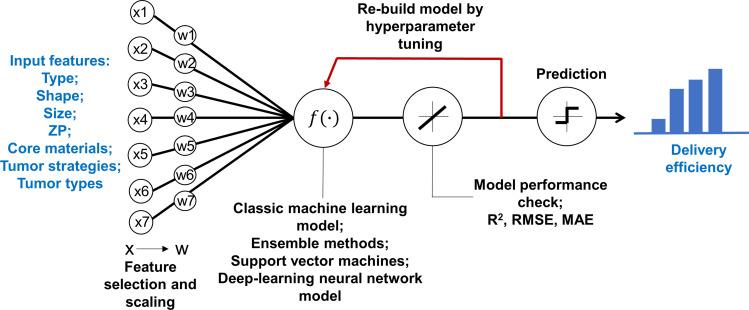
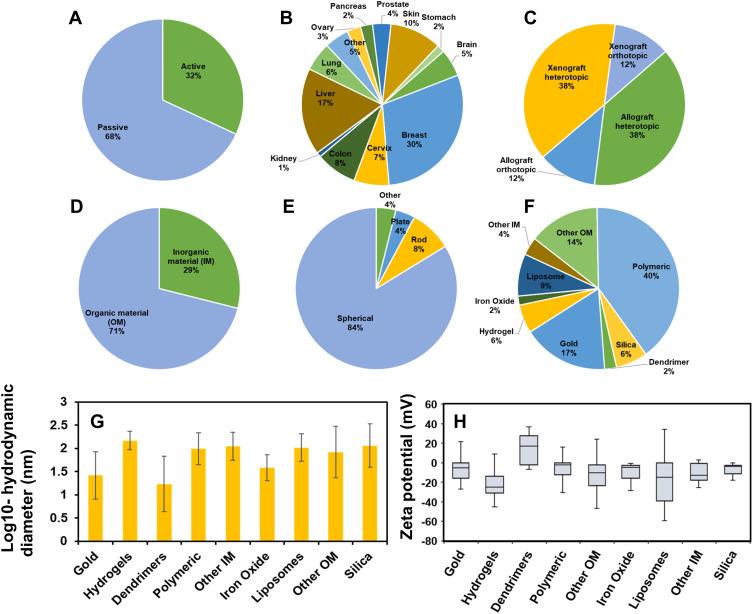
This study analyzed the roles of NP physicochemical properties, tumor models, and cancer types in NP tumor delivery efficiency using multiple machine learning and artificial intelligence methods, using data from a recently published Nano-Tumor Database that contains 376 datasets generated from a physiologically based pharmacokinetic (PBPK) model.
RESULTS
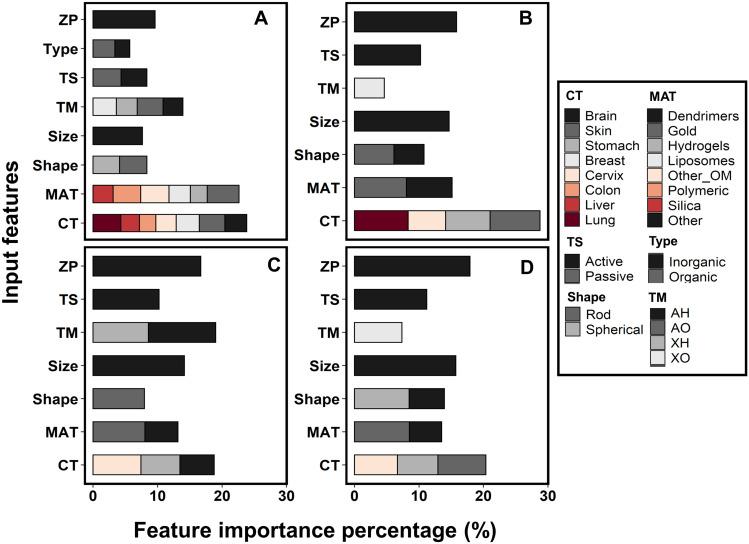
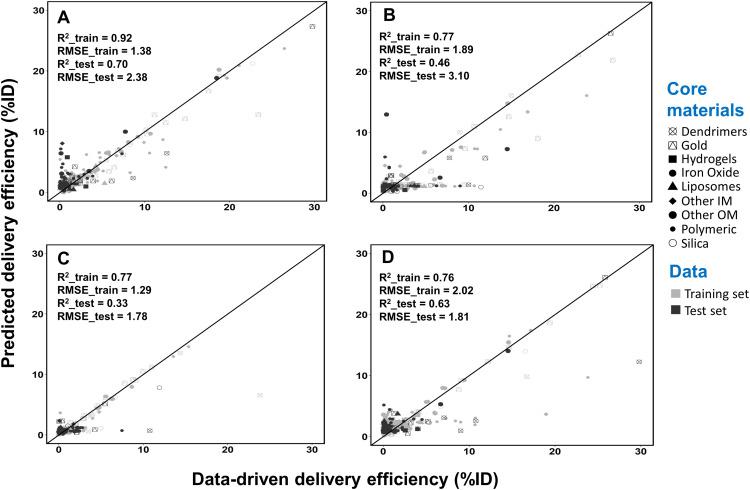
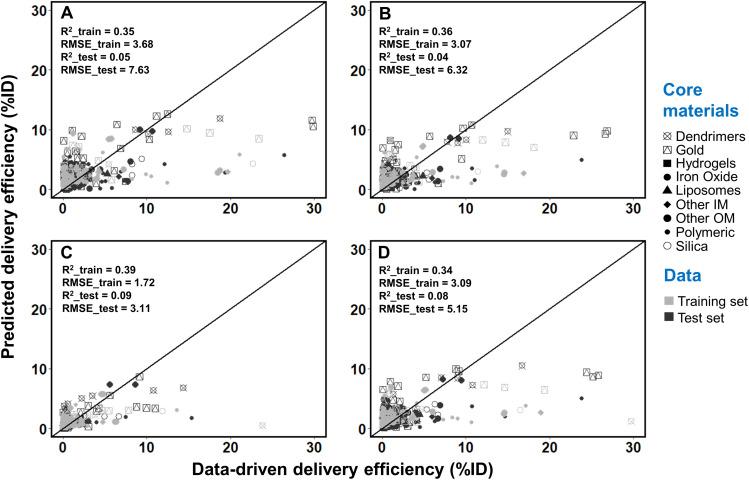
The deep neural network model adequately predicted the delivery efficiency of different NPs to different tumors and it outperformed all other machine learning methods; including random forest, support vector machine, linear regression, and bagged model methods. The adjusted determination coefficients (R) in the full training dataset were 0.92, 0.77, 0.77 and 0.76 for the maximum delivery efficiency (DE), delivery efficiency at 24 h (DE), at 168 h (DE), and at the last sampling time (DE). The corresponding R values in the test dataset were 0.70, 0.46, 0.33 and 0.63, respectively. Also, this study showed that cancer type was an important determinant for the deep neural network model in predicting the tumor delivery efficiency across all endpoints (19-29%). Among all physicochemical properties, the Zeta potential and core material played a greater role than other properties, such as the type, shape, and targeting strategy.
CONCLUSION
This study provides a quantitative model to improve the design of cancer nanomedicine with greater tumor delivery efficiency. These results help to improve our understanding of the causes of low NP tumor delivery efficiency. This study demonstrates the feasibility of integrating artificial intelligence with PBPK modeling approaches to study cancer nanomedicine.
背景
纳米颗粒(NPs)向肿瘤的递药效率低是癌症纳米医学领域的一个关键障碍。如何提高 NP 肿瘤递药效率的策略仍有待确定。
方法
本研究使用多种机器学习和人工智能方法,利用最近发表的包含来自基于生理的药代动力学(PBPK)模型的 376 个数据集的 Nano-Tumor 数据库中的数据,分析了 NP 物理化学性质、肿瘤模型和癌症类型在 NP 肿瘤递药效率中的作用。
结果
深度神经网络模型充分预测了不同 NPs 对不同肿瘤的递药效率,优于所有其他机器学习方法,包括随机森林、支持向量机、线性回归和袋装模型方法。在全训练数据集的调整确定系数(R)分别为 0.92、0.77、0.77 和 0.76,最大递药效率(DE)、24 h 递药效率(DE)、168 h 递药效率(DE)和最后采样时间(DE)。在测试数据集的相应 R 值分别为 0.70、0.46、0.33 和 0.63。此外,本研究表明,癌症类型是深度神经网络模型在预测所有终点(19-29%)肿瘤递药效率时的一个重要决定因素。在所有物理化学性质中,Zeta 电位和核心材料比其他性质(如类型、形状和靶向策略)发挥更大的作用。
结论
本研究提供了一种定量模型,以提高具有更高肿瘤递药效率的癌症纳米医学设计。这些结果有助于提高我们对 NP 肿瘤递药效率低的原因的理解。本研究证明了将人工智能与 PBPK 建模方法相结合来研究癌症纳米医学的可行性。


 Zotero 插件