
空气污染暴露与 COPD 运动诱导的氧减饱和的关系。
Association of air pollution exposure with exercise-induced oxygen desaturation in COPD.
机构信息
Division of Pulmonary Medicine, Department of Internal Medicine, Shuang Ho Hospital, Taipei Medical University, New Taipei City, Taiwan.
Division of Pulmonary Medicine, Department of Internal Medicine, School of Medicine, College of Medicine, Taipei Medical University, Taipei, Taiwan.
出版信息
Respir Res. 2022 Mar 31;23(1):77. doi: 10.1186/s12931-022-02000-1.
BACKGROUND
There is a link between exposure to air pollution and the increased prevalence of chronic obstructive pulmonary disease (COPD) and declining pulmonary function, but the association with O desaturation during exercise in COPD patients with emphysema is unclear. Our aims were to estimate the prevalence of O desaturation during exercise in patients with COPD, and determine the association of exposure to air pollution with exercise-induced desaturation (EID), the degree of emphysema, and dynamic hyperinflation (DH).
METHODS
We assessed the effects of 10-year prior to the HRCT assessment and 7 days prior to the six-minute walking test exposure to particulate matter with an aerodynamic diameter of < 10 µm (PM) or of < 2.5 µM (PM, nitrogen dioxide (NO), and ozone (O) in patients with emphysema in this retrospective cohort study. EID was defined as a nadir standard pulse oximetry (SpO) level of < 90% or a delta (△)SpO level of ≥ 4%. Ambient air pollutant (PM, PM, O, and NO) data were obtained from Taiwan Environmental Protection Administration (EPA) air-monitoring stations, usually within 10 km to each participant's home address.
RESULTS
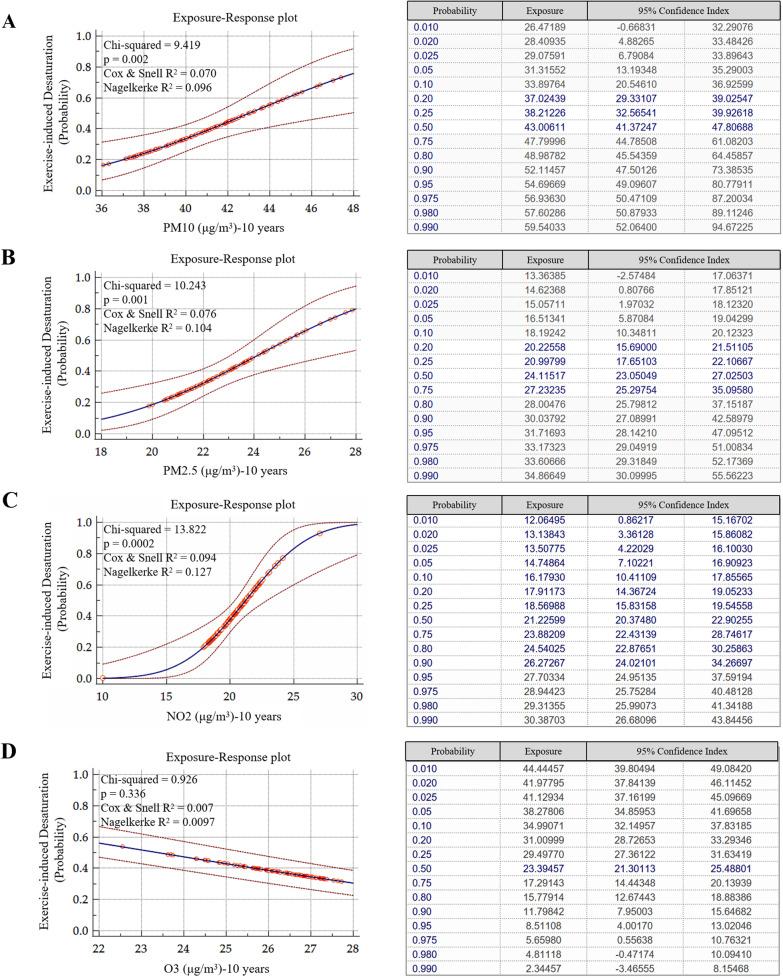
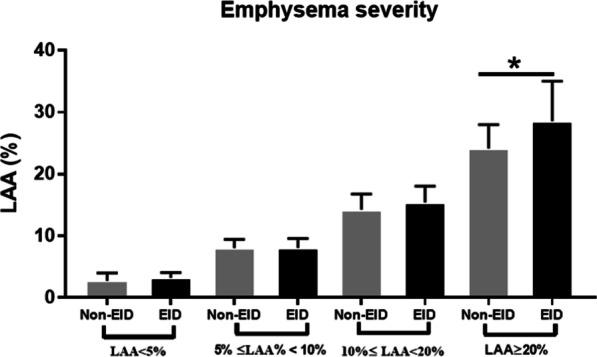
We recruited 141 subjects with emphysema. 41.1% of patients with emphysema exhibited EID, and patients with EID had more dyspnea, worse lung function, more severe emphysema, more frequent acute exacerbations, managed a shorter walking distance, had DH, and greater long-term exposure to air pollution than those without EID. We observed that levels of 10-year concentrations of PM, PM, and NO were significantly associated with EID, PM and PM were associated with the severity of emphysema, and associated with DH in patients with emphysema. In contrast, short-term exposure did not have any effect on patients.
CONCLUSION
Long-term exposure to ambient PM, PM and NO, but not O, was associated with EID.
背景
空气污染暴露与慢性阻塞性肺疾病(COPD)的患病率增加和肺功能下降之间存在关联,但与肺气肿 COPD 患者运动时的 O 饱和度下降的关联尚不清楚。我们的目的是估计 COPD 患者运动时 O 饱和度下降的发生率,并确定暴露于空气污染与运动诱导的饱和度下降(EID)、肺气肿程度和动态过度充气(DH)之间的关联。
方法
在这项回顾性队列研究中,我们评估了在 HRCT 评估前 10 年和 6 分钟步行测试前 7 天,对患有肺气肿的患者暴露于空气动力学直径<10μm(PM)或<2.5μm(PM、二氧化氮(NO)和臭氧(O)的影响。EID 定义为脉氧饱和度(SpO)标准最低值<90%或△SpO 水平≥4%。环境空气污染物(PM、PM、O 和 NO)数据来自台湾环境保护署(EPA)空气监测站,通常距离每个参与者家地址 10 公里以内。
结果
我们招募了 141 名患有肺气肿的患者。41.1%的肺气肿患者出现 EID,EID 患者呼吸困难更严重,肺功能更差,肺气肿更严重,急性加重更频繁,行走距离更短,DH 更多,长期暴露于空气污染的时间更长。我们观察到,10 年 PM、PM 和 NO 浓度的水平与 EID 显著相关,PM 和 PM 与肺气肿的严重程度相关,与肺气肿患者的 DH 相关。相比之下,短期暴露对患者没有任何影响。
结论
长期暴露于环境 PM、PM 和 NO,但不是 O,与 EID 相关。
 Zotero 插件