
肺结核后气流阻塞和小气道功能障碍:一项横断面调查。
Airflow obstruction and small airway dysfunction following pulmonary tuberculosis: a cross-sectional survey.
机构信息
Department of Respiratory and Critical Care Medicine, National Center of Gerontology, Institute of Geriatric Medicine, Chinese Academy of Medical Sciences, Beijing Hospital, Beijing, China.
Department of Respiratory and Critical Care Medicine, Peking University Fifth School of Clinical Medicine, Beijing, China.
出版信息
Thorax. 2023 Mar;78(3):274-280. doi: 10.1136/thoraxjnl-2021-218345. Epub 2022 Mar 31.
OBJECTIVES
Pulmonary function impairment and chronic respiratory symptoms after tuberculosis are relatively common in low-income and middle-income countries. We aimed to estimate the impact of post-tuberculosis (post-TB) on pulmonary function.
METHODS
This large cross-sectional, population-based study included subjects aged 15 years or older with technically acceptable postbronchodilator spirometry measurements. Post-TB was diagnosed on the basis of radiological evidence and/or medical history. Airflow obstruction was defined as a postbronchodilator forced expiratory volume in 1 s/forced vital capacity ratio below the lower limit of normal of Global Lung Function Initiative (GLI) lung function equations. Small airway dysfunction was diagnosed if at least two of the following indicators were less than 65% of predicted: maximal mid-expiratory flow, forced expiratory flow (FEF) 50% or FEF 75%.
RESULTS
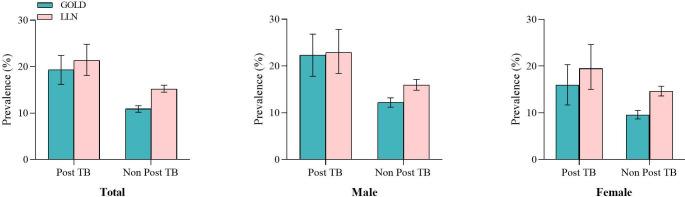
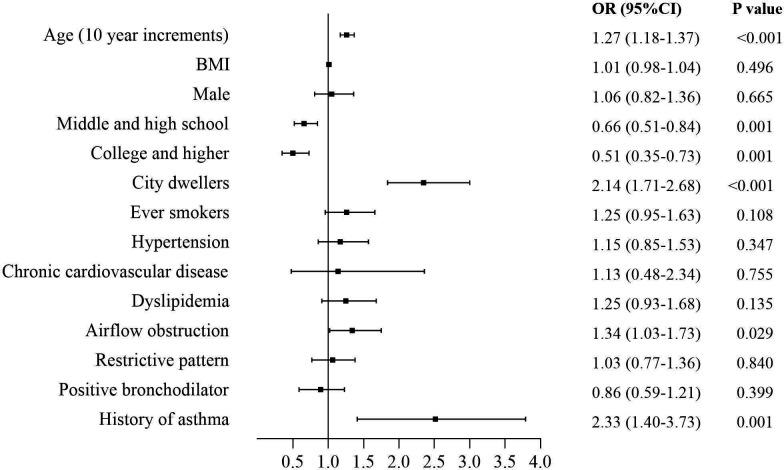
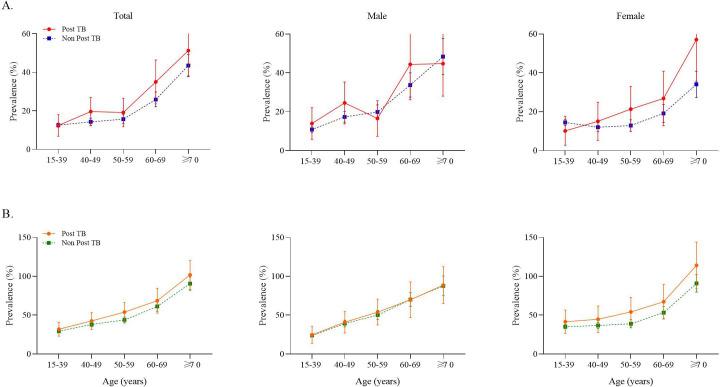
In this population sample (N=8680, mean age: 40.1 years), 610 (7.0% (95% CI 6.5 to 7.6) participants were post-TB. Post-TB subjects had more frequent respiratory symptoms (46.8% vs 28.3%). Among post-TB subjects, 130 (21.3% (95% CI 18.1 to 24.8)) had airflow obstruction; OR of airflow obstruction was significantly associated with post-TB after adjustment for other confounding factors (OR 1.31, 95% CI 1.05 to 1.62). Post-TB was also associated with small airway dysfunction (OR 1.28, 95% CI1.07 to 1.53), which was present in 297 (48.9% (95% CI 33.9 to 53.0)) post-TB subjects.
CONCLUSIONS
Our findings support existing knowledge that post-TB is positively associated with pulmonary function impairment and make for frequent respiratory symptoms. Post-TB should be considered as a potentially important cause of airflow obstruction and respiratory symptoms in patients originating from countries with a high burden of tuberculosis.
目的
在中低收入国家,肺结核(简称“结核”)后肺功能损害和慢性呼吸道症状较为常见。本研究旨在评估结核后(简称“post-TB”)对肺功能的影响。
方法
本研究为大型横断面、基于人群的研究,纳入了技术上可接受的支气管扩张剂后用力肺活量测量值的 15 岁及以上受试者。根据影像学证据和/或病史诊断 post-TB。支气管扩张剂后用力肺活量 1 秒率(FEV1/FVC)低于全球肺功能倡议(GLI)肺功能方程的下限时定义为气流阻塞。如果至少有以下两个指标低于预计值的 65%,则诊断为小气道功能障碍:最大中期呼气流量、呼气流量(FEF)50%或 FEF 75%。
结果
在该人群样本(N=8680,平均年龄:40.1 岁)中,有 610 名(7.0%(95%CI 6.5%至 7.6%))参与者为 post-TB。post-TB 受试者有更多的呼吸道症状(46.8% vs 28.3%)。在 post-TB 受试者中,有 130 名(21.3%(95%CI 18.1%至 24.8%))存在气流阻塞;在调整其他混杂因素后,post-TB 与气流阻塞显著相关(OR 1.31,95%CI 1.05 至 1.62)。post-TB 还与小气道功能障碍相关(OR 1.28,95%CI 1.07 至 1.53),post-TB 受试者中有 297 名(48.9%(95%CI 33.9%至 53.0%))存在小气道功能障碍。
结论
本研究结果支持现有知识,即 post-TB 与肺功能损害呈正相关,并导致频繁的呼吸道症状。在结核病负担较高的国家,post-TB 应被视为气流阻塞和呼吸道症状的一个潜在重要病因。
 Zotero 插件