
利用 2017-2018 年美国国家健康和营养调查瞬态弹性成像数据及机器学习预测非酒精性脂肪性肝病的流行率。
Predicting NAFLD prevalence in the United States using National Health and Nutrition Examination Survey 2017-2018 transient elastography data and application of machine learning.
机构信息
Karsh Division of Gastroenterology and HepatologyComprehensive Transplant CenterCedars-Sinai Medical CenterLos AngelesCaliforniaUSA.
Pfizer IncNew YorkNew YorkUSA.
出版信息
Hepatol Commun. 2022 Jul;6(7):1537-1548. doi: 10.1002/hep4.1935. Epub 2022 Apr 1.
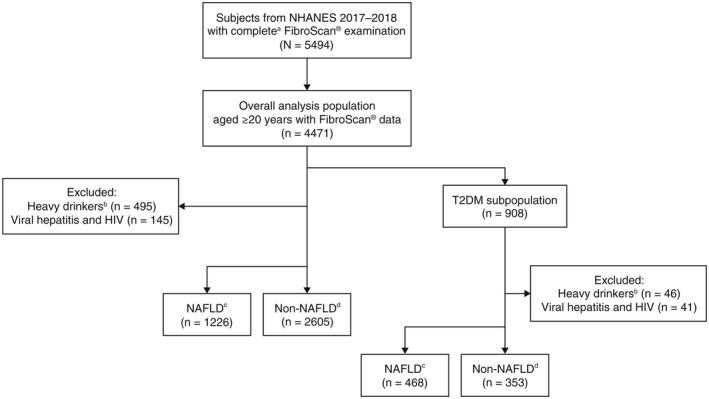
This cohort analysis investigated the prevalence of nonalcoholic fatty liver disease (NAFLD) and NAFLD with fibrosis at different stages, associated clinical characteristics, and comorbidities in the general United States population and a subpopulation with type 2 diabetes mellitus (T2DM), using the National Health and Nutrition Examination Survey (NHANES) database (2017-2018). Machine learning was explored to predict NAFLD identified by transient elastography (FibroScan ). Adults ≥20 years of age with valid transient elastography measurements were included; those with high alcohol consumption, viral hepatitis, or human immunodeficiency virus were excluded. Controlled attenuation parameter ≥302 dB/m using Youden's index defined NAFLD; vibration-controlled transient elastography liver stiffness cutoffs were ≤8.2, ≤9.7, ≤13.6, and >13.6 kPa for F0-F1, F2, F3, and F4, respectively. Predictive modeling, using six different machine-learning approaches with demographic and clinical data from NHANES, was applied. Age-adjusted prevalence of NAFLD and of NAFLD with F0-F1 and F2-F4 fibrosis was 25.3%, 18.9%, and 4.4%, respectively, in the overall population and 54.6%, 32.6%, and 18.3% in those with T2DM. The highest prevalence was among Mexican American participants. Test performance for all six machine-learning models was similar (area under the receiver operating characteristic curve, 0.79-0.84). Machine learning using logistic regression identified male sex, hemoglobin A1c, age, and body mass index among significant predictors of NAFLD (P ≤ 0.01). Conclusion: Data show a high prevalence of NAFLD with significant fibrosis (≥F2) in the general United States population, with greater prevalence in participants with T2DM. Using readily available, standard demographic and clinical data, machine-learning models could identify subjects with NAFLD across large data sets.
本队列分析调查了美国普通人群和 2 型糖尿病(T2DM)亚人群中不同阶段非酒精性脂肪性肝病(NAFLD)和伴有纤维化的 NAFLD 的流行率、相关临床特征和合并症,使用了国家健康和营养检查调查(NHANES)数据库(2017-2018 年)。探索了使用瞬态弹性成像(FibroScan)识别的 NAFLD 的机器学习预测。纳入了有有效瞬态弹性成像测量值的年龄≥20 岁的成年人;排除了大量饮酒、病毒性肝炎或人类免疫缺陷病毒感染者。使用 Youden 指数定义的控制衰减参数≥302dB/m 来定义 NAFLD;振动控制瞬态弹性成像肝硬度截止值分别为≤8.2、≤9.7、≤13.6 和>13.6kPa,用于 F0-F1、F2、F3 和 F4。使用 NHANES 的人口统计学和临床数据,应用了六种不同的机器学习方法进行预测建模。在普通人群中,NAFLD 的年龄调整患病率为 25.3%,伴有 F0-F1 和 F2-F4 纤维化的 NAFLD 患病率分别为 18.9%和 4.4%,在 T2DM 患者中,分别为 54.6%、32.6%和 18.3%。墨西哥裔美国人参与者的患病率最高。所有六种机器学习模型的测试性能均相似(接受者操作特征曲线下面积,0.79-0.84)。使用逻辑回归的机器学习确定了男性性别、糖化血红蛋白、年龄和体重指数是 NAFLD 的显著预测因子(P≤0.01)。结论:数据显示,美国普通人群中 NAFLD 伴显著纤维化(≥F2)的患病率较高,在 T2DM 患者中患病率更高。使用现成的、标准的人口统计学和临床数据,机器学习模型可以在大型数据集识别出患有 NAFLD 的受试者。


 Zotero 插件