
地西他滨强化改良白消安/环磷酰胺预处理方案可改善接受相关供体造血干细胞移植的急性髓系白血病患者的生存率:一项倾向评分匹配分析
Decitabine-Intensified Modified Busulfan/Cyclophosphamide Conditioning Regimen Improves Survival in Acute Myeloid Leukemia Patients Undergoing Related Donor Hematopoietic Stem Cell Transplantation: A Propensity Score Matched Analysis.
作者信息
Li Ziying, Shi Wei, Lu Xuan, Lu Hui, Cao Xiena, Tang Liang, Yan Han, Zhong Zhaodong, You Yong, Xia Linghui, Hu Yu, Wang Huafang
机构信息
Institute of Hematology, Union Hospital, Tongji Medical College, Huazhong University of Science and Technology, Wuhan, China.
出版信息
Front Oncol. 2022 Mar 16;12:844937. doi: 10.3389/fonc.2022.844937. eCollection 2022.
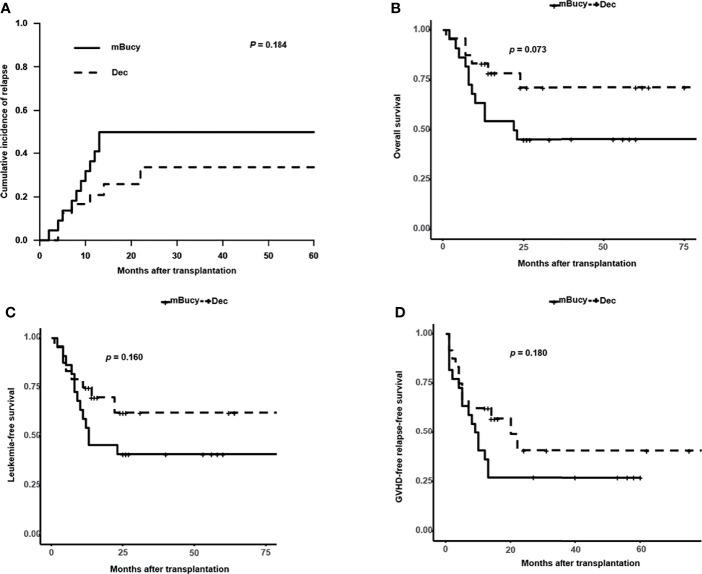
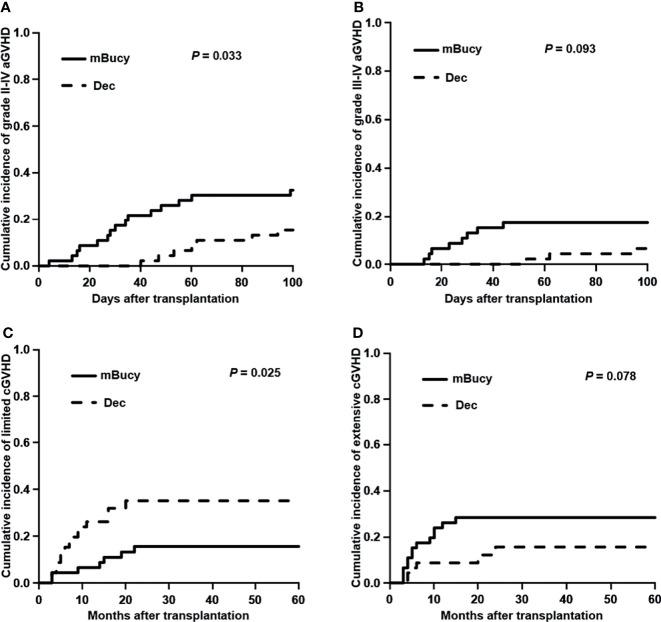
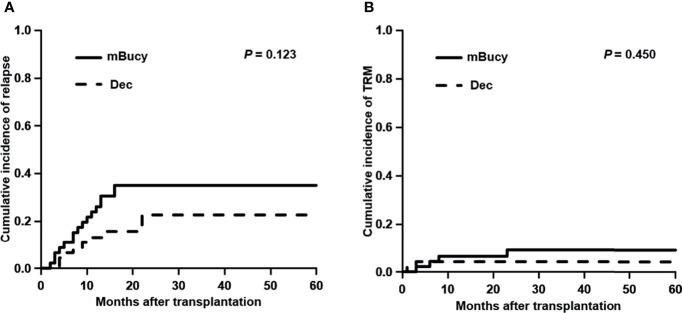
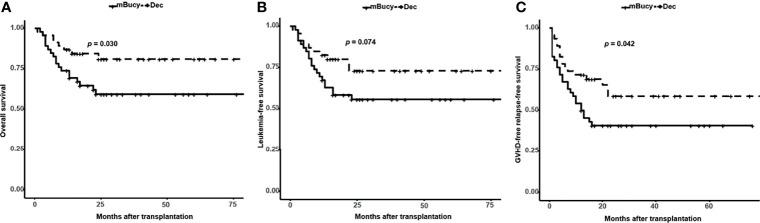
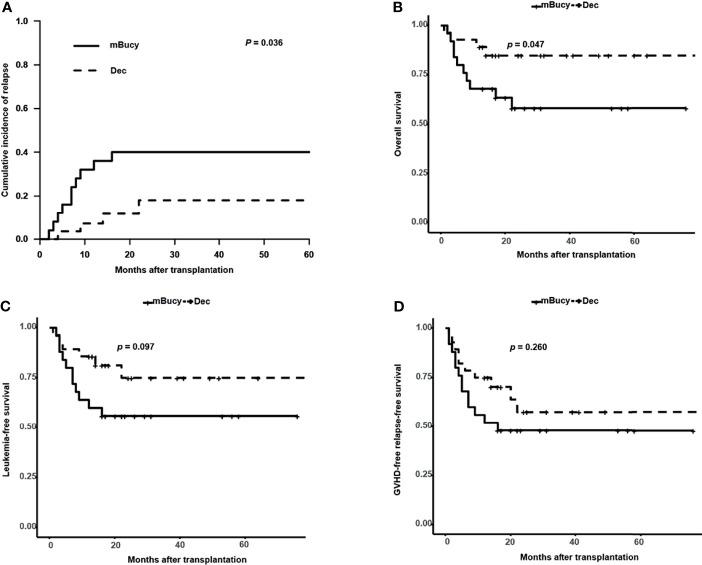
To identify the benefit of decitabine (Dec)-intensified myeloablative conditioning on the outcomes of patients with acute myeloid leukemia (AML) after related donor hematopoietic stem cell transplantation (HSCT), we performed a retrospective matched-pair study from a pool of 156 patients to evaluate Dec [20 mg/m/day intravenously (i.v.) on days -11 to -7]-intensified modified busulfan/cyclophosphamide (mBuCy) conditioning regimen vs. mBuCy regimen in 92 AML patients, with 46 patients in each cohort. The cumulative incidence of grade II-IV acute graft-versus-host disease (aGVHD) was lower in the Dec group (15.2% ± 0.3% vs. 32.6% ± 0.5%, = 0.033). Compared with mBuCy group (15.5% ± 0.3%), a significantly higher proportion of limited chronic GVHD (cGVHD) in Dec group (35% ± 0.6%) was observed ( = 0.025). Dec-intensified mBuCy conditioning was associated with better 2-year overall survival (OS) and GVHD-free relapse-free survival (GRFS) (81% ± 6.2% vs. 59.4% ± 7.5%, = 0.03; 58.7% ± 8.1% vs. 40.9% ± 7.3%, = 0.042; respectively). Our results also elucidated that the Dec group had better 2-year OS and lower 2-year cumulative incidence of relapse (CIR) in patients acquiring haploidentical HSCT than that of the mBuCy group (84.8% ± 7.1% vs. 58.2% ± 10.3%, = 0.047; 17.9% ± 0.8% vs. 40.0% ± 1.0%, = 0.036; respectively), which did not increase the treatment-related mortality and regimen-associated toxicities. Dec-intensified myeloablative regimen and high-risk stratification were the variables associated with OS, leukemia-free survival (LFS), and GRFS in multivariate analysis. In high-risk patients, no differences were found in CIR, OS, LFS, and GRFS between the two groups. These data indicated that Dec-intensified mBuCy conditioning regimen was associated with better survival than mBuCy regimen in AML patients, especially in patients undergoing haploidentical HSCT.
为确定地西他滨(Dec)强化清髓性预处理对急性髓系白血病(AML)患者在接受相关供者造血干细胞移植(HSCT)后的疗效,我们进行了一项回顾性配对研究,从156例患者中选取92例AML患者,评估Dec [在-11至-7天静脉注射(i.v.)20mg/m²/天]强化的改良白消安/环磷酰胺(mBuCy)预处理方案与mBuCy方案的疗效,每组46例患者。Dec组II-IV级急性移植物抗宿主病(aGVHD)的累积发生率较低(15.2%±0.3% vs. 32.6%±0.5%,P = 0.033)。与mBuCy组(15.5%±0.3%)相比,Dec组有限慢性移植物抗宿主病(cGVHD)的比例显著更高(35%±0.6%)(P = 0.025)。Dec强化的mBuCy预处理与更好的2年总生存率(OS)和无移植物抗宿主病无复发生存率(GRFS)相关(81%±6.2% vs.59.4%±7.5%,P = 0.03;58.7%±8.1% vs. 40.9%±7.3%,P = 0.042)。我们的结果还表明,在接受单倍体HSCT的患者中,Dec组的2年OS更好,2年累积复发率(CIR)更低,高于mBuCy组(84.8%±7.1% vs. 58.2%±10.3%,P = 0.047;17.9%±0.8% vs. 40.0%±1.0%,P = 0.036),且未增加治疗相关死亡率和方案相关毒性。在多因素分析中,Dec强化的清髓性方案和高危分层是与OS、无白血病生存率(LFS)和GRFS相关的变量。在高危患者中,两组在CIR、OS、LFS和GRFS方面未发现差异。这些数据表明,Dec强化的mBuCy预处理方案与mBuCy方案相比,在AML患者中具有更好的生存率,尤其是在接受单倍体HSCT的患者中。
 Zotero 插件