
地西他滨预处理对处于缓解期的急性髓系白血病及中高危骨髓增生异常综合征患者异基因造血干细胞移植结局的影响
Impact of Decitabine Conditioning on Allo-HSCT Outcomes in AML and Intermediate-to-High-Risk MDS Patients in Remission.
作者信息
Yu Shuling, Zhuang Wanchuan, Gao Shengfa, Li Tongyu, Yan Xiao, Ouyang Guifang, Zhang Ping
机构信息
Department of Hematology, The First Affiliated Hospital of Ningbo University, Ningbo, China.
Health Science Center, Ningbo University, Ningbo, China.
出版信息
Cancer Med. 2025 Jul;14(14):e71081. doi: 10.1002/cam4.71081.
BACKGROUND
Allogeneic hematopoietic stem cell transplantation (allo-HSCT) remains the sole curative option for myeloid malignancies, though high toxicity from conditioning regimens and complications like graft-versus-host disease (GVHD) limit its success. The potential benefit of incorporating decitabine (DAC) into conditioning regimens for acute myeloid leukemia (AML) and intermediate-to-high-risk myelodysplastic syndromes (MDS) patients in remission remains unclear.
METHODS
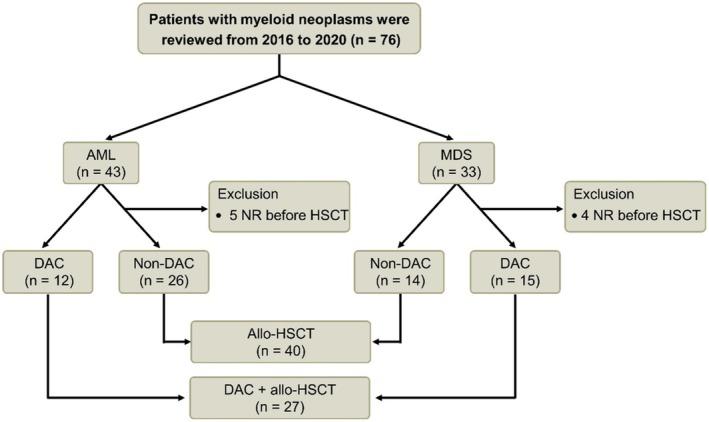
We conducted a retrospective, single-center study analyzing data from January 2016 to December 2020 at the First Affiliated Hospital of Ningbo University with a median follow-up of 45.05 months (range, 1-96 months). Outcomes were compared between patients receiving DAC+HSCT versus HSCT alone, with primary endpoints of 5-year overall survival (OS), progression-free survival (PFS), and relapse rate. Secondary analyses examined outcomes by remission status (CR1 vs. others) and age subgroups (< 31.5 years). Immune cell subsets (CD3-CD56+ NK cells) were evaluated for GVHD correlation.
RESULTS
The DAC+HSCT group exhibited 5-year OS of 51.9% and PFS of 46.1%, compared to 67% OS and 56.5% PFS in the HSCT-only group. The 5-year relapse rate was 16.9% for DAC+HSCT versus 23.2% for HSCT alone. DAC did not significantly improve outcomes in complete remission (CR1) patients but improved OS and PFS in patients under 31.5 years of age. Elevated CD3-CD56+ NK cells in the DAC+HSCT group were associated with higher incidence of severe acute GVHD (aGVHD).
CONCLUSION
While DAC conditioning did not provide overall survival benefit for AML/MDS patients undergoing allo-HSCT, it improved outcomes in younger individuals (< 31.5 years). Higher NK cell proportions may serve as a potential biomarker for early aGVHD intervention, warranting further investigation into risk-stratified conditioning approaches.
背景
异基因造血干细胞移植(allo-HSCT)仍然是髓系恶性肿瘤的唯一治愈选择,尽管预处理方案的高毒性以及移植物抗宿主病(GVHD)等并发症限制了其成功率。将地西他滨(DAC)纳入急性髓系白血病(AML)和处于缓解期的中高危骨髓增生异常综合征(MDS)患者的预处理方案中的潜在益处仍不明确。
方法
我们进行了一项回顾性单中心研究,分析了宁波大学附属第一医院2016年1月至2020年12月的数据,中位随访时间为45.05个月(范围1 - 96个月)。比较了接受DAC + HSCT与单纯HSCT患者的结局,主要终点为5年总生存率(OS)、无进展生存率(PFS)和复发率。次要分析按缓解状态(CR1与其他)和年龄亚组(<31.5岁)检查结局。评估免疫细胞亚群(CD3 - CD56 + NK细胞)与GVHD的相关性。
结果
DAC + HSCT组的5年OS为51.9%,PFS为46.1%,而单纯HSCT组的OS为67%,PFS为56.5%。DAC + HSCT组的5年复发率为16.9%,单纯HSCT组为23.2%。DAC在完全缓解(CR1)患者中未显著改善结局,但在31.5岁以下患者中改善了OS和PFS。DAC + HSCT组中CD3 - CD56 + NK细胞升高与严重急性GVHD(aGVHD)的较高发生率相关。
结论
虽然DAC预处理未为接受allo-HSCT的AML/MDS患者提供总体生存益处,但改善了较年轻个体(<31.5岁)的结局。较高的NK细胞比例可能作为早期aGVHD干预的潜在生物标志物,有必要进一步研究风险分层的预处理方法。



 Zotero 插件