
急性肾损伤会导致危重症幸存者的身体和生活质量结果更差。
Acute kidney injury contributes to worse physical and quality of life outcomes in survivors of critical illness.
机构信息
Department of Physical Therapy, College of Health Sciences, University of Kentucky, 900 Rose Street, Lexington, KY, 40536, USA.
Center for Muscle Biology, College of Health Sciences, University of Kentucky, Lexington, KY, USA.
出版信息
BMC Nephrol. 2022 Apr 7;23(1):137. doi: 10.1186/s12882-022-02749-z.
OBJECTIVES
Survivors of critical illness and acute kidney injury (AKI) are at risk of increased morbidity. The purpose of this study was to compare physical, emotional, and cognitive health in survivors of critical illness with and without AKI.
METHODS
Retrospective cohort study of adult (≥ 18 years old) survivors of critical illness due to sepsis and/or acute respiratory failure who attended follow-up in a specialized ICU Recovery Clinic. Outcomes were evaluated during 3-month visit and comprised validated tests for evaluation of physical function, muscle strength, cognitive and emotional health, and self-reported health-related quality of life (HRQOL). Descriptive statistics and group comparisons were performed.
RESULTS
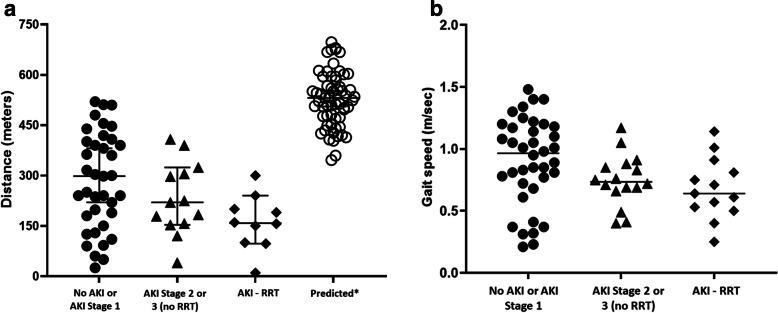
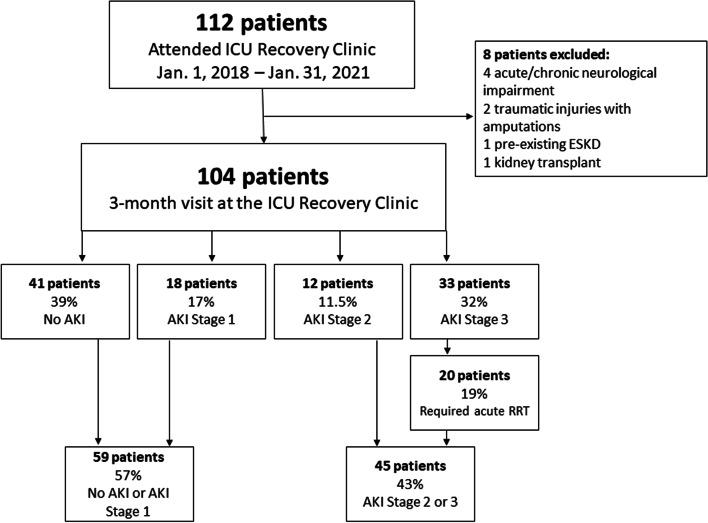
A total of 104 patients with median age of 55 [49-64] years, 54% male, and median SOFA score of 10 [8-12] were analyzed. Incidence of AKI during ICU admission was 61 and 19.2% of patients required renal replacement therapy (RRT). Patients with AKI stage 2 or 3 (vs. those with AKI stage 1 or no AKI) walked less on the 6-min walk test (223 ± 132 vs. 295 ± 153 m, p = 0.059) and achieved lower of the predicted walk distance (38% vs. 58%, p = 0.041). Similar patterns of worse physical function and more significant muscle weakness were observed in multiple tests, with overall worse metrics in patients that required RRT. Patients with AKI stage 2 or 3 also reported lower HRQOL scores when compared to their counterparts, including less ability to return to work or hobby, or reengage in driving. There were no significant differences in cognitive function or emotional health between groups.
CONCLUSIONS
Survivors of critical illness and AKI stage 2 or 3 have increased physical debility and overall lower quality of life, with more impairment in return to work, hobby, and driving when compared to their counterparts without AKI or AKI stage 1 at 3 months post-discharge.
目的
危重病和急性肾损伤(AKI)幸存者存在更高发病率的风险。本研究的目的是比较 AKI 与非 AKI 危重病幸存者的身体、情绪和认知健康。
方法
对因脓毒症和/或急性呼吸衰竭而入住重症监护病房的成年(≥18 岁)危重病幸存者进行回顾性队列研究,并在专门的 ICU 康复诊所接受随访。在 3 个月的就诊期间评估结局,包括评估身体功能、肌肉力量、认知和情绪健康以及自我报告的健康相关生活质量(HRQOL)的验证性测试。进行描述性统计和组间比较。
结果
共分析了 104 例中位年龄为 55[49-64]岁、54%为男性、中位 SOFA 评分为 10[8-12]的患者。入住 ICU 期间 AKI 的发生率为 61%,19.2%的患者需要肾脏替代治疗(RRT)。与 AKI 1 期或无 AKI 的患者相比,AKI 2 或 3 期患者的 6 分钟步行测试步行距离较短(223±132 比 295±153m,p=0.059),预测步行距离的完成度较低(38%比 58%,p=0.041)。在多项测试中,均观察到类似的身体功能下降和更明显的肌肉无力模式,且需要 RRT 的患者的指标更差。与无 AKI 或 AKI 1 期的患者相比,AKI 2 或 3 期患者的 HRQOL 评分也较低,包括重返工作或爱好,或重新开车的能力降低。各组之间的认知功能或情绪健康无显著差异。
结论
与无 AKI 或 AKI 1 期的患者相比,危重病和 AKI 2 或 3 期患者的身体虚弱程度增加,整体生活质量降低,重返工作、爱好和驾驶的能力下降更明显。
 Zotero 插件