
参与神经系统和生长调节的基因和元素会影响鲤鱼脊柱畸形的发育。
Genes and elements involved in the regulation of the nervous system and growth affect the development of spinal deformity in Cyprinus carpio.
机构信息
Centre for Agricultural Genomics and Biotechnology, Faculty of Agricultural and Food Sciences and Environmental Management, University of Debrecen, Debrecen, Hungary.
Doctoral School of Animal Science, University of Debrecen, Debrecen, Hungary.
出版信息
PLoS One. 2022 Apr 8;17(4):e0266447. doi: 10.1371/journal.pone.0266447. eCollection 2022.
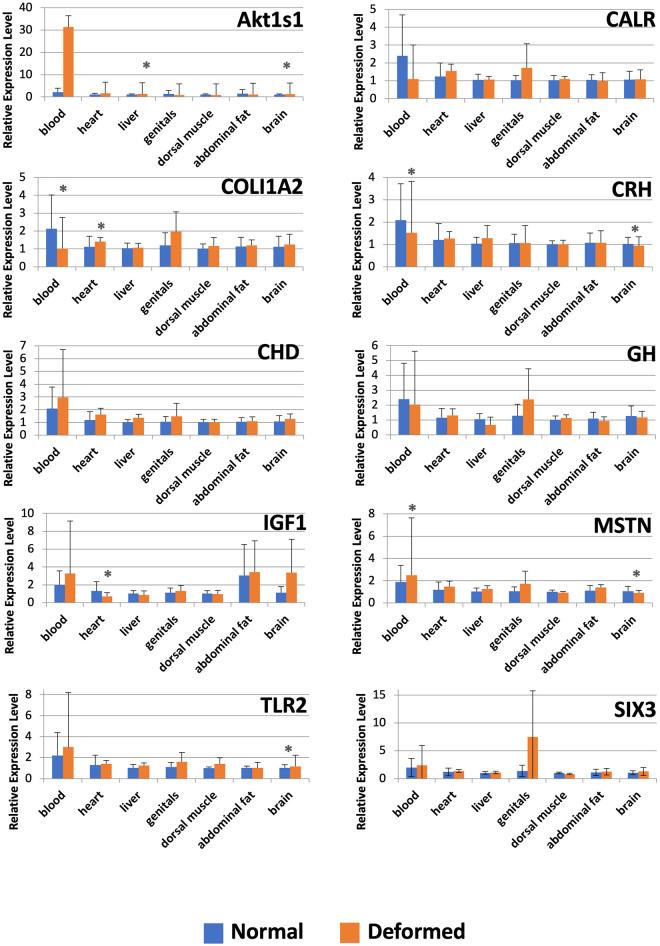
Spinal deformity is a serious economic and animal welfare problem in intensive fish farming systems, which will be a significant unsolved problem for the fish sector. The aim of this study was to determine the relative expression of genes (Akt1 substrate 1, Calreticulin, Collagen type I alpha 2 chain, Corticotropin-releasing hormone, Chromodomain-Helicase DNA-binding, Growth hormone, Insulin like growth factor 1, Myostatin, Sine oculis-related homeobox 3, Toll-like receptor 2) in different tissues associated with spinal deformity and to determine the macroelement (calcium, magnesium, phosphorus, potassium, sodium, sulfur) and microelement (barium, copper, iron, manganese, strontium, zinc) content of spine in healthy and deformed common carps (Cyprinus carpio) in Hungary. The mRNA levels of the genes were measured in 7 different tissues (abdominal fat, blood, brain, dorsal muscle, genitals, heart, liver) by qRT-PCR. Correlations between gene expression and element content were analyzed by using linear regression and Spearman rank correlation. In a total of 15 cases, we found a statistically significant connection between gene expression in a tissue and the macro- or microelement content of the spine. In these contexts, the genes Akt1 substrate 1 (3), Collagen type I alpha 2 chain (2), Corticotropin-releasing hormone (4), Insulin-like growth factor 1 (4), and Myostatin (2), the tissue's blood (3), brain (6), heart (5), and liver (1), the macroelements sodium (4), magnesium (4), phosphorus (1) and sulfur (2) as well as the microelement iron (4) were involved. We also found statistically significant mRNA level differences between healthy and deformed common carps in tissues that were not directly affected by the deformation. Based on our results, genes regulating the nervous system and growth, elements, and tissues are the most associated components in the phenomenon of spinal deformity. With our study, we wish to give direction to and momentum for the exploration of these complex processes.
鱼类脊柱畸形是集约化养殖系统中一个严重的经济和动物福利问题,也是鱼类产业尚未解决的重大难题。本研究旨在测定与鱼类脊柱畸形相关的不同组织中基因(Akt1 底物 1、钙网蛋白、I 型胶原 α2 链、促肾上腺皮质激素释放激素、染色质解旋酶 DNA 结合蛋白、生长激素、胰岛素样生长因子 1、肌肉生长抑制素、 sine oculis 同源盒 3、Toll 样受体 2)的相对表达,并确定匈牙利健康和畸形鲤鱼脊柱中的宏量元素(钙、镁、磷、钾、钠、硫)和微量元素(钡、铜、铁、锰、锶、锌)含量。采用 qRT-PCR 法测定 7 种不同组织(腹部脂肪、血液、大脑、背肌、生殖腺、心脏、肝脏)中基因的 mRNA 水平。采用线性回归和 Spearman 秩相关分析基因表达与元素含量之间的相关性。在总共 15 例中,我们发现组织中基因表达与脊柱中宏量或微量元素含量之间存在统计学显著关联。在这些情况下,Akt1 底物 1(3)、I 型胶原 α2 链(2)、促肾上腺皮质激素释放激素(4)、胰岛素样生长因子 1(4)和肌肉生长抑制素(2)、血液(3)、大脑(6)、心脏(5)和肝脏(1)组织、宏量元素钠(4)、镁(4)、磷(1)和硫(2)以及微量元素铁(4)参与其中。我们还发现健康和畸形鲤鱼组织之间存在统计学显著的 mRNA 水平差异,而这些组织不受畸形的直接影响。基于我们的结果,调节神经系统和生长的基因、元素和组织是脊柱畸形现象中最相关的组成部分。通过我们的研究,我们希望为探索这些复杂过程提供方向和动力。
 Zotero 插件