
狼疮肾炎与 B 细胞干扰素-β、抗 Smith 抗体和抗 DNA 抗体相关:一项回顾性研究。
Lupus nephritis correlates with B cell interferon-β, anti-Smith, and anti-DNA: a retrospective study.
机构信息
Division of Clinical Immunology and Rheumatology, the University of Alabama at Birmingham, Birmingham, AL, USA.
Medicine Service, Birmingham Veterans Affairs Medical Center, Birmingham, AL, USA.
出版信息
Arthritis Res Ther. 2022 Apr 18;24(1):87. doi: 10.1186/s13075-022-02766-1.
BACKGROUND
In systemic lupus erythematosus (SLE), detection of interferon-β (IFNβ) in B cells was found to be most prominent in patients with high anti-Smith (Sm) and renal disease, but a mechanistic connection was not clear. The objective of the present study is to determine the association of IFNβ in peripheral blood naïve B cells with the histopathological features of lupus nephritis (LN).
METHODS
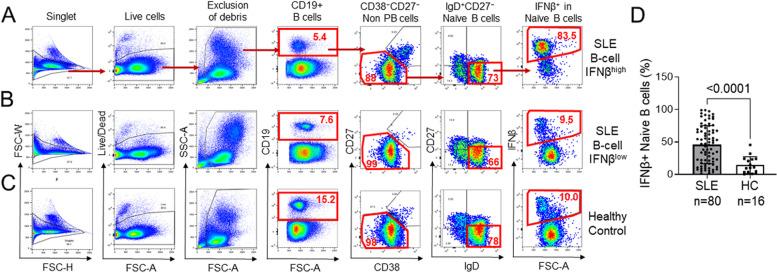
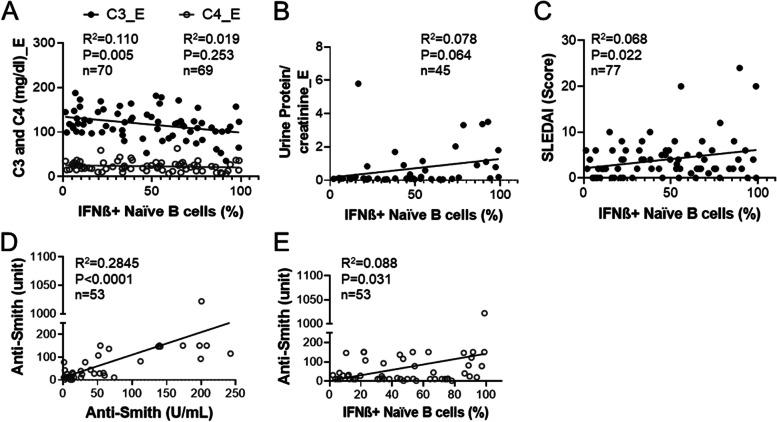
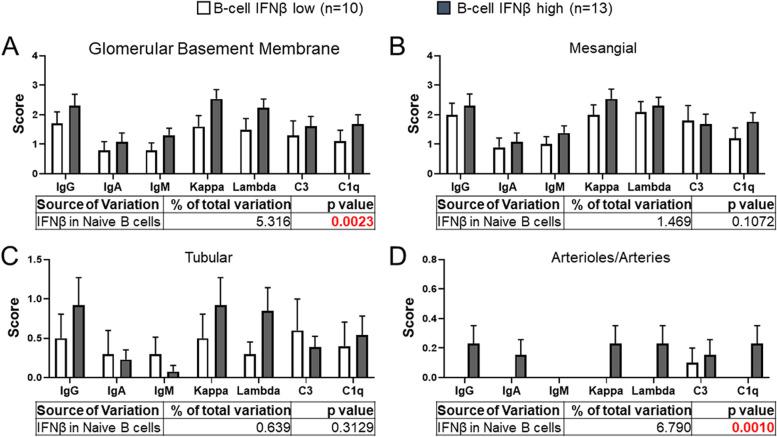
The percentage of IFNβ cells in IgDCD27 naïve CD19 B cells (B cell IFNβ) among peripheral blood mononuclear cells (PBMCs) from 80 SLE patients were analyzed using flow cytometry. Serological and clinical data were collected. The correlations of B cell IFNβ with LN classification and with histopathological findings (light, electron, and immunofluorescence [IF] microscopic analyses for deposition of IgM, IgG, IgA, C1q, and C3) were determined in 23 available biopsy specimens.
RESULTS
B cell IFNβ is positively associated with anti-Sm (p = 0.001), anti-DNA (p = 0.013), and LN (p < 0.001) but was negatively associated with oral/nasal ulcer (p = 0.003) and photosensitivity (p = 0.045). B cell IFNβ positively correlated with immune complex (IC) deposit in the glomerular basement membrane (GBM) (p = 0.002) but not in the mesangial (p = 0.107) or tubular region (p = 0.313). Patients with high B cell IFNβ had statistically increased development of the proliferative LN (Classes III, IV and/or V), compared to patients with low B cell IFNβ (p < 0.0001). Histopathological features positively associated with increased B cell IFNβ included active glomerular lesions as determined by fibrocellular crescents (p = 0.023), chronic glomerular lesions indicated by segmental sclerosis (p = 0.033), and a membranous pattern of renal damage indicated by spike/holes (p = 0.015).
CONCLUSION
B cell IFNβ correlates with history of severe LN, glomerular basement membrane (GBM) IC deposition, and anatomical features of both active and chronic glomerular lesions.
背景
在系统性红斑狼疮(SLE)中,发现 B 细胞中干扰素-β(IFNβ)的存在与高抗-Smith(Sm)和肾脏疾病的患者最为相关,但机制联系尚不清楚。本研究的目的是确定外周血初始 B 细胞中 IFNβ与狼疮肾炎(LN)的组织病理学特征之间的关联。
方法
通过流式细胞术分析 80 例 SLE 患者外周血单个核细胞(PBMC)中 IgDCD27 初始 CD19 B 细胞(B 细胞 IFNβ)中的 IFNβ细胞百分比。收集血清学和临床数据。在 23 例可获得的活检标本中,确定 B 细胞 IFNβ与 LN 分类以及与组织病理学发现(光镜、电子显微镜和免疫荧光[IF]显微镜分析用于沉积的 IgM、IgG、IgA、C1q 和 C3)之间的相关性。
结果
B 细胞 IFNβ与抗 Sm(p=0.001)、抗 DNA(p=0.013)和 LN(p<0.001)呈正相关,与口腔/鼻溃疡(p=0.003)和光敏感(p=0.045)呈负相关。B 细胞 IFNβ与肾小球基底膜(GBM)中的免疫复合物(IC)沉积呈正相关(p=0.002),而与系膜(p=0.107)或肾小管区域(p=0.313)无关。与低 B 细胞 IFNβ的患者相比,高 B 细胞 IFNβ的患者有统计学意义地发展为增生性 LN(III、IV 和/或 V 类)(p<0.0001)。与增加的 B 细胞 IFNβ呈正相关的组织病理学特征包括由纤维细胞性新月体确定的活动性肾小球病变(p=0.023)、由节段性硬化指示的慢性肾小球病变(p=0.033)以及由刺/孔指示的膜性肾损伤模式(p=0.015)。
结论
B 细胞 IFNβ与严重 LN 病史、GBM IC 沉积以及活动性和慢性肾小球病变的解剖特征相关。


 Zotero 插件