
红斑狼疮重叠症患者的单核细胞受 TNF 影响,在 gp130/sIL-6Rb 和 APRIL 的产生中。
Mononuclear cells from patients with rhupus are influenced by TNF in their production of gp130/sIL-6Rb and APRIL.
机构信息
Department of Immunology, Instituto Nacional de Cardiología Ignacio Chávez, Mexico City, Mexico.
Department of Health Care, Universidad Autónoma Metropolitana-Xochimilco, Mexico City, Mexico.
出版信息
Lupus Sci Med. 2023 Oct;10(2). doi: 10.1136/lupus-2023-000970.
OBJECTIVE
Rhupus is a rare disease that shares characteristics of systemic lupus erythematosus (SLE) and rheumatoid arthritis (RA). While several studies have explored the clinical and immunological profiles of patients with rhupus, the underlying cause of the disease remains unknown due to its complex pathogenesis. The objective of this study was to investigate the role of tumour necrosis factor (TNF) in the production of inflammatory molecules by peripheral blood mononuclear cells (PBMCs) from patients with rhupus.
METHODS
The study involved five healthy controls, seven patients with rhupus and seven patients with SLE. PBMCs were obtained from each participant and stimulated with recombinant human TNF for 24 hours. The levels of various molecules secreted by the cells, such as cytokines and chemokines, were measured using immunobead-based assays on xMAP technology.
RESULTS
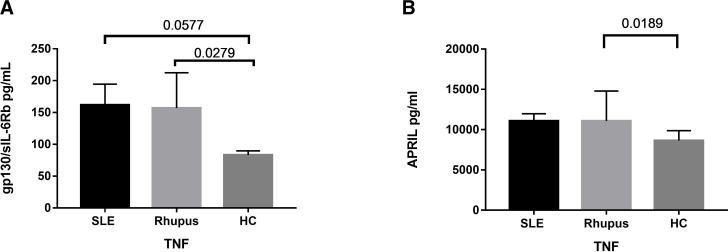
The production levels of some molecules were higher in TNF-stimulated PBMCs from patients with rhupus and SLE than in unstimulated cells. In addition, the levels of certain molecules, including gp130/sIL-6Rb, a proliferation-inducing ligand (APRIL), interferon-β, matrix metalloproteinase-3 and interleukin (IL)-12, were higher in PBMCs from patients with rhupus even without TNF stimulation. Similarly, the levels of gp130/sIL-6Rb and APRIL were higher in TNF-stimulated PBMCs from patients with rhupus than in healthy controls. These results were further validated against patients with RA using enzyme-linked immunosorbent assay.
CONCLUSIONS
These findings suggest that the spontaneous production of molecules by cells from patients with rhupus may contribute to the development of the disease, and that TNF may play a role in this process by regulating the secretion of gp130/sIL-6Rb and APRIL.
目的
红斑狼疮类风湿关节炎(rhupus)是一种具有系统性红斑狼疮(SLE)和类风湿关节炎(RA)特征的罕见疾病。虽然有几项研究探讨了 rhupus 患者的临床和免疫学特征,但由于其复杂的发病机制,该疾病的根本原因仍不清楚。本研究的目的是探讨肿瘤坏死因子(TNF)在 rhupus 患者外周血单个核细胞(PBMC)产生炎症分子中的作用。
方法
本研究纳入了五名健康对照者、七名 rhupus 患者和七名系统性红斑狼疮(SLE)患者。从每位参与者中获取 PBMC 并使用重组人 TNF 刺激 24 小时。使用基于免疫珠的 xMAP 技术测定细胞分泌的各种分子(如细胞因子和趋化因子)的水平。
结果
与未刺激的细胞相比,rhupus 和 SLE 患者经 TNF 刺激的 PBMC 产生的某些分子水平更高。此外,即使没有 TNF 刺激,rhupus 患者的 PBMC 中某些分子(包括 gp130/sIL-6Rb、增殖诱导配体(APRIL)、干扰素-β、基质金属蛋白酶-3 和白细胞介素(IL)-12)的水平也更高。同样,rhupus 患者经 TNF 刺激的 PBMC 中 gp130/sIL-6Rb 和 APRIL 的水平也高于健康对照组。这些结果使用酶联免疫吸附试验进一步验证了针对 RA 患者的结果。
结论
这些发现表明 rhupus 患者细胞的自发性分子产生可能有助于疾病的发展,并且 TNF 可能通过调节 gp130/sIL-6Rb 和 APRIL 的分泌在该过程中发挥作用。

 Zotero 插件