
SARS-CoV-2 疫苗接种与 2300 万居民的北欧队列研究中的心肌炎。
SARS-CoV-2 Vaccination and Myocarditis in a Nordic Cohort Study of 23 Million Residents.
机构信息
Department of Chronic Diseases, Norwegian Institute of Public Health, Oslo, Norway.
Department of Public Health and Welfare, Finnish Institute for Health and Welfare, Helsinki, Finland.
出版信息
JAMA Cardiol. 2022 Jun 1;7(6):600-612. doi: 10.1001/jamacardio.2022.0583.
IMPORTANCE
Reports of myocarditis after SARS-CoV-2 messenger RNA (mRNA) vaccination have emerged.
OBJECTIVE
To evaluate the risks of myocarditis and pericarditis following SARS-CoV-2 vaccination by vaccine product, vaccination dose number, sex, and age.
DESIGN, SETTING, AND PARTICIPANTS: Four cohort studies were conducted according to a common protocol, and the results were combined using meta-analysis. Participants were 23 122 522 residents aged 12 years or older. They were followed up from December 27, 2020, until incident myocarditis or pericarditis, censoring, or study end (October 5, 2021). Data on SARS-CoV-2 vaccinations, hospital diagnoses of myocarditis or pericarditis, and covariates for the participants were obtained from linked nationwide health registers in Denmark, Finland, Norway, and Sweden.
EXPOSURES
The 28-day risk periods after administration date of the first and second doses of a SARS-CoV-2 vaccine, including BNT162b2, mRNA-1273, and AZD1222 or combinations thereof. A homologous schedule was defined as receiving the same vaccine type for doses 1 and 2.
MAIN OUTCOMES AND MEASURES
Incident outcome events were defined as the date of first inpatient hospital admission based on primary or secondary discharge diagnosis for myocarditis or pericarditis from December 27, 2020, onward. Secondary outcome was myocarditis or pericarditis combined from either inpatient or outpatient hospital care. Poisson regression yielded adjusted incidence rate ratios (IRRs) and excess rates with 95% CIs, comparing rates of myocarditis or pericarditis in the 28-day period following vaccination with rates among unvaccinated individuals.
RESULTS
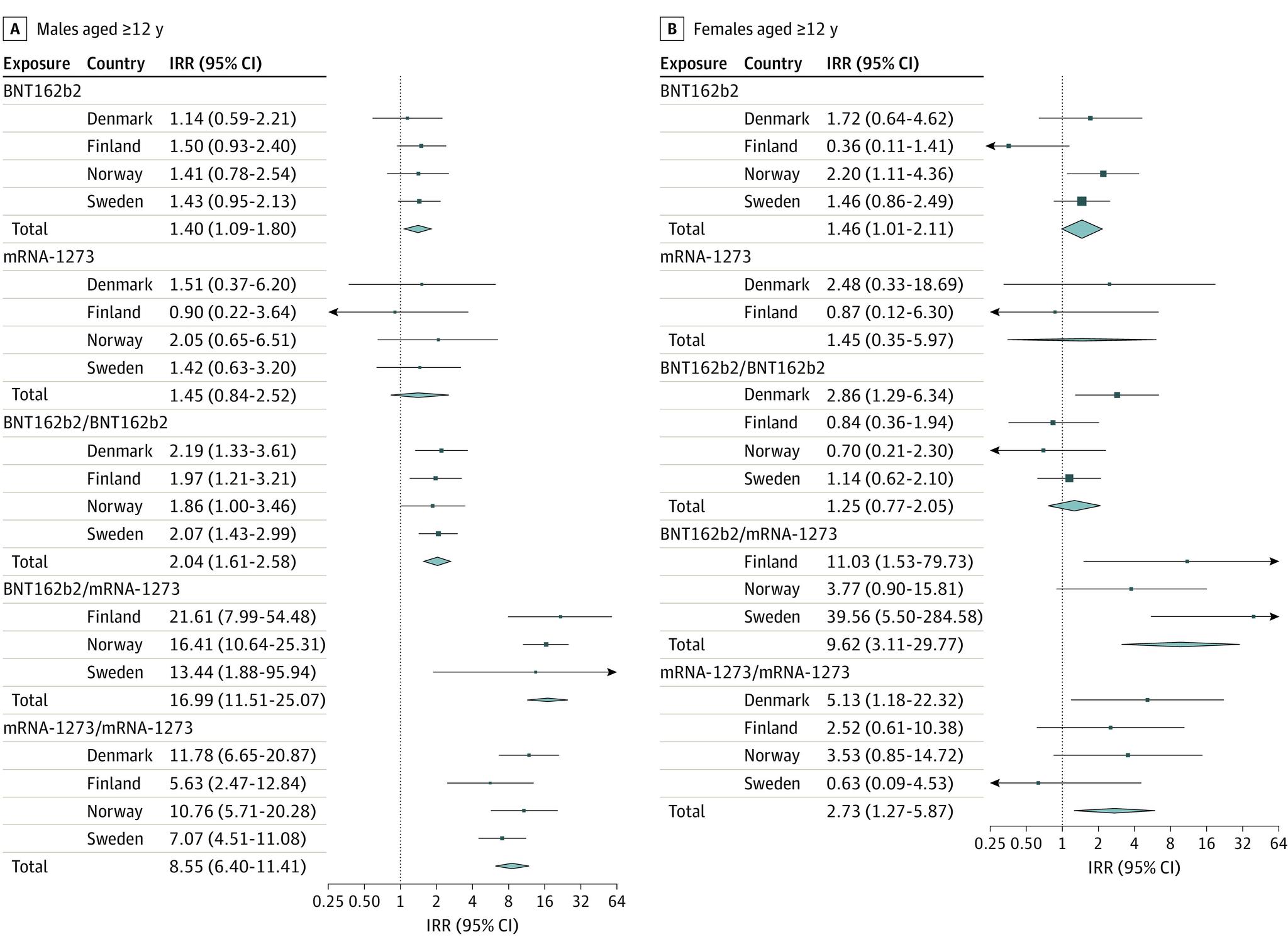
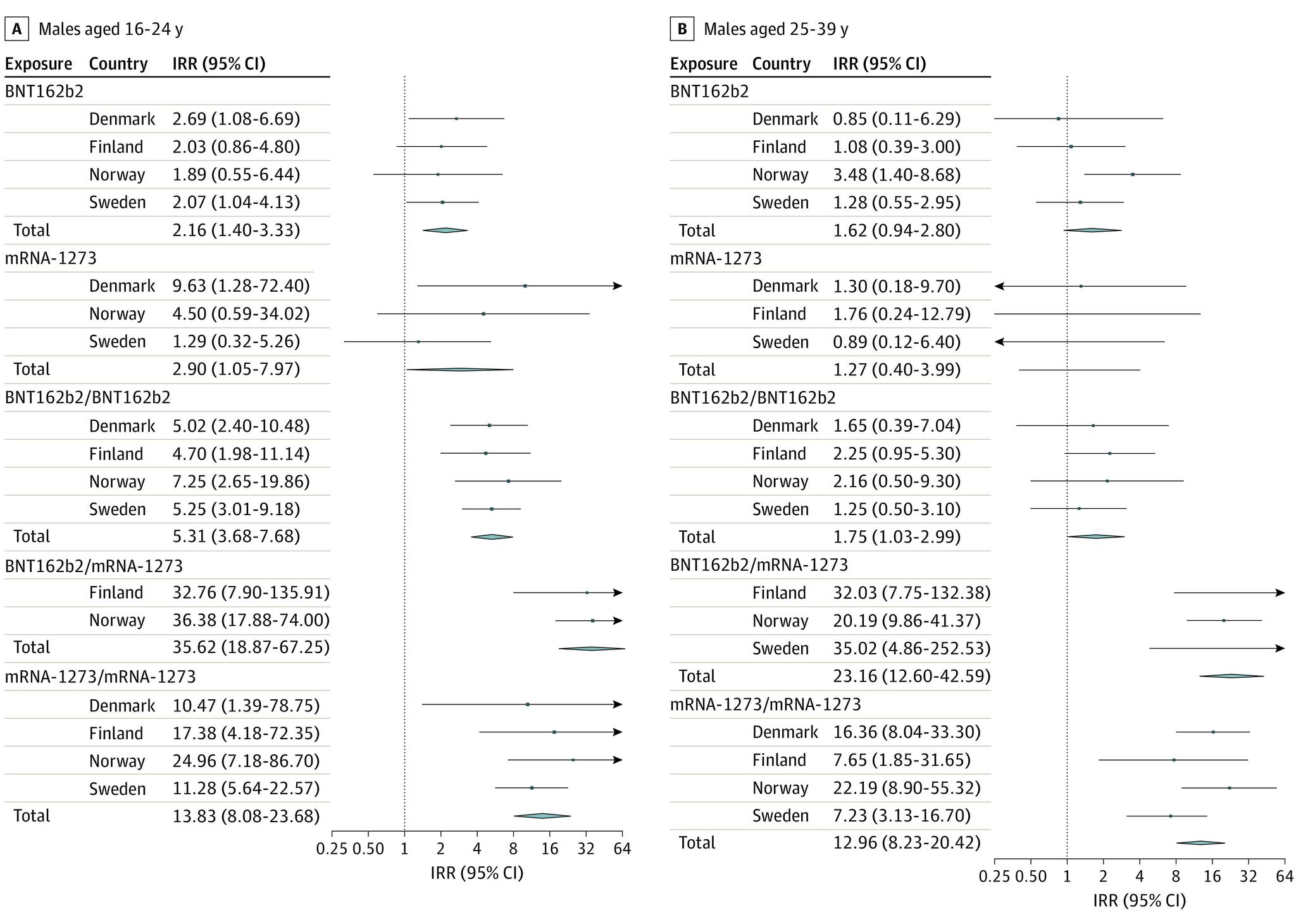
Among 23 122 522 Nordic residents (81% vaccinated by study end; 50.2% female), 1077 incident myocarditis events and 1149 incident pericarditis events were identified. Within the 28-day period, for males and females 12 years or older combined who received a homologous schedule, the second dose was associated with higher risk of myocarditis, with adjusted IRRs of 1.75 (95% CI, 1.43-2.14) for BNT162b2 and 6.57 (95% CI, 4.64-9.28) for mRNA-1273. Among males 16 to 24 years of age, adjusted IRRs were 5.31 (95% CI, 3.68-7.68) for a second dose of BNT162b2 and 13.83 (95% CI, 8.08-23.68) for a second dose of mRNA-1273, and numbers of excess events were 5.55 (95% CI, 3.70-7.39) events per 100 000 vaccinees after the second dose of BNT162b2 and 18.39 (9.05-27.72) events per 100 000 vaccinees after the second dose of mRNA-1273. Estimates for pericarditis were similar.
CONCLUSIONS AND RELEVANCE
Results of this large cohort study indicated that both first and second doses of mRNA vaccines were associated with increased risk of myocarditis and pericarditis. For individuals receiving 2 doses of the same vaccine, risk of myocarditis was highest among young males (aged 16-24 years) after the second dose. These findings are compatible with between 4 and 7 excess events in 28 days per 100 000 vaccinees after BNT162b2, and between 9 and 28 excess events per 100 000 vaccinees after mRNA-1273. This risk should be balanced against the benefits of protecting against severe COVID-19 disease.
重要性
在接种 SARS-CoV-2 信使 RNA(mRNA)疫苗后,出现了心肌炎的报告。
目的
通过疫苗产品、接种剂量数、性别和年龄评估 SARS-CoV-2 疫苗接种后心肌炎和心包炎的风险。
设计、设置和参与者:根据一个共同的方案进行了四项队列研究,结果通过荟萃分析进行了合并。参与者为 23122522 名年龄在 12 岁或以上的居民。从 2020 年 12 月 27 日开始对他们进行随访,直到出现心肌炎或心包炎的事件、随访结束或研究结束(2021 年 10 月 5 日)。丹麦、芬兰、挪威和瑞典的全国卫生登记处获取了与 SARS-CoV-2 疫苗接种、医院诊断的心肌炎或心包炎以及参与者的协变量相关的数据。
暴露
接种第一剂和第二剂 SARS-CoV-2 疫苗后 28 天的风险期,包括 BNT162b2、mRNA-1273 和 AZD1222 或其组合。同源方案定义为第 1 剂和第 2 剂使用相同的疫苗类型。
主要结果和测量
定义首次住院事件为 2020 年 12 月 27 日以后,根据主要或次要出院诊断为心肌炎或心包炎的首次住院入院日期。次要结果是来自住院或门诊医疗的心肌炎或心包炎的合并症。泊松回归得出了调整后的发病率比值比(IRR)和 95%置信区间(CI),比较了疫苗接种后 28 天内的心肌炎或心包炎发生率与未接种疫苗者的发生率。
结果
在 23122522 名北欧居民中(81%在研究结束时接种疫苗;50.2%为女性),发现 1077 例心肌炎事件和 1149 例心包炎事件。在 12 岁或以上的男性和女性中,对于接受同源方案的人,第二剂疫苗与更高的心肌炎风险相关,BNT162b2 的调整后的 IRR 为 1.75(95%CI,1.43-2.14),mRNA-1273 的为 6.57(95%CI,4.64-9.28)。在 16 至 24 岁的男性中,BNT162b2 第二剂的调整后的 IRR 为 5.31(95%CI,3.68-7.68),mRNA-1273 的为 13.83(95%CI,8.08-23.68),第二剂疫苗后每 100000 名接种者的超额事件数分别为 5.55(95%CI,3.70-7.39)和 18.39(9.05-27.72)。心包炎的估计值相似。
结论和相关性
这项大型队列研究的结果表明,mRNA 疫苗的第一剂和第二剂都与心肌炎和心包炎的风险增加有关。对于接受同种疫苗 2 剂的人,第二剂后年轻男性(16-24 岁)的心肌炎风险最高。这些发现与每 100000 名接种者在接种 BNT162b2 后 28 天内发生 4 至 7 例超额事件和接种 mRNA-1273 后发生 9 至 28 例超额事件相吻合。这种风险应该与保护免受严重 COVID-19 疾病的益处相平衡。

 Zotero 插件