
非药物干预措施对新冠病毒疾病死亡率的影响:一项涵盖169个国家的广义合成对照法研究
The Effects of Non-pharmaceutical Interventions on COVID-19 Mortality: A Generalized Synthetic Control Approach Across 169 Countries.
作者信息
Mader Sebastian, Rüttenauer Tobias
机构信息
Institute of Sociology, University of Bern, Bern, Switzerland.
Nuffield College, University of Oxford, Oxford, United Kingdom.
出版信息
Front Public Health. 2022 Apr 4;10:820642. doi: 10.3389/fpubh.2022.820642. eCollection 2022.
IMPORTANCE
Governments have introduced non-pharmaceutical interventions (NPIs) in response to the pandemic outbreak of Coronavirus disease (COVID-19). While NPIs aim at preventing fatalities related to COVID-19, the previous literature on their efficacy has focused on infections and on data of the first half of 2020. Still, findings of early NPI studies may be subject to underreporting and missing timeliness of reporting of cases. Moreover, the low variation in treatment timing during the first wave makes identification of robust treatment effects difficult.
OBJECTIVE
We enhance the literature on the effectiveness of NPIs with respect to the period, the number of countries, and the analytical approach.
DESIGN SETTING AND PARTICIPANTS
To circumvent problems of reporting and treatment variation, we analyse data on daily confirmed COVID-19-related deaths per capita from Our World in Data, and on 10 different NPIs from the Oxford COVID-19 Government Response Tracker (OxCGRT) for 169 countries from 1st July 2020 to 1st September 2021. To identify the causal effects of introducing NPIs on COVID-19-related fatalities, we apply the generalized synthetic control (GSC) method to each NPI, while controlling for the remaining NPIs, weather conditions, vaccinations, and NPI-residualized COVID-19 cases. This mitigates the influence of selection into treatment and allows to model flexible post-treatment trajectories.
RESULTS
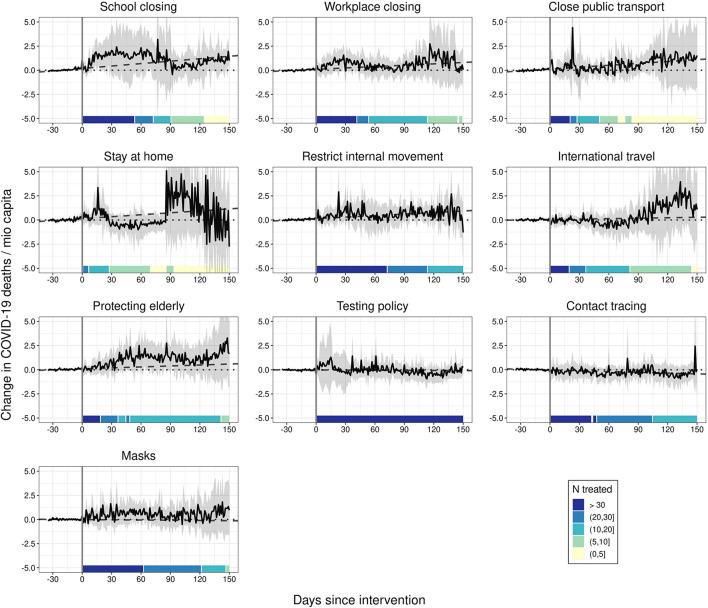
We do not find substantial and consistent COVID-19-related fatality-reducing effects of any NPI under investigation. We see a tentative change in the trend of COVID-19-related deaths around 30 days after strict stay-at-home rules and to a slighter extent after workplace closings have been implemented. As a proof of concept, our model is able to identify a fatality-reducing effect of COVID-19 vaccinations. Furthermore, our results are robust with respect to various crucial sensitivity checks.
CONCLUSION
Our results demonstrate that many implemented NPIs may not have exerted a significant COVID-19-related fatality-reducing effect. However, NPIs might have contributed to mitigate COVID-19-related fatalities by preventing exponential growth in deaths. Moreover, vaccinations were effective in reducing COVID-19-related deaths.
重要性
各国政府已采取非药物干预措施(NPIs)应对冠状病毒病(COVID-19)的大流行爆发。虽然非药物干预措施旨在预防与COVID-19相关的死亡,但先前关于其有效性的文献主要集中在感染情况以及2020年上半年的数据上。然而,早期非药物干预措施研究的结果可能存在报告不足和病例报告及时性缺失的问题。此外,第一波疫情期间治疗时间差异较小,难以确定有力的治疗效果。
目的
我们从时间范围、国家数量和分析方法等方面丰富了关于非药物干预措施有效性的文献。
设计、背景和参与者:为规避报告和治疗差异问题,我们分析了“Our World in Data”中人均每日确诊的与COVID-19相关死亡数据,以及牛津COVID-19政府应对跟踪器(OxCGRT)中2020年7月1日至2021年9月1日期间169个国家的10种不同非药物干预措施数据。为确定实施非药物干预措施对与COVID-19相关死亡的因果效应,我们对每种非药物干预措施应用广义合成控制(GSC)方法,同时控制其余非药物干预措施、天气状况、疫苗接种情况以及经非药物干预措施调整后的COVID-19病例数。这减轻了治疗选择的影响,并允许对灵活的治疗后轨迹进行建模。
结果
我们未发现所调查的任何非药物干预措施对与COVID-19相关的死亡有显著且一致的减少作用。我们看到,在实施严格的居家规定约30天后,与COVID-19相关的死亡趋势出现了初步变化,在实施工作场所关闭措施后,这种变化程度稍小。作为概念验证,我们的模型能够识别出COVID-19疫苗接种的死亡减少效果。此外,我们的结果在各种关键敏感性检查中都很稳健。
结论
我们的结果表明,许多已实施的非药物干预措施可能并未对与COVID-19相关的死亡产生显著的减少作用。然而,非药物干预措施可能通过防止死亡人数呈指数增长,对减轻与COVID-19相关的死亡有所贡献。此外,疫苗接种在减少与COVID-19相关的死亡方面是有效的。

 Zotero 插件