
内生菌M2RT4诱导番茄植株中水杨酸甲酯和()-茉莉酮的系统释放,影响[某种昆虫,原文未明确]的寄主定位和取食。
The Endophyte M2RT4 Induces the Systemic Release of Methyl Salicylate and ()-jasmone in Tomato Plant Affecting Host Location and Herbivory of .
作者信息
Agbessenou Ayaovi, Akutse Komivi S, Yusuf Abdullahi A, Khamis Fathiya M
机构信息
International Centre of Insect Physiology and Ecology, Nairobi, Kenya.
Department of Zoology and Entomology, University of Pretoria, Hatfield, South Africa.
出版信息
Front Plant Sci. 2022 Apr 5;13:860309. doi: 10.3389/fpls.2022.860309. eCollection 2022.
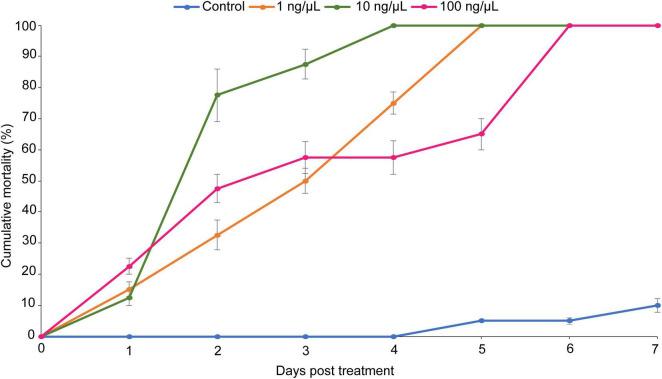
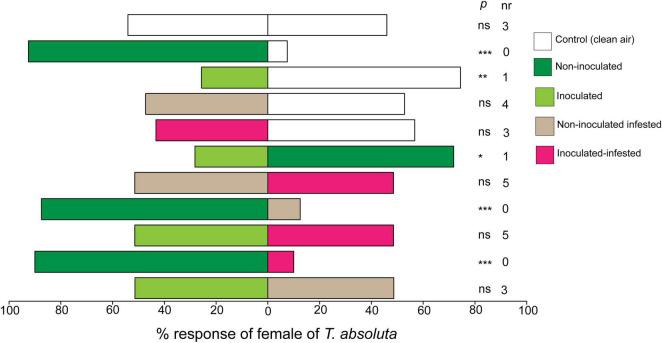
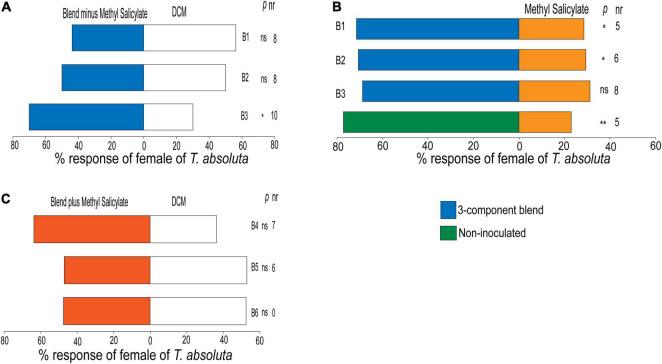
The use of endophytic fungi has dramatically increased plant performance through the enhancement of plant protection against abiotic and biotic stressors. We previously demonstrated that the endophytic fungus M2RT4 improves tomato defenses against the tomato leafminer through the reduction of oviposition, leafmining, pupation, and adult emergence. However, the underlying mechanism by which the presence of this endophytic fungus within tomato host plant affects host selection and life-history traits is unknown. We tested the behavioral responses of in Y-tube olfactometer bioassays and found that females preferred non-inoculated tomato plants against those inoculated by endophytes. Additionally, females were not attracted to non-inoculated infested nor to inoculated-infested tomato plants. Chemical analysis revealed the emission of methyl salicylate in inoculated tomato plant and an increase in the amounts of monoterpenes emitted from non-inoculated infested plants. Additionally, we found that upon herbivory, M2RT4 modulates tomato plant chemistry through the production of ()-jasmone thus activating both salicylic and jasmonic acid defense pathways. Further, females were attracted to monoterpernes including α-pinene, 2-carene, and β-phellandrene but repelled by methyl salicylate. Methyl salicylate could therefore be considered as a good semiochemical-based candidate for sustainable management using a "push-pull" approach. However, in dose-response bioassays, females of did not show any preference to the four component-blend (α-pinene, 2-carene, β-phellandrene, and methyl salicylate). ()-jasmone-treated tomato leaflets significantly reduced the leafmining activity of the pest at the concentration of 10 ng/μL and causing the highest larval mortality rate (83%) with the shortest LT (1.73 days) 7 days post-treatment. M2RT4 effect on herbivore performance was then ()-jasmone-mediated. These findings expand our understanding of how the endophytic fungus M2RT4 could mediate chemical interactions between and its host plant which are potentially important for development of environmentally friendly management programs.
内生真菌的使用通过增强植物对非生物和生物胁迫的保护作用,显著提高了植物的性能。我们之前证明,内生真菌M2RT4通过减少产卵、潜叶、化蛹和成虫羽化,提高了番茄对番茄潜叶蛾的防御能力。然而,这种内生真菌在番茄寄主植物中的存在影响寄主选择和生活史特征的潜在机制尚不清楚。我们在Y型管嗅觉仪生物测定中测试了其行为反应,发现雌虫更喜欢未接种内生真菌的番茄植株,而不是接种了内生真菌的植株。此外,雌虫对未接种且受侵染的番茄植株以及接种且受侵染的番茄植株均无吸引力。化学分析表明,接种内生真菌的番茄植株会释放水杨酸甲酯,未接种但受侵染的植株释放的单萜类化合物数量增加。此外,我们发现,在受到食草动物侵害时,M2RT4通过产生()-茉莉酮调节番茄植株的化学成分,从而激活水杨酸和茉莉酸防御途径。此外,雌虫会被包括α-蒎烯、2-蒈烯和β-水芹烯在内的单萜类化合物吸引,但会被水杨酸甲酯排斥。因此,水杨酸甲酯可被视为一种基于信息素的良好候选物,用于采用“推拉”方法进行可持续管理。然而,在剂量反应生物测定中,该虫的雌虫对四种成分混合物(α-蒎烯、2-蒈烯、β-水芹烯和水杨酸甲酯)没有表现出任何偏好。在10 ng/μL的浓度下,用()-茉莉酮处理的番茄小叶显著降低了害虫的潜叶活动,并在处理7天后导致最高的幼虫死亡率(83%)和最短的幼虫期(1.73天)。M2RT4对食草动物性能的影响是由()-茉莉酮介导的。这些发现扩展了我们对内生真菌M2RT4如何介导其与寄主植物之间化学相互作用的理解,这对制定环境友好型管理方案可能具有重要意义。


 Zotero 插件