
骨质疏松症的筛查和管理:马来西亚初级保健医生知识、态度和实践的调查。
Screening and management of osteoporosis: a survey of knowledge, attitude and practice among primary care physicians in Malaysia.
机构信息
Simpang Health Clinic, Health District Office of Larut, Matang and Selama, Ministry of Health Malaysia, Perak, Malaysia.
Department of Primary Care Medicine, Faculty of Medicine, Universiti Malaya, Kuala Lumpur, Malaysia.
出版信息
Arch Osteoporos. 2022 Apr 26;17(1):72. doi: 10.1007/s11657-022-01111-y.
UNLABELLED
We surveyed primary care physicians in Malaysia for their knowledge, attitude and practice in screening and managing osteoporosis. We found a low level of screening and active management of osteoporosis in the primary care setting despite positive attitudes towards them. We advocate for the active management of osteoporosis at the primary care level.
INTRODUCTION
Prevention of osteoporotic fracture is important in primary healthcare for healthy ageing. Little is known about the knowledge, attitude, practice and barriers in the screening and managing osteoporosis among primary care doctors.
METHODS
A cross-sectional study, using an online pre-tested questionnaire after face and content validation, was conducted for primary care doctors from 1 June to 30 July 2021 across Malaysia. Pearson's chi-square test and logistic regression were employed.
RESULTS
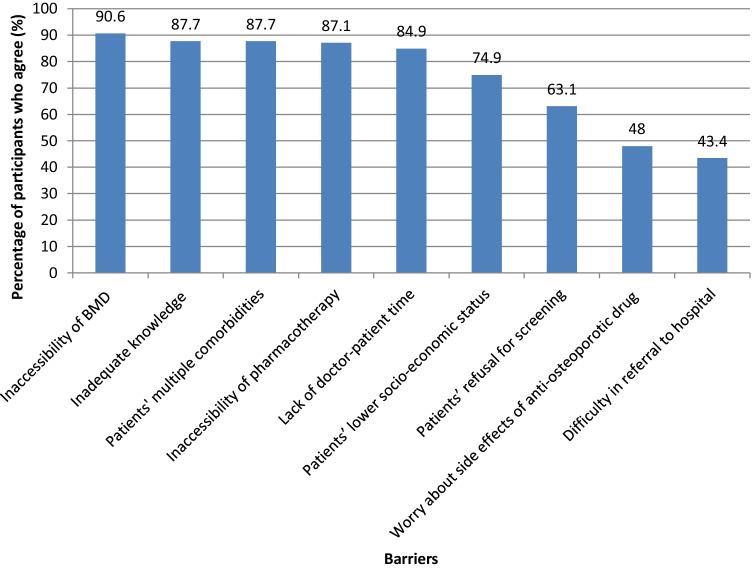
A total of 350 primary care doctors in Malaysia, consisting of 113 (32.3%) family medicine specialists (FMS) and 237 (67.7%) medical officers, participated in this study. The mean ± SD score of osteoporosis knowledge was 50.46 ± 15.09 with minimum and maximum values of 0 and 83.64%, respectively. One hundred and ten (31.4%) respondents achieved a satisfactory overall knowledge score of ≥ 60%, 156 (44.6%) were confident in advising patients for initiation of anti-osteoporotic medication, and 243 (69.4%) perceived that bisphosphonate should be made available in health clinics. Only 97 (27.7%) practised osteoporosis screening. Inaccessibility of bone mineral densitometry (BMD) (90.6%), inadequate knowledge (87.7%) and inaccessibility of pharmacotherapy (87.1%) are perceived modifiable barriers to osteoporosis screening and management. Factors associated with a satisfactory knowledge of osteoporosis are designation as a family medicine specialist (AOR 3.034, p = 0.002), attendance at an osteoporosis management update course (AOR 2.095, p = 0.034) and the practice of osteoporosis screening for the elderly (AOR 2.767, p = 0.001).
CONCLUSION
Given the insufficient knowledge and low level of osteoporosis screening, there is a need for a national structured health programme to address the knowledge gap, increase screening practices and enhance accessibility to BMD and anti-osteoporosis medication in primary care.
目的
调查马来西亚基层医疗医生在骨质疏松症筛查和管理方面的知识、态度和实践情况。方法:采用在线预测试问卷,对 2021 年 6 月 1 日至 7 月 30 日期间马来西亚的基层医疗医生进行横断面研究。采用 Pearson χ²检验和逻辑回归进行分析。结果:共有 350 名马来西亚基层医疗医生参与了这项研究,其中 113 名(32.3%)为家庭医学专家,237 名(67.7%)为医疗官。骨质疏松症知识平均得分为 50.46±15.09,最低值和最高值分别为 0 和 83.64%。110 名(31.4%)受访者的总体知识得分达到了≥60%,156 名(44.6%)有信心为患者开始使用抗骨质疏松药物,243 名(69.4%)认为双膦酸盐应该在诊所提供。只有 97 名(27.7%)进行了骨质疏松症筛查。骨密度(BMD)检测不可及(90.6%)、知识不足(87.7%)和药物不可及(87.1%)被认为是骨质疏松症筛查和管理的可改变障碍。与骨质疏松症知识满意度相关的因素包括被指定为家庭医学专家(优势比 3.034,p=0.002)、参加骨质疏松症管理更新课程(优势比 2.095,p=0.034)和为老年人进行骨质疏松症筛查(优势比 2.767,p=0.001)。结论:鉴于骨质疏松症知识不足和筛查水平低,需要制定一个全国性的结构化健康计划,以解决知识差距,增加筛查实践,并提高基层医疗中 BMD 和抗骨质疏松药物的可及性。
 Zotero 插件