
超声微泡介导的靶向WNT1诱导信号通路蛋白1(WISP1)的RNA干扰抑制乳腺癌细胞的增殖和转移。
Ultrasound microbubble-mediated RNA interference targeting WNT1 inducible signaling pathway protein 1(WISP1) suppresses the proliferation and metastasis of breast cancer cells.
作者信息
Fang Faying, Xu Weizhi, Zhang Jian, Gu Jin, Yang Gaoyi
机构信息
Department of Special Examination, Maternal and Child Health Hospital of Chun'an County, Hangzhou, Zhejiang, China.
Department of Ultrasound, Sanmen People's Hospital, Taizhou, Zhejiang, China.
出版信息
Bioengineered. 2022 Apr;13(4):11050-11060. doi: 10.1080/21655979.2022.2068738.
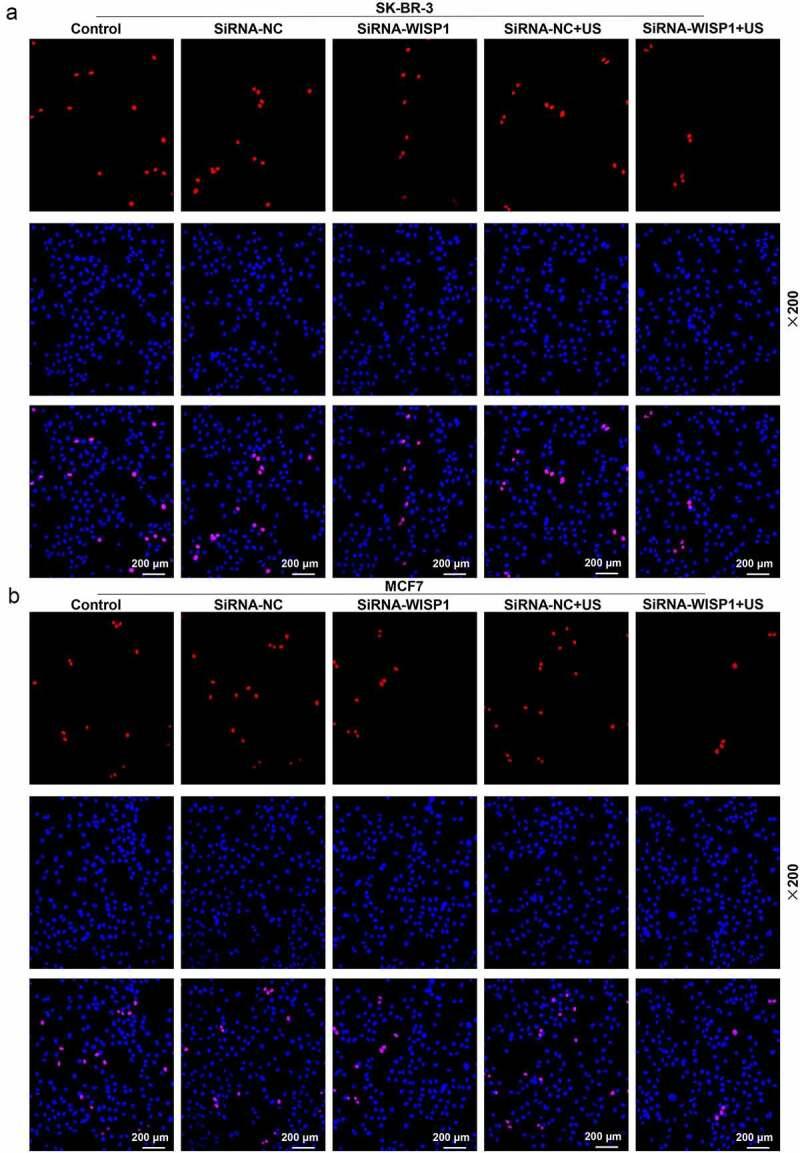
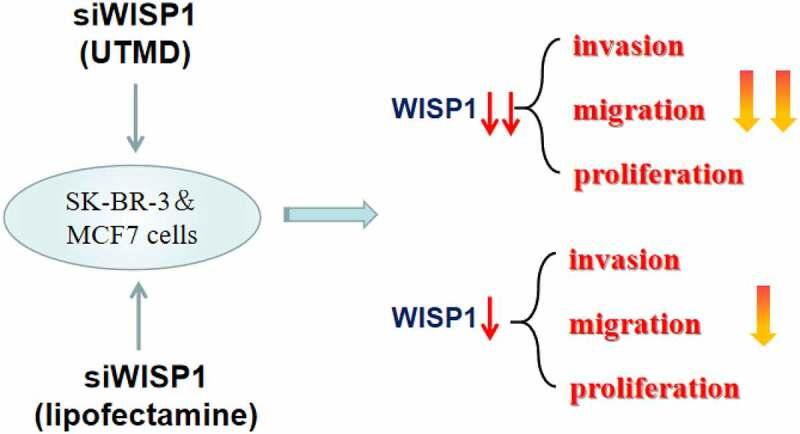
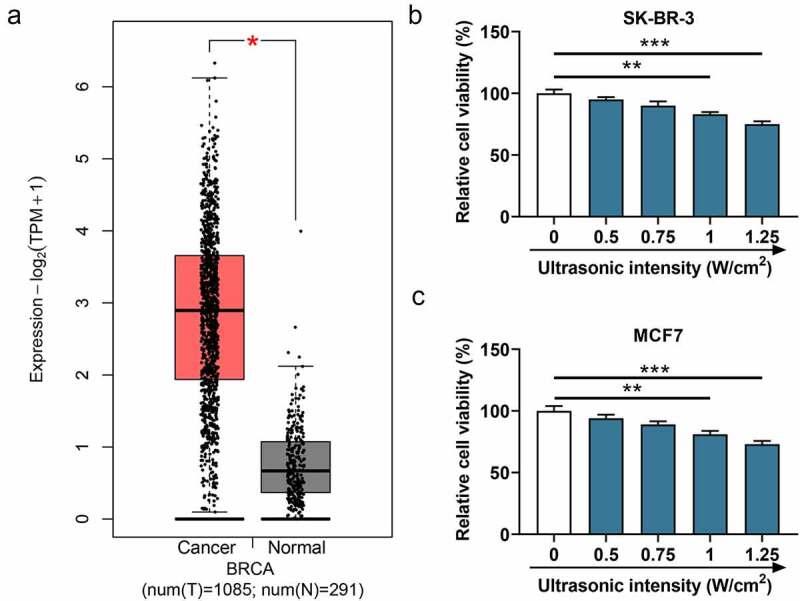
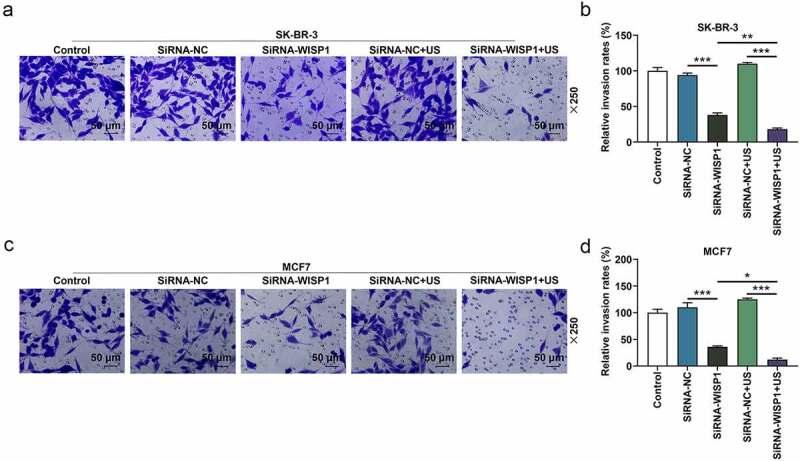
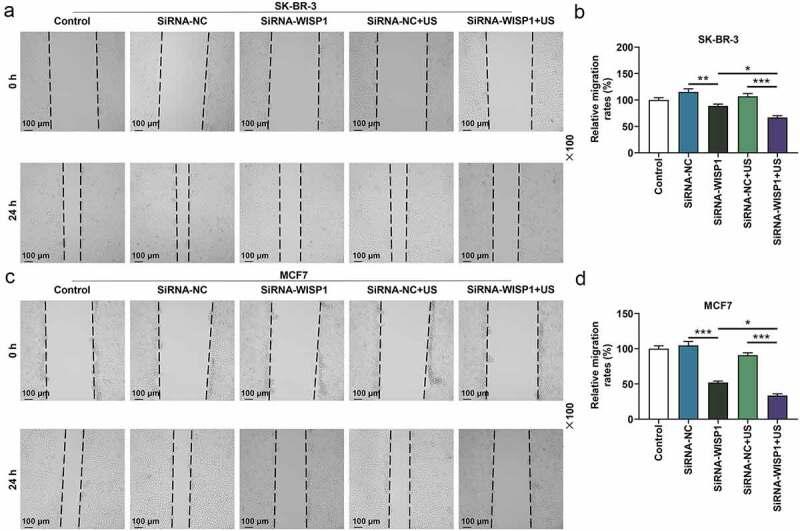
In the context of relatively sufficient research that annotated WNT1 inducible signaling pathway protein 1 (WISP1) as a promoting factor in tumor progression of breast cancer, and identified the effects of ultrasound microbubble technology on enhancing the transfection efficiency and achieving better gene interference, this study managed to investigate the effects of ultrasound microbubble-mediated siWISP1 transfection on proliferation and metastasis of breast cancer cells. To achieve our research objectives, the expression of WISP1 in breast cancer tissues was retrieved from GEPIA website, and the viability of breast cancer cells (SK-BR-3 and MCF7) was assessed by 3-(4,5-dimethylthiazol-2-yl)-2,5-diphenyltetrazolium bromide (MTT) assay for ultrasound intensity screening. After the transfection of siWISP1 by ultrasound microbubble or lipofectamine 6000, the content of WISP1 secreted by cells was detected through Enzyme-linked immunosorbent assay (ELISA), and WISP1 expression in cells was determined by quantitative reverse transcription polymerase-chain reaction (qRT-PCR). Besides, the cell invasion, migration, and proliferation were evaluated by wound healing, transwell, and EdU assays, respectively. In accordance with experimental results, WISP1 was highly expressed in breast cancer tissues, and the 1 W/cm intensity was the onset of a notable decrease in cell viability. Compared with lipofectamine 6000 transfection, the transfection of siWISP1 mediated by ultrasound microbubble further reduced the expression of WISP1, and meanwhile suppressed cell invasion, migration, and proliferation. Collectively, ultrasound microbubble-mediated transfection of siWISP1 worked rather effectively in improving transfection efficiency and inhibiting the progression of breast cancer.
在有相对充分研究将WNT1诱导信号通路蛋白1(WISP1)注释为乳腺癌肿瘤进展促进因子,并确定了超声微泡技术对提高转染效率和实现更好基因干扰效果的背景下,本研究旨在探讨超声微泡介导的siWISP1转染对乳腺癌细胞增殖和转移的影响。为实现我们的研究目标,从GEPIA网站检索乳腺癌组织中WISP1的表达,并通过3-(4,5-二甲基噻唑-2-基)-2,5-二苯基四氮唑溴盐(MTT)法评估乳腺癌细胞(SK-BR-3和MCF7)的活力以进行超声强度筛选。在通过超声微泡或脂质体6000转染siWISP1后,通过酶联免疫吸附测定(ELISA)检测细胞分泌的WISP1含量,并通过定量逆转录聚合酶链反应(qRT-PCR)测定细胞中WISP1的表达。此外,分别通过伤口愈合、Transwell和EdU测定评估细胞侵袭、迁移和增殖。根据实验结果,WISP1在乳腺癌组织中高表达,且1W/cm强度是细胞活力显著下降的起始点。与脂质体6000转染相比,超声微泡介导的siWISP1转染进一步降低了WISP1的表达,同时抑制了细胞侵袭、迁移和增殖。总体而言,超声微泡介导的siWISP1转染在提高转染效率和抑制乳腺癌进展方面效果显著。

 Zotero 插件