
一项针对 COVID-19 后持续症状患者的在线呼吸与健康计划(ENO Breathe):一项平行组、单盲、随机对照试验。
An online breathing and wellbeing programme (ENO Breathe) for people with persistent symptoms following COVID-19: a parallel-group, single-blind, randomised controlled trial.
机构信息
National Heart and Lung Institute, Imperial College London, London, UK; National Institute for Health Research Imperial Biomedical Research Centre, Imperial College London, London, UK.
National Heart and Lung Institute, Imperial College London, London, UK; Respiratory Medicine, Imperial College Healthcare NHS Trust, London, UK.
出版信息
Lancet Respir Med. 2022 Sep;10(9):851-862. doi: 10.1016/S2213-2600(22)00125-4. Epub 2022 Apr 27.
BACKGROUND
There are few evidence-based interventions for long COVID; however, holistic approaches supporting recovery are advocated. We assessed whether an online breathing and wellbeing programme improves health related quality-of-life (HRQoL) in people with persisting breathlessness following COVID-19.
METHODS
We conducted a parallel-group, single-blind, randomised controlled trial in patients who had been referred from one of 51 UK-based collaborating long COVID clinics. Eligible participants were aged 18 years or older; were recovering from COVID-19 with ongoing breathlessness, with or without anxiety, at least 4 weeks after symptom onset; had internet access with an appropriate device; and were deemed clinically suitable for participation by one of the collaborating COVID-19 clinics. Following clinical assessment, potential participants were given a unique online portal code. Participants were randomly assigned (1:1) to either immediate participation in the English National Opera (ENO) Breathe programme or to usual care. Randomisation was done by the research team using computer-generated block randomisation lists, with block size 10. The researcher responsible for randomisation was masked to responses. Participants in the ENO Breathe group participated in a 6-week online breathing and wellbeing programme, developed for people with long COVID experiencing breathlessness, focusing on breathing retraining using singing techniques. Those in the deferred group received usual care until they exited the trial. The primary outcome, assessed in the intention-to-treat population, was change in HRQoL, assessed using the RAND 36-item short form survey instrument mental health composite (MHC) and physical health composite (PHC) scores. Secondary outcome measures were the chronic obstructive pulmonary disease assessment test score, visual analogue scales (VAS) for breathlessness, and scores on the dyspnoea-12, the generalised anxiety disorder 7-item scale, and the short form-6D. A thematic analysis exploring participant experience was also conducted using qualitative data from focus groups, survey responses, and email correspondence. This trial is registered with ClinicalTrials.gov, NCT04830033.
FINDINGS
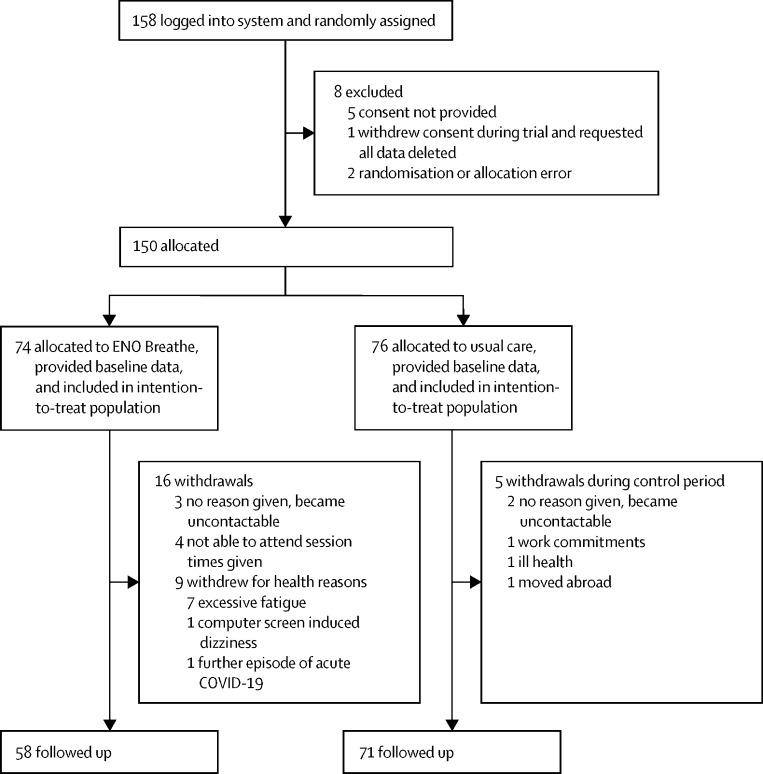
Between April 22 and May 25, 2021, 158 participants were recruited and randomly assigned. Of these, eight (5%) individuals were excluded and 150 participants were allocated to a treatment group (74 in the ENO Breathe group and 76 in the usual care group). Compared with usual care, ENO Breathe was associated with an improvement in MHC score (regression coefficient 2·42 [95% CI 0·03 to 4·80]; p=0·047), but not PHC score (0·60 [-1·33 to 2·52]; p=0·54). VAS for breathlessness (running) favoured ENO Breathe participation (-10·48 [-17·23 to -3·73]; p=0·0026). No other statistically significant between-group differences in secondary outcomes were observed. One minor self-limiting adverse event was reported by a participant in the ENO Breathe group who felt dizzy using a computer for extended periods. Thematic analysis of ENO Breathe participant experience identified three key themes: (1) improvements in symptoms; (2) feeling that the programme was complementary to standard care; and (3) the particular suitability of singing and music to address their needs.
INTERPRETATION
Our findings suggest that an online breathing and wellbeing programme can improve the mental component of HRQoL and elements of breathlessness in people with persisting symptoms after COVID-19. Mind-body and music-based approaches, including practical, enjoyable, symptom-management techniques might have a role supporting recovery.
FUNDING
Imperial College London.
背景
针对长新冠,目前几乎没有循证干预措施;然而,提倡采用整体方法来支持康复。我们评估了一种在线呼吸和健康计划是否可以改善 COVID-19 后持续呼吸困难患者的健康相关生活质量(HRQoL)。
方法
我们在英国 51 家合作的长新冠诊所之一转诊的患者中进行了一项平行组、单盲、随机对照试验。符合条件的参与者年龄在 18 岁或以上;从 COVID-19 中康复,症状出现后至少 4 周仍有持续性呼吸困难,伴有或不伴有焦虑;有适当设备的互联网接入;并且被其中一家合作的 COVID-19 诊所认为临床适合参加。经过临床评估后,潜在参与者会获得一个独特的在线门户代码。参与者被随机分配(1:1)至立即参加英国国家歌剧院(ENO)呼吸计划或接受常规护理。随机化由研究团队使用计算机生成的块随机分组列表进行,分组大小为 10。负责随机分组的研究人员对反应进行了屏蔽。参加 ENO 呼吸计划组的参与者参加了一个为期 6 周的在线呼吸和健康计划,专为患有长新冠并出现呼吸困难的患者设计,重点是使用唱歌技巧进行呼吸训练。延迟组在退出试验之前接受常规护理。主要结局是使用 RAND 36 项简短形式调查工具心理健康综合评分(MHC)和生理健康综合评分(PHC)评估的 HRQoL 变化,在意向治疗人群中进行评估。次要结局测量指标是慢性阻塞性肺疾病评估测试评分、呼吸困难的视觉模拟量表(VAS)以及呼吸困难-12 评分、广泛性焦虑症 7 项量表评分和简短形式-6D 评分。还使用焦点小组、调查回复和电子邮件往来的定性数据进行了探索参与者体验的主题分析。这项试验在 ClinicalTrials.gov 上注册,编号为 NCT04830033。
发现
在 2021 年 4 月 22 日至 5 月 25 日期间,招募了 158 名参与者并进行了随机分配。其中,有 8 名(5%)个体被排除,150 名参与者被分配到治疗组(74 名参加 ENO 呼吸计划组,76 名参加常规护理组)。与常规护理相比,ENO 呼吸计划与 MHC 评分的改善相关(回归系数 2.42 [95%CI 0.03 至 4.80];p=0.047),但与 PHC 评分无关(0.60 [-1.33 至 2.52];p=0.54)。VAS 呼吸困难(跑步)有利于 ENO 呼吸计划的参与(-10.48 [-17.23 至 -3.73];p=0.0026)。没有观察到其他次要结局在组间有统计学意义的差异。ENO 呼吸计划组的一名参与者报告了一例轻微的自限性不良事件,该参与者在使用计算机时感到头晕。对 ENO 呼吸计划参与者体验的主题分析确定了三个关键主题:(1)症状改善;(2)感觉该计划是对标准护理的补充;(3)唱歌和音乐特别适合满足他们的需求。
解释
我们的研究结果表明,一种在线呼吸和健康计划可以改善 COVID-19 后持续症状患者的心理健康成分和呼吸困难的一些方面。身心和基于音乐的方法,包括实用、愉快、症状管理技术,可能在支持康复方面发挥作用。
资金
伦敦帝国理工学院。

 Zotero 插件