
使用近似熵来表征新冠病毒急性后遗症中出现的呼吸功能障碍。
Characterising dysfunctional breathing seen in post-acute sequelae of SARS-CoV-2 using approximate entropy.
作者信息
Eschbach Erin, Natelson Benjamin H, Mancini Donna M, Cook Dane B, Rurak Kevin, Miranda Melissa, Oppenheimer Beno W, Rapoport David M, Parekh Ankit
机构信息
Icahn School of Medicine at Mount Sinai, Department of Pulmonary, Critical Care, and Sleep Medicine, New York, NY, USA.
Icahn School of Medicine, Department of Neurology, New York, NY, USA.
出版信息
ERJ Open Res. 2025 Jun 2;11(3). doi: 10.1183/23120541.00652-2024. eCollection 2025 May.
RATIONALE
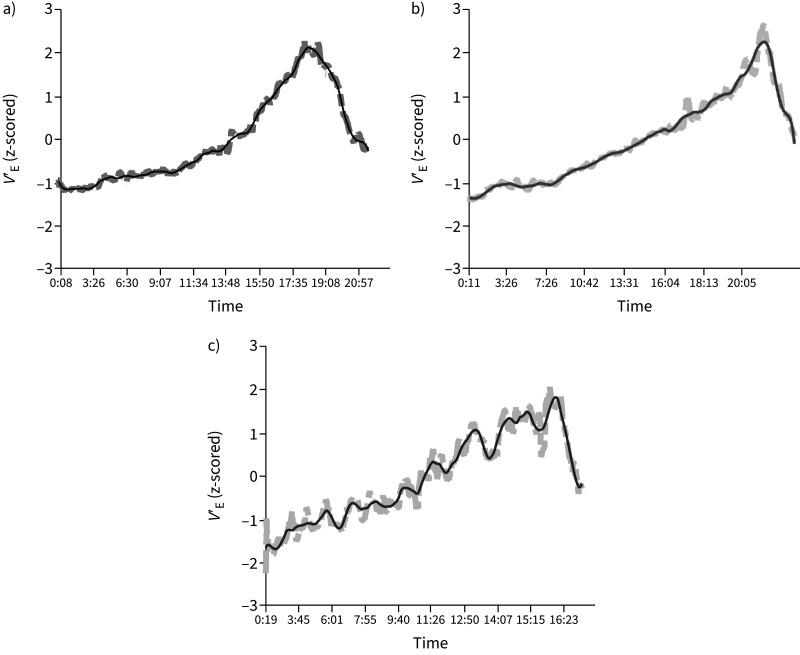
Dysfunctional breathing (DB) is a commonly identified abnormality in post-acute sequelae of SARS-CoV-2 (PASC) patients undergoing cardiopulmonary exercise testing (CPET), and is potentially a contributor to ongoing symptoms. Currently, this oscillating, irregular breathing pattern is identified by visual observation of CPET data by an experienced interpreter, which is subjective. We hypothesise that approximate entropy (ApEn), a regularity statistic that quantifies the unpredictability of time-series data can reliably distinguish DB from normal breathing states.
METHODS
Breath-by-breath CPET data were obtained for 82 PASC subjects and 25 controls. CPETs were visually analysed for DB prior to analysis. Minute ventilation ('), tidal volume ( ) and breathing frequency (BF) over time data were normalised with 100% considered as the ventilation at anaerobic threshold (AT) and detrended before ApEn was calculated. Analysis was initiated at 25 W and ceased at AT.
RESULTS
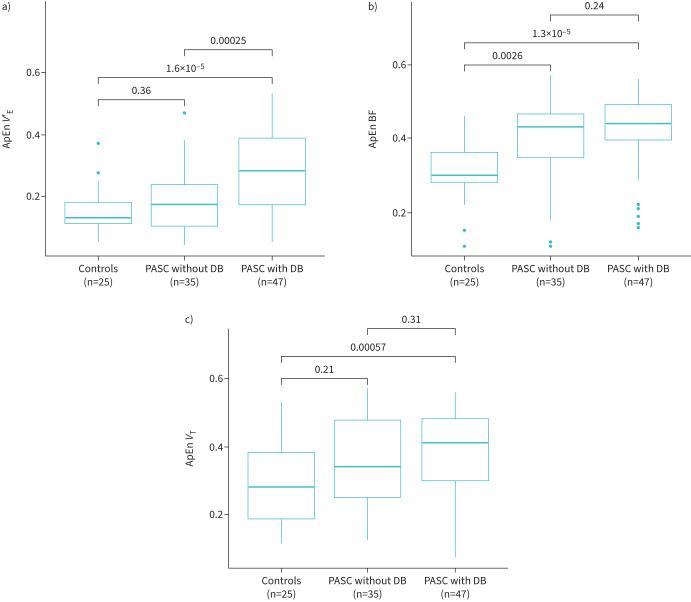
The ApEn ' of PASC subjects with visualised DB was 0.286±0.128 (mean±sd), which was significantly different from control subjects (0.143±0.081) and PASC subjects without visualised DB (0.183±0.104); p<0.05. Receiver operating characteristic curve analysis produced an optimal cut-off value of 0.17 for distinguishing DB, which resulted in a sensitivity of 81% and specificity of 72%. ApEn and ApEn BF were similar among all PASC patients despite visually recognised DB, but significantly greater than controls.
CONCLUSIONS
Identifying DB on CPET requires visual recognition, which has limitations. ApEn ' is an objective metric that can reliably differentiate DB from normal breathing patterns on CPET. This can be a valuable addition to keen visual scrutiny of CPET data.
理论依据
功能失调性呼吸(DB)是接受心肺运动试验(CPET)的新冠后遗症(PASC)患者中常见的异常情况,并且可能是导致持续症状的一个因素。目前,这种振荡、不规则的呼吸模式是由经验丰富的解读人员通过视觉观察CPET数据来识别的,这具有主观性。我们假设近似熵(ApEn),一种量化时间序列数据不可预测性的规律性统计量,能够可靠地将DB与正常呼吸状态区分开来。
方法
获取了82名PASC受试者和25名对照者的逐次呼吸CPET数据。在分析之前,对CPET进行了DB的视觉分析。随着时间推移的分钟通气量(')、潮气量( )和呼吸频率(BF)数据进行了归一化处理,将100%视为无氧阈(AT)时的通气量,并在计算ApEn之前进行去趋势处理。分析从25W开始,在AT时停止。
结果
有可视化DB的PASC受试者的ApEn '为0.286±0.128(平均值±标准差),这与对照受试者(0.143±0.081)和无可视化DB的PASC受试者(0.183±0.104)有显著差异;p<0.05。受试者工作特征曲线分析得出区分DB的最佳临界值为0.17,其灵敏度为81%,特异性为72%。尽管在视觉上识别出了DB,但所有PASC患者的ApEn 和ApEn BF相似,但显著高于对照者。
结论
在CPET上识别DB需要视觉识别,这存在局限性。ApEn '是一种客观指标,能够可靠地在CPET上将DB与正常呼吸模式区分开来。这可以成为对CPET数据进行敏锐视觉检查的有价值补充。

 Zotero 插件