
药师主导的心力衰竭诊所对指南导向的药物治疗优化的影响(PHARM-HF)。
Impact of Pharmacist-Led Heart Failure Clinic on Optimization of Guideline-Directed Medical Therapy (PHARM-HF).
机构信息
Salem Veterans Affair Medical Center, 1970 Roanoke Blvd., Salem, VA, 24153, USA.
出版信息
J Cardiovasc Transl Res. 2022 Dec;15(6):1424-1435. doi: 10.1007/s12265-022-10262-9. Epub 2022 May 2.
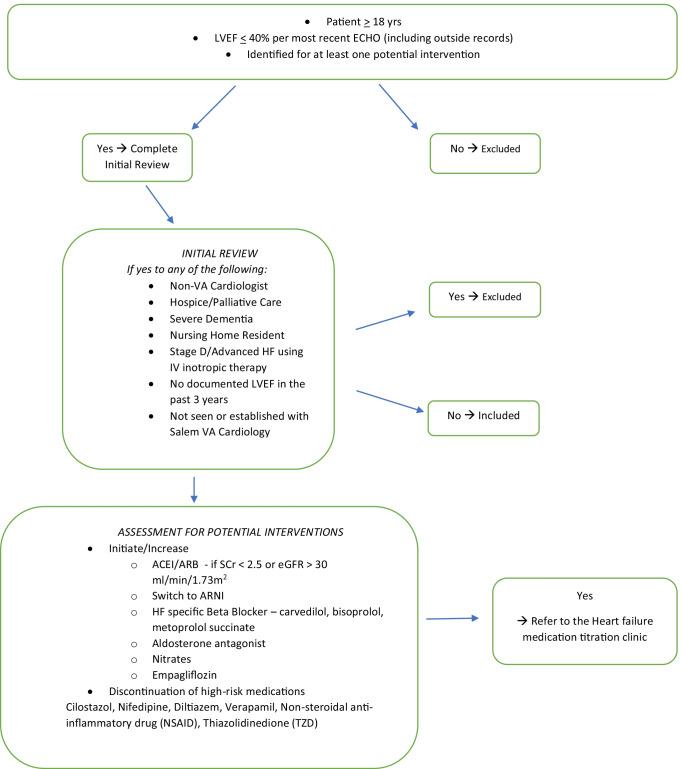
This prospective study included patients with heart failure (HF) with reduced ejection fraction (HFrEF) with LVEF < = 40% to evaluate the impact of pharmacist on guideline directed medical therapy (GDMT). The primary outcome was to compare proportion of triple GDMT achieved for Angiotensin-Converting-Enzyme-Inhibitors (ACEI)/Angiotensin-Receptor-Blockers (ARB)/Angiotensin-Receptor-Neprilysin-Inhibitors (ARNI), beta-blockers, aldosterone antagonists (AA), and quadruple GDMT which in additional to triple therapy, included Sodium glucose co-transporter 2 inhibitor (SGLT2i) at 90-day post-enrollment compared to baseline. Secondary endpoints included achieving target and/or maximally tolerated ACEI/ARB/ARNI and beta-blockers combined and individually as well as SGLT2i and AA GDMT at 90-day post-enrollment compared to baseline. We also compared combined and individual HF-related hospitalization/emergency room (ER) visits 90 days pre-/post-enrollment. Of the total 974 patients screened, 80 patients seen at least once in the heart failure medication titration clinic (HMTC) were included in the analysis. Median (IQR) age was 71 (57-69) years with majority white male. There was a significant improvement in the proportion of patients who achieved quadruple GDMT (p = 0.001) and triple GDMT (p-value = 0.020) at 90-day post-enrollment compared to baseline. The secondary GDMT outcomes were also significantly increased at 90 days post-enrollment compared to baseline. Significant difference in mean as well as proportion of combined HF-related hospitalization/ER-visits was found 90 days pre-/post-enrollment (p = 0.047). Our study found that pharmacist's intervention increased the proportion of patients who achieved GDMT at 90 days.
这项前瞻性研究纳入了射血分数降低的心力衰竭(HFrEF)患者(LVEF < = 40%),以评估药剂师对指南指导的药物治疗(GDMT)的影响。主要结局是比较在 90 天随访时达到 ACEI/ARB/ARNI、β受体阻滞剂、醛固酮拮抗剂(AA)和四重 GDMT 的患者比例,三重 GDMT 包括 ACEI/ARB/ARNI、β受体阻滞剂、醛固酮拮抗剂(AA)和 SGLT2i,与基线相比。次要终点包括在 90 天随访时与基线相比,达到 ACEI/ARB/ARNI 和β受体阻滞剂的目标和/或最大耐受剂量的总和和个体,以及 SGLT2i 和 AA 的 GDMT。我们还比较了 90 天随访前/后的 HF 相关住院/急诊室(ER)就诊的总和和个体。在总共筛选的 974 名患者中,有 80 名在心力衰竭药物滴定门诊(HMTC)至少就诊过一次,被纳入分析。中位数(IQR)年龄为 71(57-69)岁,大多数为白人男性。与基线相比,在 90 天随访时,达到四重 GDMT(p = 0.001)和三重 GDMT(p 值= 0.020)的患者比例显著增加。与基线相比,次要 GDMT 结局在 90 天随访时也显著增加。与基线相比,90 天随访前/后的 HF 相关住院/ER 就诊的平均和比例都有显著差异(p = 0.047)。我们的研究发现,药剂师的干预增加了 90 天内达到 GDMT 的患者比例。

 Zotero 插件