
由药剂师主导的心力衰竭指南指导药物治疗:基层医疗中的影响分析
Pharmacist-led guideline-directed medical therapy in heart failure: impact analysis in primary care.
作者信息
Schichtel Markus, Barclay Stephen, Papworth Helena, Mills Leila, Bowers Ben
机构信息
Department of Public Health and Primary Care, University of Cambridge, Cambridge, England, UK
Department of Public Health and Primary Care, University of Cambridge, Cambridge, England, UK.
出版信息
BMJ Open Qual. 2025 Sep 1;14(3):e003401. doi: 10.1136/bmjoq-2025-003401.
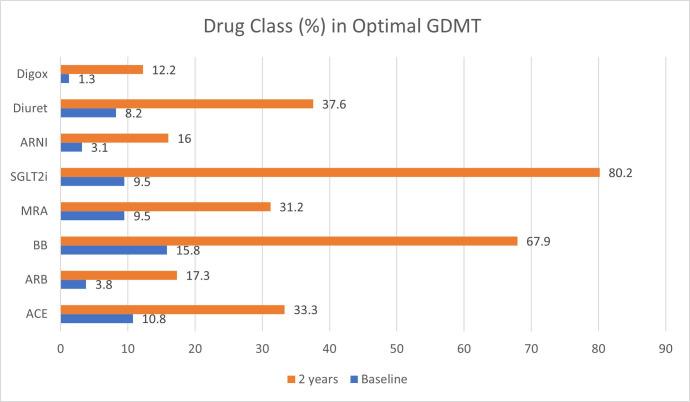
Optimal guideline-directed medical therapy (GDMT) can reduce mortality, unplanned hospital admissions and improve quality of life for patients suffering from heart failure (HF). However, GDMT remains underused in primary care. Only a minority of patients on HF registers receive optimal GDMT in the UK. This suboptimal care is compounded by a mounting lack of GP capacity and the growing burden of HF.A multisite, quantitative impact analysis was undertaken to evaluate the optimisation of HF patients by a novel pharmacist-led GDMT model in UK primary care.We identified low-risk HF patients suitable for pharmacists' input, including a community validated risk stratification tool-the HF Event STrengthening Score. The primary outcome was to compare the proportion of patients on optimal HF GDMT at 6 months and 2 years with baseline. Secondary outcomes were direct personnel healthcare costs and GP workload. A subgroup analysis was modelled to estimate effect on mortality, hospitalisation and quality of life.A total of 237 patients were included. Pharmacist-led GDMT contributed to the increase of optimal GDMT from 17.7% at baseline to 76.5% at 6 months and 94.5% at 2 years follow-up. The novel approach reduced GPs' HF GDMT workload by 36.6% at 6 months and 42.1% at 2 years and healthcare costs by 18.4% at 6 months and 20.3% at 2 years. Patients with combined angiotensin receptor neprilysin inhibitor/sodium glucose co-transporter 2 inhibitor treatment indicated a reduction of 20.8% in cardiovascular mortality, a reduction of 34.8% in hospitalisations and a 5.31 Kansas City Cardiomyopathy Questionnaire Score for improved quality of life at 2 years.For low-risk HF patients, pharmacist-led optimisation achieved significantly higher GDMT rates, reduced personnel healthcare costs, reduced GPs' workload, contributed to reduced cardiovascular mortality, reduced hospitalisations and improved quality of life. In the context of current workload pressures, this approach should be considered for widespread implementation in general practice.
优化的指南导向药物治疗(GDMT)可降低心力衰竭(HF)患者的死亡率、减少非计划住院次数,并改善其生活质量。然而,GDMT在基层医疗中仍未得到充分应用。在英国,只有少数登记患有HF的患者接受了优化的GDMT。这种不充分的治疗因全科医生(GP)能力的日益缺乏和HF负担的不断加重而变得更加复杂。
一项多中心定量影响分析旨在评估英国基层医疗中一种新型的由药剂师主导的GDMT模式对HF患者的优化效果。我们确定了适合药剂师参与的低风险HF患者,包括一种经社区验证的风险分层工具——HF事件强化评分。主要结果是比较6个月和2年时接受优化HF GDMT的患者比例与基线时的情况。次要结果是直接的人员医疗保健成本和GP工作量。进行了亚组分析以估计对死亡率、住院率和生活质量的影响。
总共纳入了237名患者。由药剂师主导的GDMT促使优化的GDMT比例从基线时的17.7%增加到6个月时的76.5%以及2年随访时的94.5%。这种新方法在6个月时将GP的HF GDMT工作量减少了36.6%,在2年时减少了42.1%,并在6个月时将医疗保健成本降低了18.4%,在2年时降低了20.3%。接受血管紧张素受体脑啡肽酶抑制剂/钠-葡萄糖协同转运蛋白2抑制剂联合治疗的患者在2年时心血管死亡率降低了20.8%,住院率降低了34.8%,堪萨斯城心肌病问卷评分提高了5.31分,生活质量得到改善。
对于低风险HF患者,由药剂师主导的优化实现了显著更高的GDMT率,降低了人员医疗保健成本,减轻了GP的工作量,有助于降低心血管死亡率、减少住院次数并改善生活质量。在当前工作量压力的背景下,应考虑在全科医疗中广泛实施这种方法。


 Zotero 插件