
中国 2017-2019 年大气污染物暴露与自然流产的急性和滞后效应分析:病例交叉研究。
The acute effect and lag effect analysis between exposures to ambient air pollutants and spontaneous abortion: a case-crossover study in China, 2017-2019.
机构信息
Chongqing Health Center for Women and Children, Chongqing, 401147, China.
Institute of Toxicology, College of Preventive Medicine, Army Medical University (Third Military Medical University), Chongqing, 400038, China.
出版信息
Environ Sci Pollut Res Int. 2022 Sep;29(44):67380-67389. doi: 10.1007/s11356-022-20379-8. Epub 2022 May 6.
INTRODUCTION
Recent studies demonstrated that living in areas with high ambient air pollution may have adverse effects on pregnancy outcomes, but few studies have investigated its association with spontaneous abortion. Further investigation is needed to explore the acute effect and lag effect of air pollutants exposure on spontaneous abortion.
OBJECTIVE
To investigate the acute effect and lag effect between exposure to ambient air pollutants and spontaneous abortion.
METHODS
Research data of spontaneous abortion were collected from the Chongqing Health Center for Women and Children (CQHCWC) in China. The daily ambient air pollution exposure measurements were estimated for each woman using inverse distance weighting from monitoring stations. A time-stratified, case-crossover design combined with distributed lag linear models was applied to assess the associations between spontaneous pregnancy loss and exposure to each of the air pollutants over lags 0-7 days, adjusted for temperature and relative humidity.
RESULTS
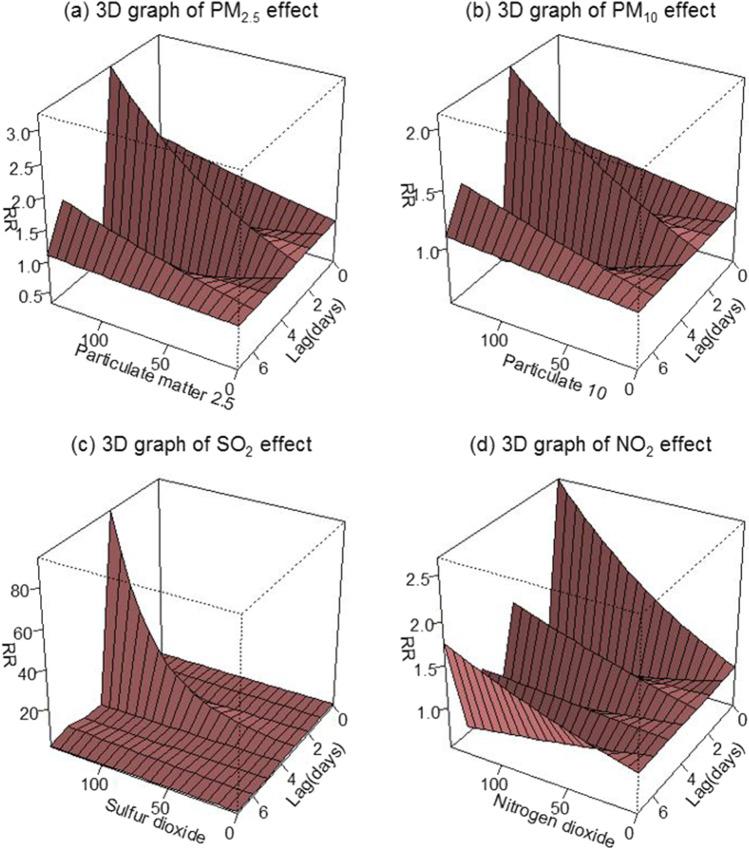
A total of 1399 women who experienced spontaneous pregnancy loss events from November 1, 2016, to September 30, 2019, were selected for this study. Maternal exposure to particulate matter 2.5 (PM), particle matter 10 (PM) nitrogen dioxide (NO), and sulfur dioxide (SO) exhibited a significant association with spontaneous abortion. For every 20 μg/m increase in PM, PM, NO, and SO, the RRs were 1.18 (95% CI: 1.06, 1.34), 1.12 (95% CI, 1.04-1.20), 1.15 (95% CI: 1.02, 1.30), and 1.92 (95% CI: 1.18, 3.11) on lag day 3, lag day 3, lag day 0, and lag day 3, respectively. In two-pollutant model combined with PM and PM, a statistically significant increase in spontaneous abortion incidence of 18.0% (RR = 1.18, 95% CI: 1.06, 1.32) was found for a 20 μg/m increase in PM exposure, and 11.2% (RR = 1.11, 95% CI: 1.03, 1.20) for a 20 μg/m increase in PM exposure on lag day 3, similar to single-pollutant model analysis.
CONCLUSION
Maternal exposure to high levels of PM, PM, NO, and SO during pregnancy may increase the risk of spontaneous abortion for acute effects and lag effects. Further research to explore sensitive exposure time windows is needed.
简介
最近的研究表明,生活在大气环境污染物含量高的地区可能对妊娠结局产生不良影响,但很少有研究调查其与自然流产的关系。需要进一步研究以探讨空气污染物暴露对自然流产的急性和滞后效应。
目的
探讨大气环境污染物暴露与自然流产之间的急性和滞后效应。
方法
本研究从中国重庆妇幼保健中心(CQHCWC)收集了自然流产的研究数据。使用来自监测站的反距离加权法,为每位妇女估计每日大气污染物暴露测量值。采用时间分层病例交叉设计和分布式滞后线性模型,调整温度和相对湿度后,评估暴露于每种空气污染物与 0-7 天滞后时间内自然妊娠丢失之间的关联。
结果
共选择了 1399 名 2016 年 11 月 1 日至 2019 年 9 月 30 日经历自然妊娠丢失事件的女性。母体暴露于细颗粒物 2.5(PM)、颗粒物 10(PM)、二氧化氮(NO)和二氧化硫(SO)与自然流产呈显著相关性。每增加 20μg/m 的 PM、PM、NO 和 SO,RR 分别为 1.18(95%CI:1.06,1.34)、1.12(95%CI,1.04-1.20)、1.15(95%CI:1.02,1.30)和 1.92(95%CI:1.18,3.11)在滞后第 3 天、滞后第 3 天、滞后第 0 天和滞后第 3 天。在结合 PM 和 PM 的两污染物模型中,发现 PM 暴露增加 20μg/m 时,自然流产发生率增加 18.0%(RR=1.18,95%CI:1.06,1.32),PM 暴露增加 20μg/m 时,自然流产发生率增加 11.2%(RR=1.11,95%CI:1.03,1.20)在滞后第 3 天,与单污染物模型分析相似。
结论
妊娠期间母体暴露于高水平的 PM、PM、NO 和 SO 可能会增加自然流产的风险,具有急性和滞后效应。需要进一步研究以探索敏感的暴露时间窗口。

 Zotero 插件