
两种新型席夫碱作为锌的选择性化学传感器的开启发光机制的量子化学阐释:合成、理论及生物成像应用
Quantum chemical elucidation of the turn-on luminescence mechanism in two new Schiff bases as selective chemosensors of Zn: synthesis, theory and bioimaging applications.
作者信息
Berrones-Reyes Jessica C, Muñoz-Flores Blanca M, Cantón-Diáz Arelly M, Treto-Suárez Manuel A, Páez-Hernández Dayan, Schott Eduardo, Zarate Ximena, Jiménez-Pérez Víctor M
机构信息
Universidad Autónoma de Nuevo León, Facultad de Ciencias Químicas, Ciudad Universitaria 66451 Nuevo León México
Doctorado en Fisicoquímica Molecular, Center of Applied Nanosciences (CENS), Universidad Andres Bello Ave. República #275 Santiago de Chile Chile.
出版信息
RSC Adv. 2019 Sep 30;9(53):30778-30789. doi: 10.1039/c9ra05010h. eCollection 2019 Sep 26.
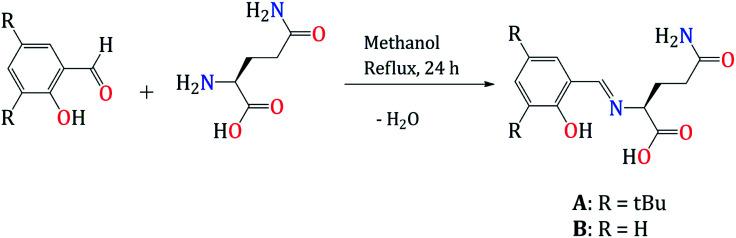
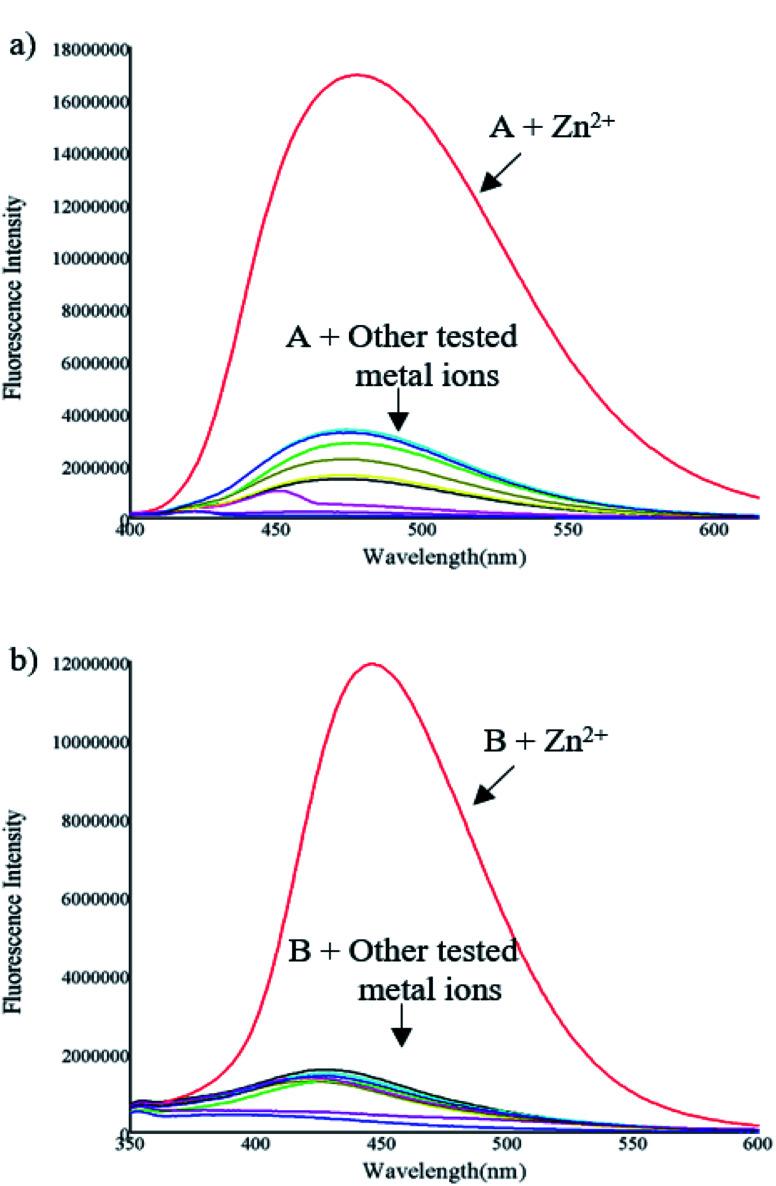
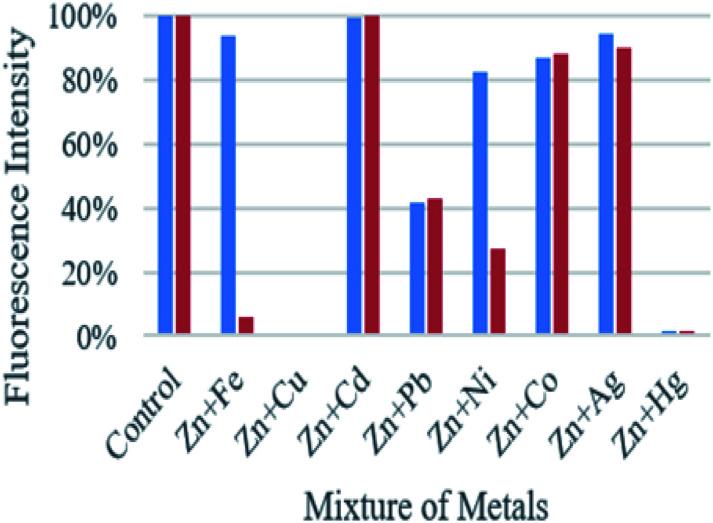
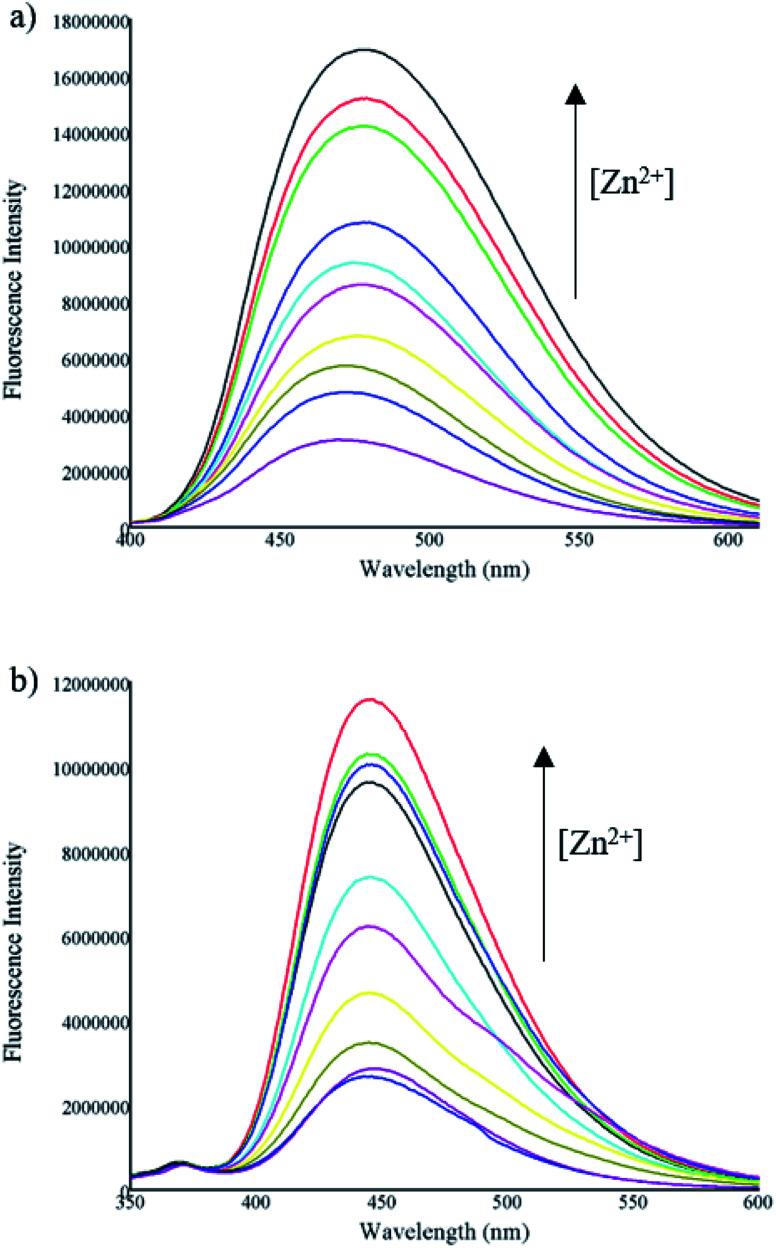
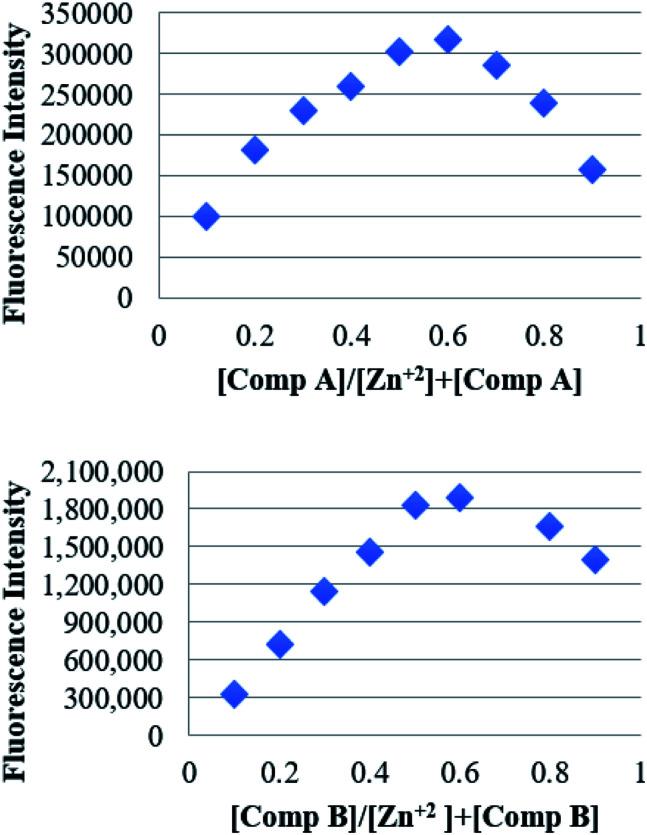
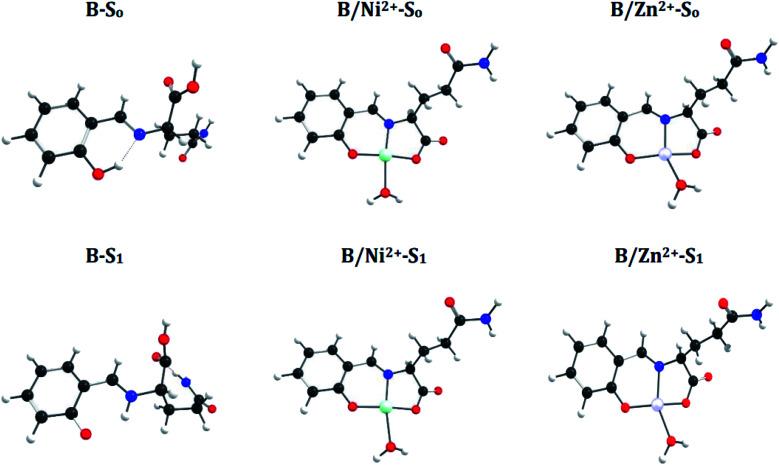
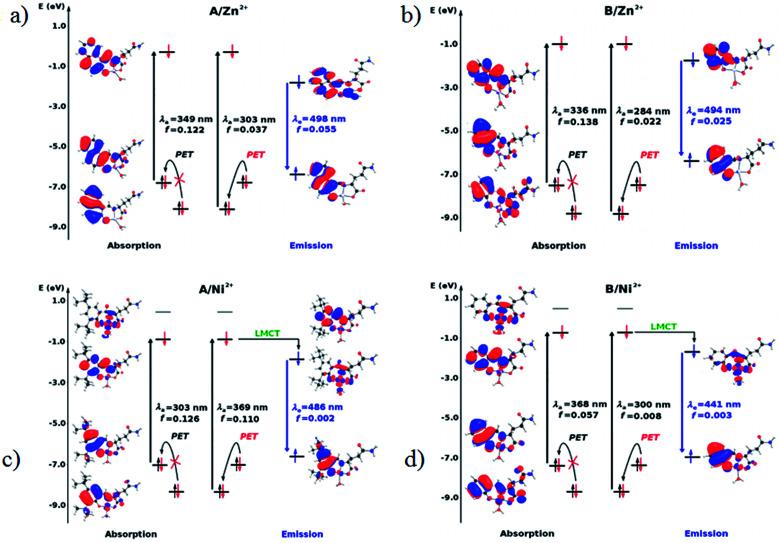
We report the synthesis and characterization of two new selective zinc sensors (,)-11-amino-8-((2,4-di--butyl-1-hydroxybenzylidene) amino)-11-oxopentanoic acid (A) and (,)-11-amino-8-((8-hydroxybenzylidene)amino)-11-oxopentanoic acid (B) based on a Schiff base and an amino acid. The fluorescent probes, after binding to Zn ions, presented an enhancement in fluorescent emission intensity up to 30 times ( = A 50.10 and B 18.14%). The estimated LOD for compounds A and B was 1.17 and 1.20 μM respectively (mixture of acetonitrile : water 1 : 1). Theoretical research has enabled us to rationalize the behaviours of the two selective sensors to Zn synthesized in this work. Our results showed that in the free sensors, PET and ESIPT are responsible for the quenching of the luminescence and that the turn-on of luminescence upon coordination to Zn is mainly induced by the elimination of the PET, which is deeply analysed through EDA, NOCV, molecular structures, excited states and electronic transitions TD-DFT computations. Confocal fluorescence microscopy experiments demonstrate that compound A could be used as a fluorescent probe for Zn in living cells.
我们报道了基于席夫碱和氨基酸的两种新型选择性锌传感器(,)-11-氨基-8-((2,4-二叔丁基-1-羟基亚苄基)氨基)-11-氧代戊酸(A)和(,)-11-氨基-8-((8-羟基亚苄基)氨基)-11-氧代戊酸(B)的合成与表征。荧光探针与锌离子结合后,荧光发射强度增强高达30倍(A为50.10,B为18.14%)。化合物A和B的估计检测限分别为1.17和1.20 μM(乙腈∶水1∶1的混合物)。理论研究使我们能够解释这项工作中合成的两种锌选择性传感器的行为。我们的结果表明,在游离传感器中,光致电子转移(PET)和激发态分子内质子转移(ESIPT)导致发光猝灭,而与锌配位后发光开启主要是由PET的消除引起的,这通过电子密度分析(EDA)、自然轨道耦合价键(NOCV)、分子结构、激发态和电子跃迁 含时密度泛函理论(TD-DFT)计算进行了深入分析。共聚焦荧光显微镜实验表明,化合物A可作为活细胞中锌的荧光探针。





 Zotero 插件