
协调原核生物命名法:解决门名称翻转的争议。
Harmonizing Prokaryotic Nomenclature: Fixing the Fuss over Phylum Name Flipping.
机构信息
Institute of Bioinformatics and Applied Biotechnologygrid.418831.7 (IBAB), Bengaluru, Karnataka, India.
Institut National de la Recherche Scientifique (INRS), Centre Armand-Frappier Santé Biotechnologie, Université du Québec, Institut Pasteur International Network, Laval, Quebec, Canada.
出版信息
mBio. 2022 Jun 28;13(3):e0097022. doi: 10.1128/mbio.00970-22. Epub 2022 May 10.
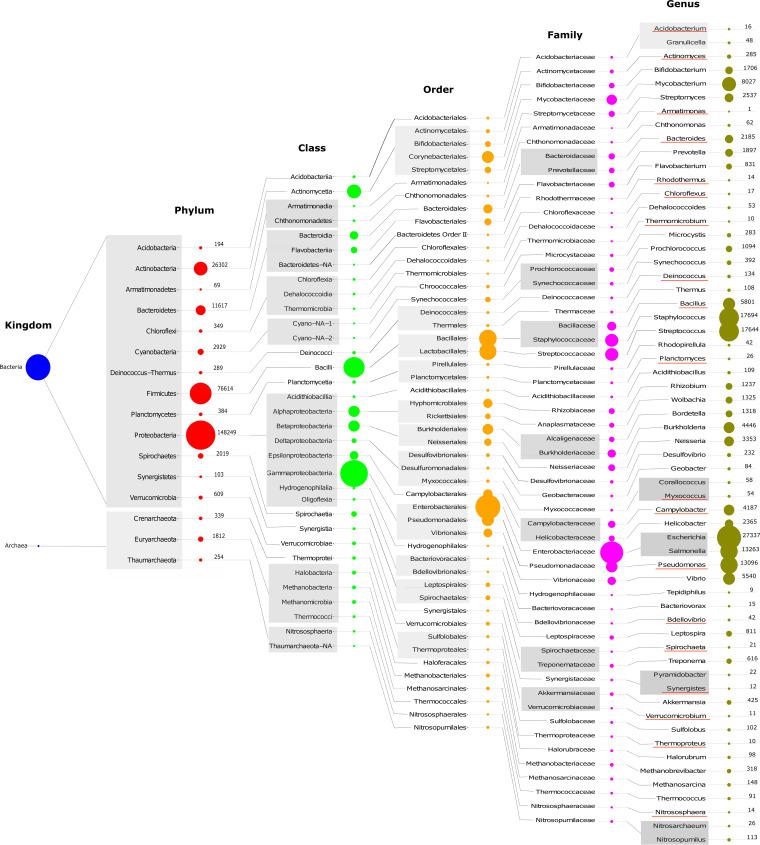
Lloyd and Tahon recently criticized proposed bacterial phylum nomenclature changes (K.G. Lloyd, G. Tahon, Nat Rev Microbiol 20:123-124, 2022, https://doi.org/10.1038/s41579-022-00684-2) precipitated by the International Committee on Systematics of Prokaryotes (ICSP)'s official recognition of phylum nomenclature rules. Here, we extend the critique. While we applaud bringing consistency to phylum names, we prognosticate what this minute but momentous change entails for the future of microbial nomenclature and how this will sow confusion among researchers. Several pitfalls of the proposed ICSP framework-based nomenclature are also detailed, including (i) improper type genus name and suffix usage, (ii) loss of Bacteria/Archaea distinctions, (iii) disruption of major phylum name prefixes, and (iv) absence of organism name prevalidation. Finally, we suggest new names for the key bacterial phyla Proteobacteria (), Firmicutes (), Actinobacteria (), and Tenericutes (), while keeping the archaeal phylum names Crenarchaeota, Thaumarchaeota, and Euryarchaeota. Together, these changes will help researchers attain chaos-free uniform nomenclature.
劳埃德和塔洪最近批评了国际原核生物系统学委员会(ICSP)正式承认的细菌门命名法变化提议(K.G. 劳埃德、G. 塔洪,《自然评论微生物学》20:123-124,2022,https://doi.org/10.1038/s41579-022-00684-2)。在这里,我们扩展了批评。虽然我们赞赏为门名称带来一致性,但我们预测这一微小但重要的变化对未来微生物命名法的影响,以及这将如何在研究人员中引起混乱。还详细说明了拟议的基于 ICSP 框架的命名法的几个陷阱,包括(i)不正确的模式属名和后缀用法,(ii)失去细菌/古菌的区别,(iii)破坏主要门名前缀,以及(iv)缺乏生物体名称预验证。最后,我们建议为关键的细菌门 Proteobacteria()、Firmicutes()、Actinobacteria() 和 Tenericutes() 提供新的名称,同时保留古菌门的名称 Crenarchaeota、Thaumarchaeota 和 Euryarchaeota。这些变化将有助于研究人员获得无混乱的统一命名法。
 Zotero 插件