
漆酶固定化单宁酸介导的埃洛石纳米管表面改性用于高效降解双酚A
Laccase-immobilized tannic acid-mediated surface modification of halloysite nanotubes for efficient bisphenol-A degradation.
作者信息
Zhang Liting, Tang Wen, Ma Tonghao, Zhou Lina, Hui Chenggong, Wang Xiaoli, Wang Ping, Zhang Changai, Chen Chao
机构信息
Zhejiang Province Key Laboratory of Recycling and Eco-treatment of Waste Biomass, Zhejiang University of Science and Technology Hangzhou 310023 China
State Key Laboratory of Bioreactor Engineering, Biomedical Nanotechnology Center, School of Biotechnology, East China University of Science and Technology Shanghai 200237 People's Republic of China
出版信息
RSC Adv. 2019 Nov 27;9(67):38935-38942. doi: 10.1039/c9ra06171a.
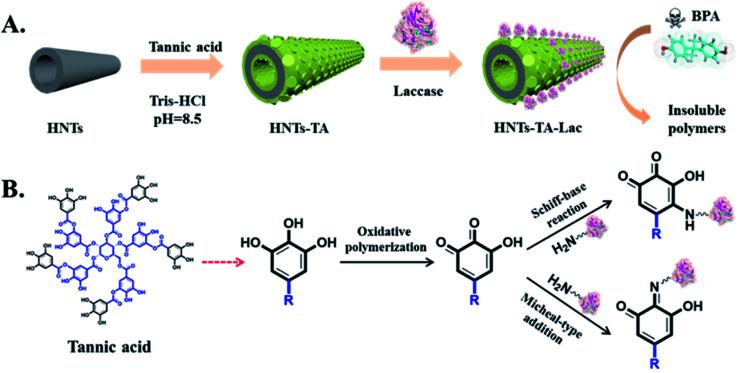
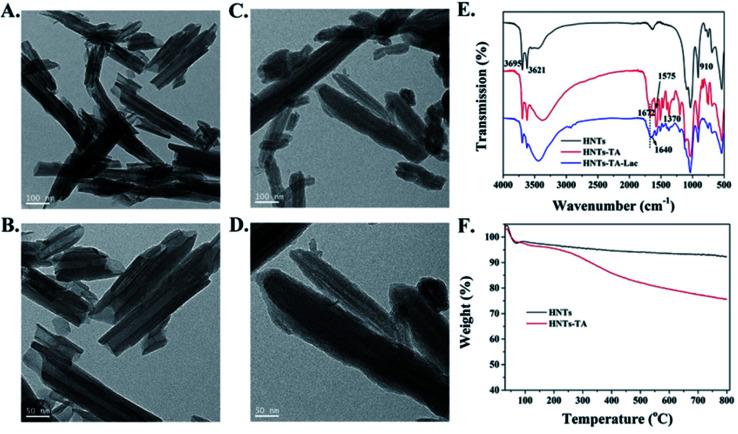
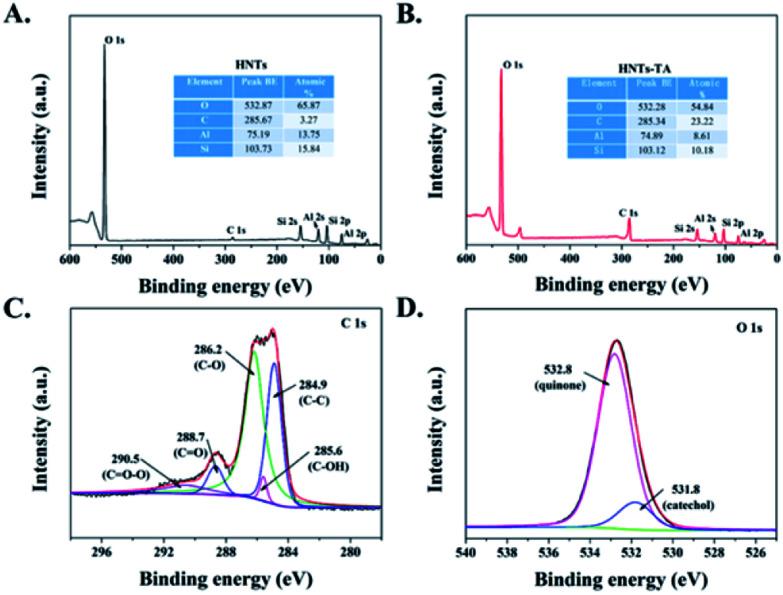
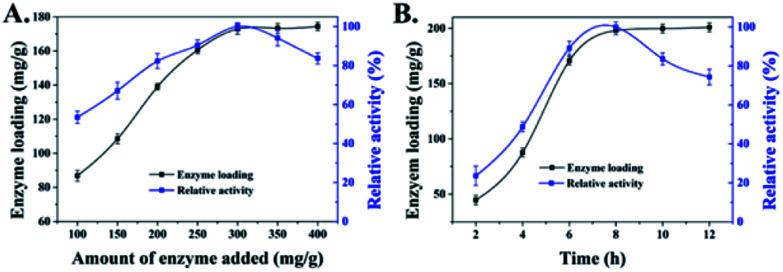
Halloysite nanotubes (HNTs) have been pursued as promising carriers for enzyme immobilization, but the lack of functional groups severely limits their applications. Herein, we reported a simple tannic acid (TA)-mediated surface modification strategy for the fabrication of HNT-based efficient enzyme immobilization supports. Particularly, TA was first self-polymerized and deposited onto the surface of HNTs to form a thin active film a mussel-inspired method, and the model enzyme laccase was directly conjugated the Michael addition and/or Schiff base condensation between quinone groups on poly(tannic acid) layer surfaces and exposed amine groups on laccase surfaces. Under the optimum conditions, this newly fabricated support retained good enzyme-loading and activity recovery properties with 197.9 mg protein per gram of support and 55.4% of activity recovery being achieved. In addition, this immobilized laccase was less influenced by pH, temperature, and inhibitor changes and exhibited higher storage stability than free laccases as more than 70% of initial activity was retained by the immobilized laccase, while less than 30% was retained for free laccase after one-month storage at 4 °C. Finally, a higher bisphenol-A (BPA) removal efficiency and more reuse cycles were demonstrated for immobilized laccases. As a result, this TA-mediated surface modification is a simple and green method for biological macromolecule immobilization on HNTs in one step.
埃洛石纳米管(HNTs)已被视为用于酶固定化的有前途的载体,但缺乏官能团严重限制了它们的应用。在此,我们报道了一种简单的单宁酸(TA)介导的表面改性策略,用于制备基于HNT的高效酶固定化载体。具体而言,TA首先通过一种受贻贝启发的方法进行自聚合并沉积在HNTs表面以形成薄的活性膜,然后通过聚(单宁酸)层表面上的醌基与漆酶表面上暴露的胺基之间的迈克尔加成和/或席夫碱缩合将模型酶漆酶直接共轭。在最佳条件下,这种新制备的载体保留了良好的酶负载和活性恢复性能,每克载体可负载197.9毫克蛋白质,活性恢复率达到55.4%。此外,这种固定化漆酶受pH、温度和抑制剂变化的影响较小,并且比游离漆酶表现出更高的储存稳定性,因为固定化漆酶在4℃下储存一个月后仍保留超过70%的初始活性,而游离漆酶仅保留不到30%的初始活性。最后,固定化漆酶表现出更高的双酚A(BPA)去除效率和更多的重复使用循环次数。因此,这种TA介导的表面改性是一种简单且绿色的方法,可一步实现生物大分子在HNTs上的固定化。



 Zotero 插件