
漆酶固定在壳聚糖功能化埃洛石纳米管上用于降解水溶液中的双酚A:降解机制与矿化途径
Immobilization of laccase on chitosan functionalized halloysite nanotubes for degradation of Bisphenol A in aqueous solution: degradation mechanism and mineralization pathway.
作者信息
Wang Zhaobo, Ren Dajun, Cheng Yaohui, Zhang Xiaoqing, Zhang Shuqin, Chen Wangsheng
机构信息
College of Resource and Environmental Engineering, Wuhan University of Science and Technology, Wuhan 430081, China.
Hubei Key Laboratory for Efficient Utilization and Agglomeration of Metallurgic Mineral Resources, Wuhan University of Science and Technology, Wuhan, Hubei 430081, China.
出版信息
Heliyon. 2022 Jul 13;8(7):e09919. doi: 10.1016/j.heliyon.2022.e09919. eCollection 2022 Jul.
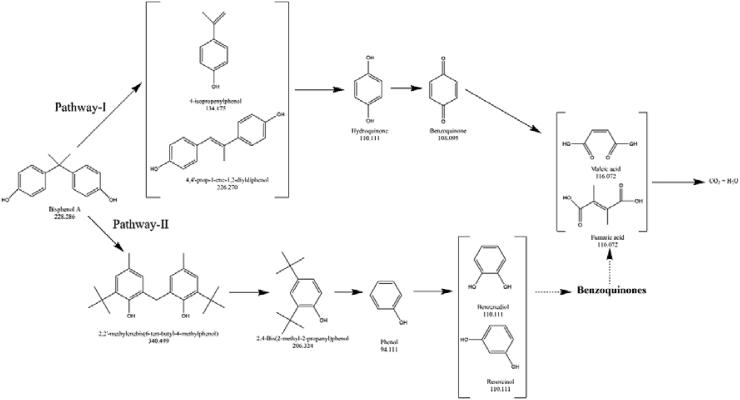
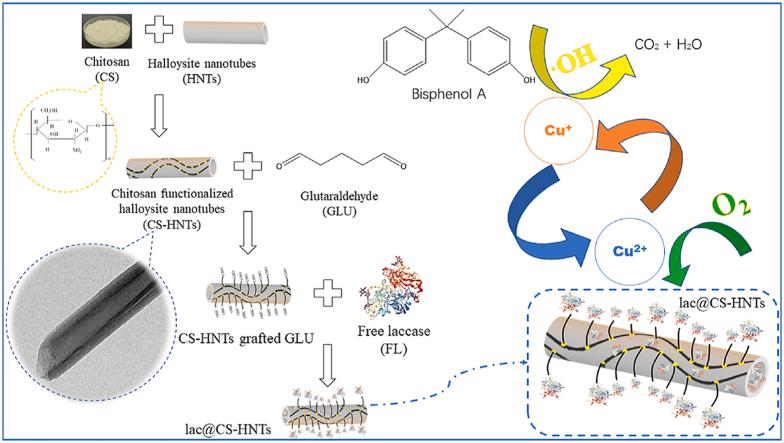
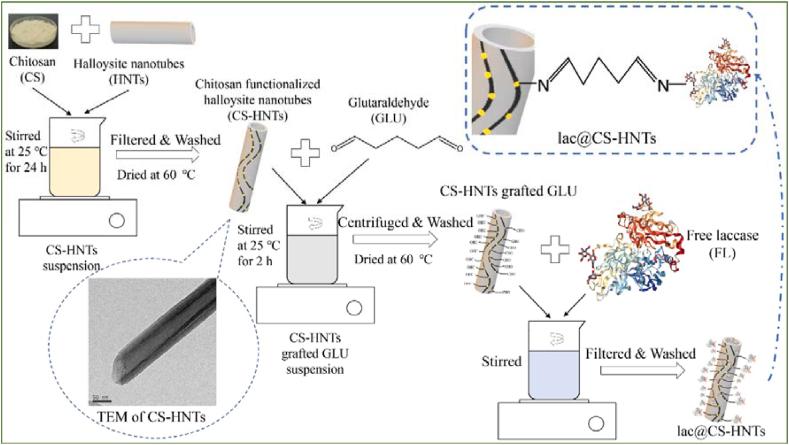
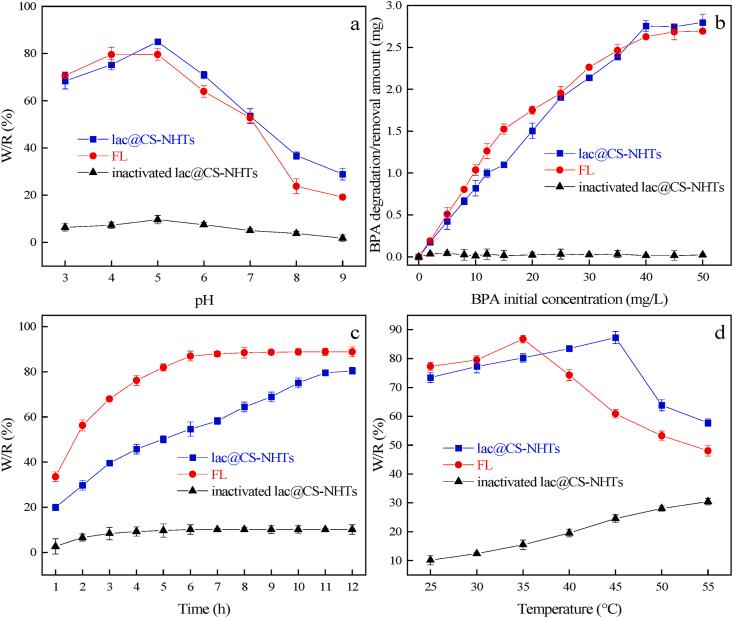
As a hazardous organic chemical raw material, Bisphenol A (BPA) has attracted a great deal of scientific and public attention. In this study, the chitosan functionalized halloysite nanotubes immobilized laccase (lac@CS-HNTs) was prepared by simultaneous adsorption-covalent binding method to remove BPA for the first time. We optimized the preparation of lac@CS-NHTs by controlling one-factor variable method and response surface methodology (RSM). The cubic polynomial regression model via Design-Expert 12 was developed to describe the optimal preparation conditions of immobilized laccase. Under the optimal conditions, lac@CS-NHTs obtained the maximum enzyme activity, and the enzyme loading was as high as 60.10 mg/g. The results of batch removal experiment of BPA showed that under the optimum treatment condition, the BPA removal rate of lac@CS-NHTs, FL and heat-inactivated lac@CS-NHTs was 87.31 %, 60.89 % and 24.54 %, respectively, which indicated that the contribution of biodegradation was greater than adsorption. In addition, the relative activity of lac@CS-NHTs dropped to about 44.24 % after 8 cycles of BPA removal, which demonstrated that lac@CS-NHTs have the potential to reduce costs in practical applications. Finally, the possible degradation mechanism and mineralization pathway of BPA were given via High-performance liquid chromatography (HPLC) analysis and gas chromatography-mass spectrometry (GC-MS) analysis.
作为一种有害的有机化学原料,双酚A(BPA)已引起了大量的科学关注和公众关注。在本研究中,首次采用同时吸附-共价结合法制备了壳聚糖功能化埃洛石纳米管固定化漆酶(lac@CS-HNTs)以去除双酚A。我们通过单因素变量法和响应面法(RSM)优化了lac@CS-NHTs的制备。通过Design-Expert 12建立了三次多项式回归模型,以描述固定化漆酶的最佳制备条件。在最佳条件下,lac@CS-NHTs获得了最大酶活性,酶负载量高达60.10 mg/g。双酚A的分批去除实验结果表明,在最佳处理条件下,lac@CS-NHTs、游离漆酶(FL)和热灭活的lac@CS-NHTs对双酚A的去除率分别为87.31%、60.89%和24.54%,这表明生物降解的贡献大于吸附。此外,经过8次双酚A去除循环后,lac@CS-NHTs的相对活性降至约44.24%,这表明lac@CS-NHTs在实际应用中具有降低成本的潜力。最后,通过高效液相色谱(HPLC)分析和气相色谱-质谱联用(GC-MS)分析给出了双酚A可能的降解机理和矿化途径。

 Zotero 插件