
左旋薄荷醇通过抑制氧化应激和炎症、核因子κB、p38丝裂原活化蛋白激酶和核因子E2相关因子2信号通路减轻香烟烟雾提取物诱导的大鼠肺损伤。
l-Menthol alleviates cigarette smoke extract induced lung injury in rats by inhibiting oxidative stress and inflammation nuclear factor kappa B, p38 MAPK and Nrf2 signalling pathways.
作者信息
Liu Yan, Li Ang, Feng Xiuli, Jiang Xiaoyan, Sun Xiao, Huang Weizhen, Zhu Xiaosong, Zhao Zhongxi
机构信息
School of Pharmaceutical Sciences, Shandong University 44 West Wenhua Road Jinan Shandong 250012 China.
Department of Clinical Pharmacy, Qilu Hospital, Shandong University 107 West Wenhua Road Jinan Shandong 250012 China.
出版信息
RSC Adv. 2018 Mar 5;8(17):9353-9363. doi: 10.1039/c8ra00160j. eCollection 2018 Feb 28.
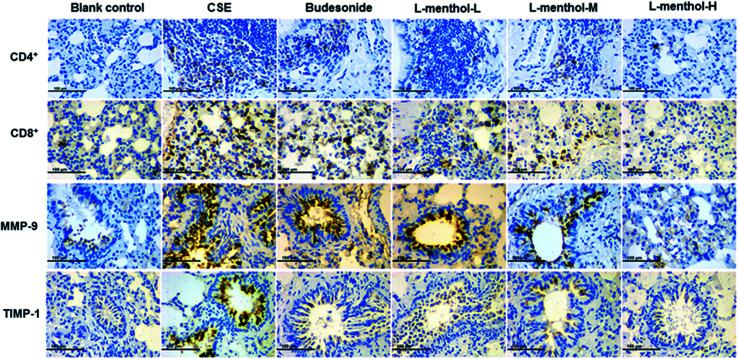
l-Menthol is the main ingredient of peppermint which affects various pharmacological effects such as anti-inflammation and anti-oxidative activity. In this study, we aimed to evaluate the potential effects of l-menthol on cigarette smoke extract (CSE) induced lung injury in rats. Morphology assessment results revealed that administration with l-menthol (5, 10 or 20 mg kg d) significantly alleviated CSE-induced lung injury. Besides, l-menthol significantly reduced the inflammatory response by suppressing the production of tumor necrosis factor-α (TNF-α), interleukin-1β (IL-1β) and interleukin-6 (IL-6) downregulating nuclear factor kappa B (NF-κB) and p38 MAPK pathways. Meanwhile, l-menthol decreased the levels of oxidative stress markers including malondialdehyde (MDA) and myeloperoxidase (MPO) whereas it increased the amount of glutathione (GSH), glutathione peroxidase (GSH-Px), superoxide dismutase (SOD) and total antioxidant capacity (T-AOC) through activation of the Nrf2 pathway. Furthermore, the expression of MMP-9 and TIMP-1 in lungs was reduced after treatment with l-menthol, and this indicated that l-menthol might have a potential effect on airway remodeling. Moreover, immunohistochemistry analyses indicated that l-menthol could suppress the infiltration of CD4 and CD8 T cells in lung tissues and this was probably due to the immune regulation activity of l-menthol. Taken together, our findings support that l-menthol might be a potential candidate for the treatment of CSE-induced lung injury in rats.
左旋薄荷醇是薄荷的主要成分,具有多种药理作用,如抗炎和抗氧化活性。在本研究中,我们旨在评估左旋薄荷醇对香烟烟雾提取物(CSE)诱导的大鼠肺损伤的潜在影响。形态学评估结果显示,给予左旋薄荷醇(5、10或20mg/kg/d)可显著减轻CSE诱导的肺损伤。此外,左旋薄荷醇通过抑制肿瘤坏死因子-α(TNF-α)、白细胞介素-1β(IL-1β)和白细胞介素-6(IL-6)的产生,下调核因子κB(NF-κB)和p38丝裂原活化蛋白激酶(MAPK)信号通路,显著减轻炎症反应。同时,左旋薄荷醇降低了包括丙二醛(MDA)和髓过氧化物酶(MPO)在内的氧化应激标志物水平,而通过激活Nrf2信号通路增加了谷胱甘肽(GSH)、谷胱甘肽过氧化物酶(GSH-Px)、超氧化物歧化酶(SOD)和总抗氧化能力(T-AOC)的含量。此外,左旋薄荷醇处理后肺组织中基质金属蛋白酶-9(MMP-9)和金属蛋白酶组织抑制因子-1(TIMP-1)的表达降低,这表明左旋薄荷醇可能对气道重塑有潜在影响。此外,免疫组织化学分析表明,左旋薄荷醇可抑制肺组织中CD4和CD8 T细胞的浸润,这可能归因于左旋薄荷醇的免疫调节活性。综上所述,我们的研究结果支持左旋薄荷醇可能是治疗CSE诱导的大鼠肺损伤的潜在候选药物。


 Zotero 插件