
双种干燥表面生物膜;芽孢杆菌属对金黄色葡萄球菌存活和表面消毒的影响。
Dual species dry surface biofilms; Bacillus species impact on Staphylococcus aureus survival and surface disinfection.
机构信息
School of Pharmacy and Pharmaceutical Sciences, Cardiff University, Cardiff, UK.
GAMA Healthcare Ltd., Hertfordshire, UK.
出版信息
J Appl Microbiol. 2022 Aug;133(2):1130-1140. doi: 10.1111/jam.15619. Epub 2022 Jun 5.
AIMS
Dry surface biofilms (DSB) survive on environmental surfaces throughout hospitals, able to resist cleaning and disinfection interventions. This study aimed to produce a dual species DSB and explore the ability of commercially available wipe products to eliminate pathogens within a dual species DSB and prevent their transfer.
METHODS AND RESULTS
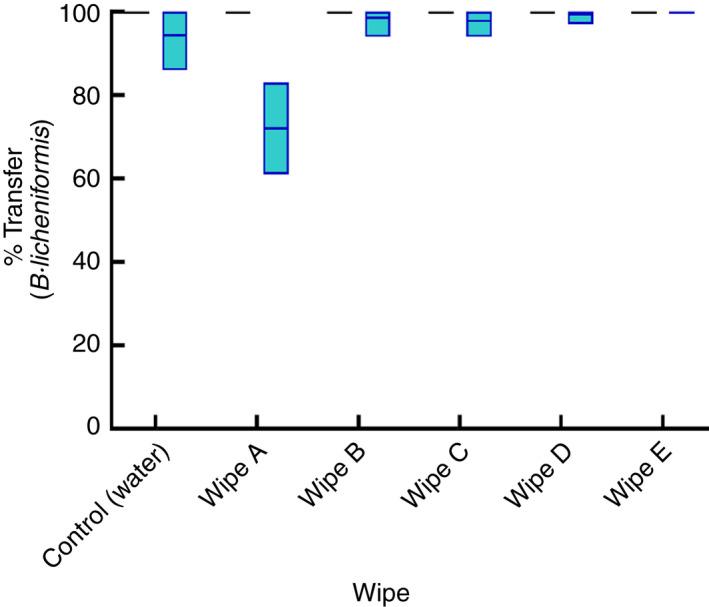
Staphylococcus aureus was grown with two different species of Bacillus on stainless steel discs, over 12 days using sequential hydration and dehydration phases. A modified version of ASTM 2967-15 was used to test six wipe products including one water control with the Fitaflex Wiperator. Staphylococcus aureus growth was inhibited when combined with Bacillus subtilis. Recovery of S. aureus on agar from a dual DSB was not always consistent. Our results did not provide evidence that Bacillus licheniformis protected S. aureus from wipe action. There was no significant difference of S. aureus elimination by antimicrobial wipes between single and dual species DSB. B. licheniformis was easily transferred by the wipe itself and to new surfaces both in a single and dual species DSB, whilst several wipe products inhibited the transfer of S. aureus from wipe. However, S. aureus direct transfer to new surfaces was not inhibited post-wiping.
CONCLUSIONS
Although we observed that the dual DSB did not confer protection of S. aureus, we demonstrated that environmental species can persist on surfaces after disinfection treatment. Industries should test DSB against future products and hospitals should consider carefully the products they choose.
SIGNIFICANCE AND IMPACT OF THE STUDY
To our knowledge, this is the first study reporting on the production of a dual species DSB. Multispecies DSB have been identified throughout the world on hospital surfaces, but many studies focus on single species biofilms. This study has shown that DSB behave differently to hydrated biofilms.
目的
干燥表面生物膜(DSB)在医院环境表面存活,能够抵抗清洁和消毒干预。本研究旨在制作双物种 DSB,并探索市售擦拭产品在双物种 DSB 中消除病原体并防止其转移的能力。
方法和结果
使用顺序水合和脱水阶段,在不锈钢盘上用两种不同的 Bacillus 物种培养金黄色葡萄球菌,共 12 天。使用修改后的 ASTM 2967-15 测试了六种擦拭产品,包括一个带有 Fitaflex Wiperator 的水对照。当与枯草芽孢杆菌结合时,金黄色葡萄球菌的生长受到抑制。从双 DSB 琼脂上回收金黄色葡萄球菌并不总是一致的。我们的结果并没有提供证据表明地衣芽孢杆菌保护金黄色葡萄球菌免受擦拭作用。在单种和双种 DSB 中,抗菌擦拭巾对金黄色葡萄球菌的消除没有显著差异。地衣芽孢杆菌很容易通过擦拭本身转移到新表面,无论是在单种还是双种 DSB 中,而几种擦拭产品抑制了金黄色葡萄球菌从擦拭巾转移到新表面。然而,擦拭后并未抑制金黄色葡萄球菌直接转移到新表面。
结论
尽管我们观察到双 DSB 并没有为金黄色葡萄球菌提供保护,但我们证明了即使经过消毒处理,环境物种仍可以在表面上存活。工业界应针对未来产品对 DSB 进行测试,医院应仔细考虑他们选择的产品。
研究的意义和影响
据我们所知,这是第一项关于生产双物种 DSB 的研究。多物种 DSB 已在世界各地的医院表面上被发现,但许多研究都集中在单物种生物膜上。本研究表明 DSB 的行为与水合生物膜不同。



 Zotero 插件