
无袖带血压监测中提高准确性和估计不确定性的融合方法。
A fusion approach to improve accuracy and estimate uncertainty in cuffless blood pressure monitoring.
机构信息
Mechanical and Mechatronics Engineering Department, University of Waterloo, Waterloo, ON, Canada.
Toronto Rehabilitation Institute (KITE), University Health Network, Toronto, ON, Canada.
出版信息
Sci Rep. 2022 May 13;12(1):7948. doi: 10.1038/s41598-022-12087-7.
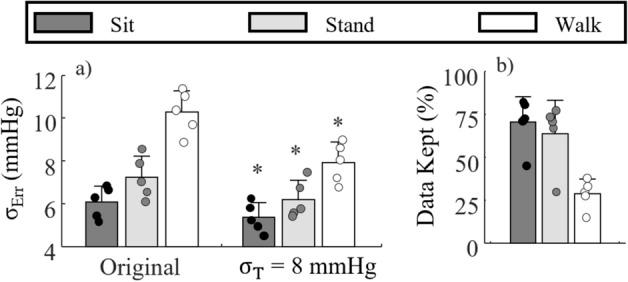
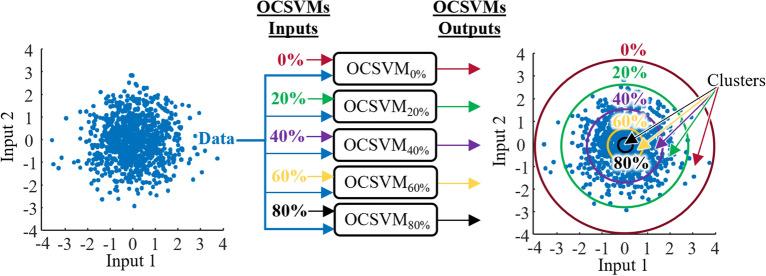
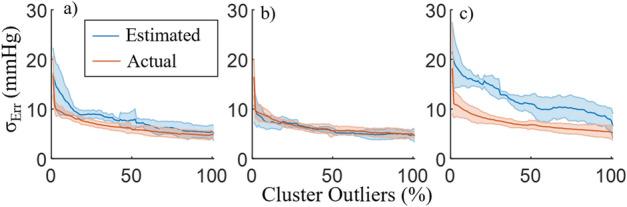
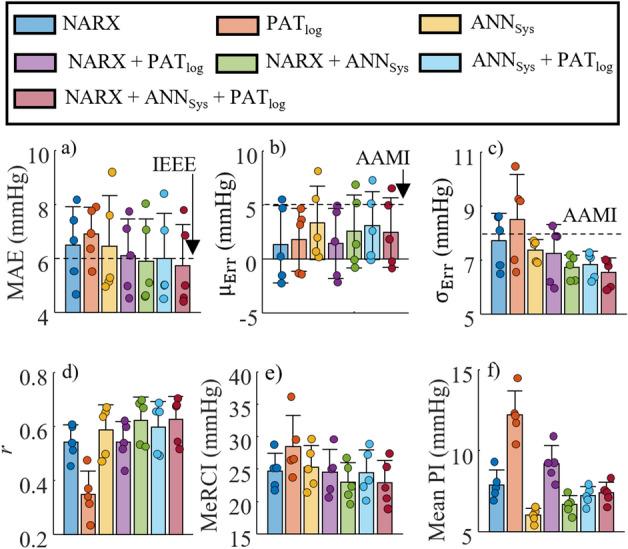
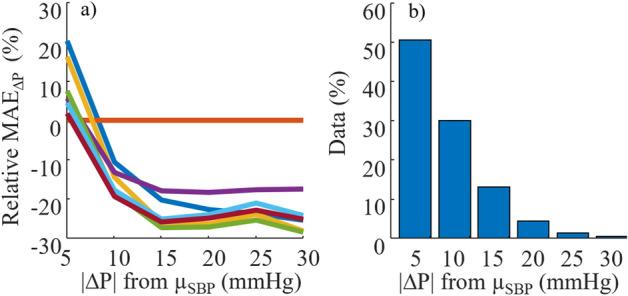
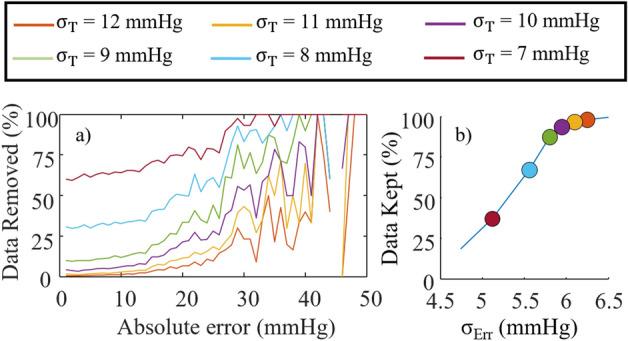
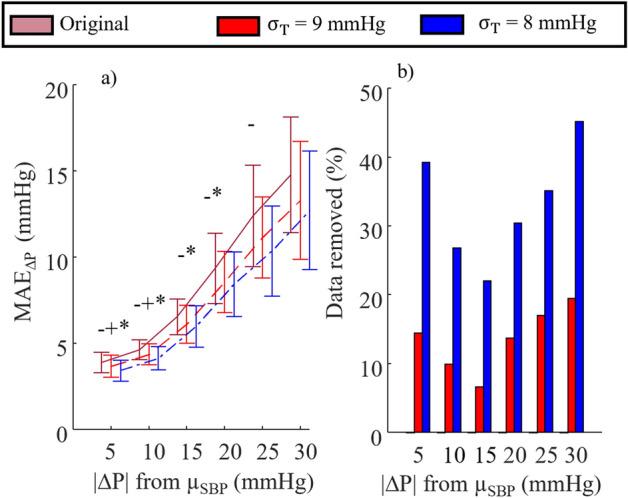
A substantial barrier to the clinical adoption of cuffless blood pressure (BP) monitoring techniques is the lack of unified error standards and methods of estimating measurement uncertainty. This study proposes a fusion approach to improve accuracy and estimate prediction interval (PI) as a proxy for uncertainty for cuffless blood BP monitoring. BP was estimated during activities of daily living using three model architectures: nonlinear autoregressive models with exogenous inputs, feedforward neural network models, and pulse arrival time models. Multiple one-class support vector machine (OCSVM) models were trained to cluster data in terms of the percentage of outliers. New BP estimates were then assigned to a cluster using the OCSVMs hyperplanes, and the PIs were estimated using the BP error standard deviation associated with different clusters. The OCSVM was used to estimate the PI for the three BP models. The three BP estimations from the models were fused using the covariance intersection fusion algorithm, which improved BP and PI estimates in comparison with individual model precision by up to 24%. The employed model fusion shows promise in estimating BP and PI for potential clinical uses. The PI indicates that about 71%, 64%, and 29% of the data collected from sitting, standing, and walking can result in high-quality BP estimates. Our PI estimator offers an effective uncertainty metric to quantify the quality of BP estimates and can minimize the risk of false diagnosis.
cuffless 血压 (BP) 监测技术在临床应用中面临的一个重大障碍是缺乏统一的误差标准和测量不确定度估计方法。本研究提出了一种融合方法,以提高 cuffless 血压监测的准确性,并估计预测区间 (PI) 作为不确定性的代理。在日常生活活动中使用三种模型架构估计 BP:具有外部输入的非线性自回归模型、前馈神经网络模型和脉搏到达时间模型。训练了多个单类支持向量机 (OCSVM) 模型,以根据离群值的百分比对数据进行聚类。然后使用 OCSVM 超平面将新的 BP 估计分配到一个聚类中,并使用与不同聚类相关的 BP 误差标准差估计 PI。使用 OCSVM 估计三种 BP 模型的 PI。使用协方差交叉融合算法融合三种 BP 估计值,与单个模型精度相比,BP 和 PI 估计值最多提高了 24%。所采用的模型融合在估计潜在临床应用中的 BP 和 PI 方面显示出了前景。PI 表明,从坐姿、站立和行走中收集的数据约有 71%、64%和 29%可以产生高质量的 BP 估计值。我们的 PI 估计器提供了一种有效的不确定性度量标准,可以量化 BP 估计值的质量,并最大程度地降低误诊的风险。
 Zotero 插件