
中国 COPD 吸烟者戒烟的障碍和促进因素:定性研究。
Barriers and Facilitators for Smoking Cessation in Chinese Smokers with Chronic Obstructive Pulmonary Disease: A Qualitative Study.
机构信息
Centre for Evidence-Based Chinese Medicine, Beijing University of Chinese Medicine, Beijing, 100029, People's Republic of China.
Pingyi Hospital of Traditional Chinese Medicine, Linyi, Shandong, People's Republic of China.
出版信息
Int J Chron Obstruct Pulmon Dis. 2022 May 6;17:1107-1120. doi: 10.2147/COPD.S356935. eCollection 2022.
BACKGROUND
Smoking cessation is recommended as a key intervention for chronic obstructive pulmonary disease (COPD) smokers. However, in China, few COPD smokers quit successfully. The aim of this study was to explore in depth the barriers and facilitators for smoking cessation among smokers with COPD in China.
METHODS
A purposive sample of 32 hospitalized smokers with COPD were included, 17 ex-smokers and 15 current smokers, participated in the semi-structured interviews. Interviews were analyzed thematically and using a deductive approach guided by Capability, Opportunity, Motivation-Behavior (COM-B) framework.
RESULTS
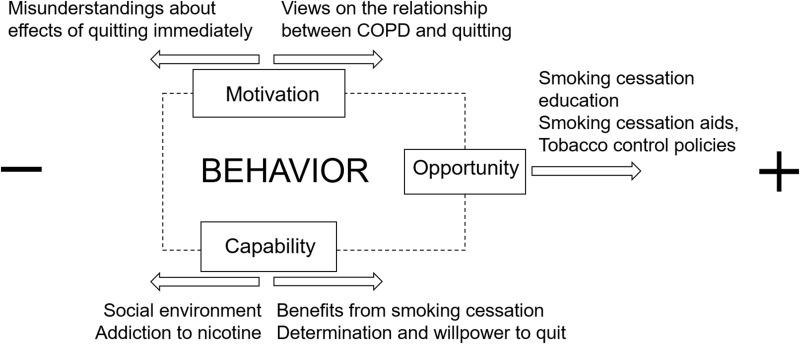
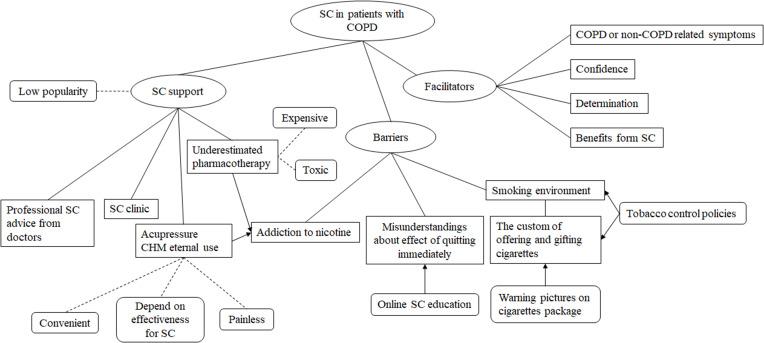
Three inter-related themes were generated: smokers' motivation was a prerequisite for quitting, maintaining capability to quit smoking, and opportunities that facilitated smokers to quit. Motivation to quit for most participants was activated by COPD-related symptoms, although they had a limited knowledge of COPD. Physical benefits from quitting and strong willpower were facilitators for maintaining quitting, while exposure to smoking environment and strong addiction to nicotine were frequent reasons for relapse. Most ex-smokers quit smoking by their own willpower rather than professionally delivered smoking cessation interventions. Smokers' attitudes toward these interventions depended on their effectiveness and convenience. Very few participants had experienced pharmacotherapy or behavioral support from physicians. However, interviewees preferred auricular acupressure to pharmacotherapy.
CONCLUSION
Motivation to quit among smokers with COPD was usually initiated by COPD-related symptoms. Physical benefits observed by quitting and strong willpower facilitated smoking cessation, while exposure to smoking environment and strong addiction to nicotine led to relapse. COPD smokers in China preferred auricular acupressure to pharmacotherapy.
背景
戒烟被推荐为慢性阻塞性肺疾病(COPD)吸烟者的关键干预措施。然而,在中国,很少有 COPD 吸烟者成功戒烟。本研究旨在深入探讨中国 COPD 吸烟者戒烟的障碍和促进因素。
方法
采用目的抽样法,选取 32 名住院 COPD 吸烟者,其中 17 名曾吸烟者和 15 名现吸烟者参与半结构式访谈。采用主题分析法和能力、机会、动机-行为(COM-B)框架指导的演绎方法进行分析。
结果
产生了三个相互关联的主题:吸烟者的动机是戒烟的前提,保持戒烟的能力,以及促进吸烟者戒烟的机会。大多数参与者戒烟的动机是由 COPD 相关症状引起的,尽管他们对 COPD 的了解有限。戒烟的身体益处和坚强的意志力是保持戒烟的促进因素,而暴露于吸烟环境和对尼古丁的强烈上瘾是经常复吸的原因。大多数曾吸烟者是通过自己的意志力而不是专业的戒烟干预措施戒烟的。吸烟者对这些干预措施的态度取决于其有效性和便利性。很少有参与者接受过医生提供的药物治疗或行为支持。然而,受访者更喜欢耳穴按压而不是药物治疗。
结论
COPD 吸烟者的戒烟动机通常是由 COPD 相关症状引起的。戒烟时观察到的身体益处和坚强的意志力促进了戒烟,而暴露于吸烟环境和对尼古丁的强烈上瘾导致了复吸。中国的 COPD 吸烟者更喜欢耳穴按压而不是药物治疗。
 Zotero 插件