
32周高强度间歇训练和抗阻训练对延缓肌肉减少症的影响:聚焦内源性细胞凋亡
Effect of 32-Weeks High-Intensity Interval Training and Resistance Training on Delaying Sarcopenia: Focus on Endogenous Apoptosis.
作者信息
Su Hao, Wen Tianhao, Liu Dongsen, Shao Jia, Zhao Lei, Gao Qi
机构信息
Department of Exercise Biochemistry, Beijing Sport University, Beijing, China.
Military Common Subject Teaching and Research Section, PLA Rocket Force University of Engineering, Xi'an, China.
出版信息
Front Physiol. 2022 Apr 28;13:811369. doi: 10.3389/fphys.2022.811369. eCollection 2022.
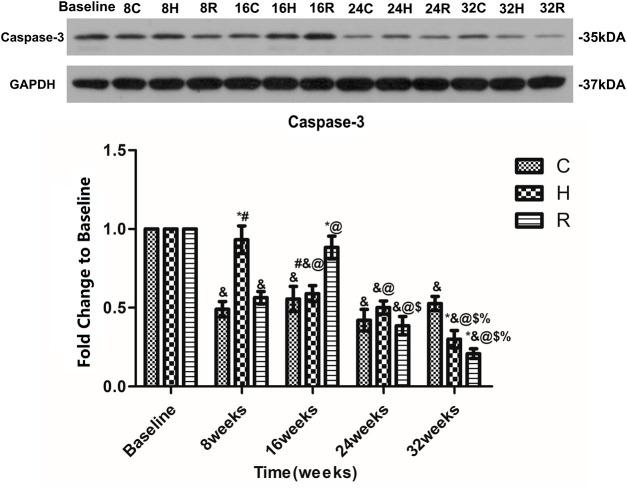
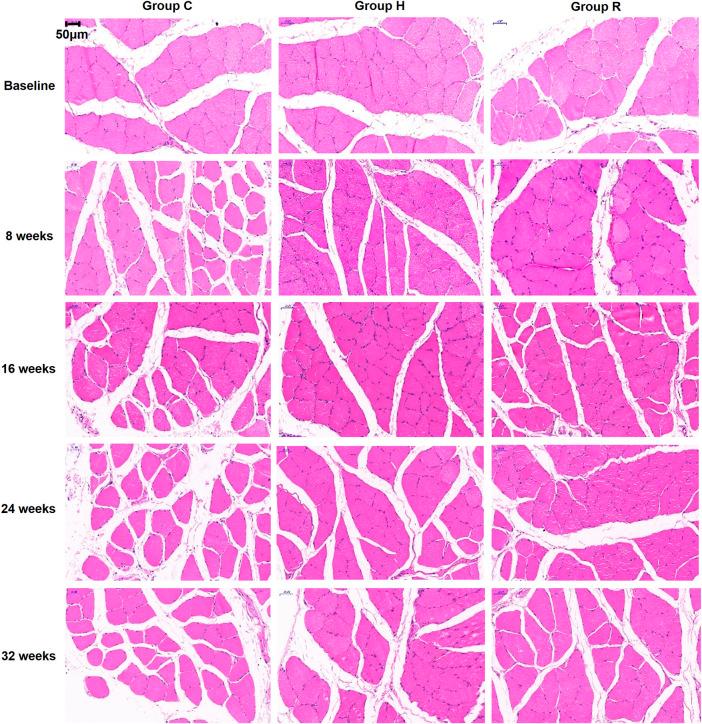
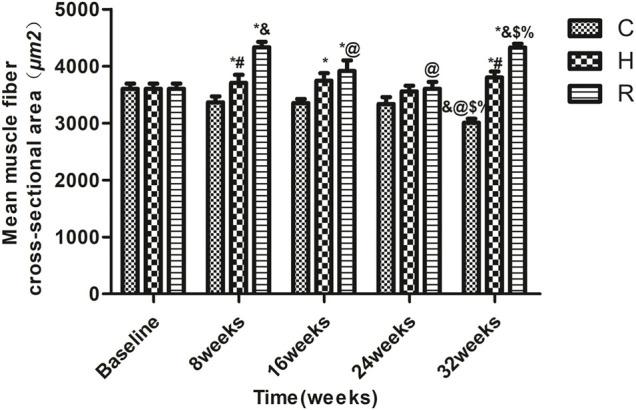
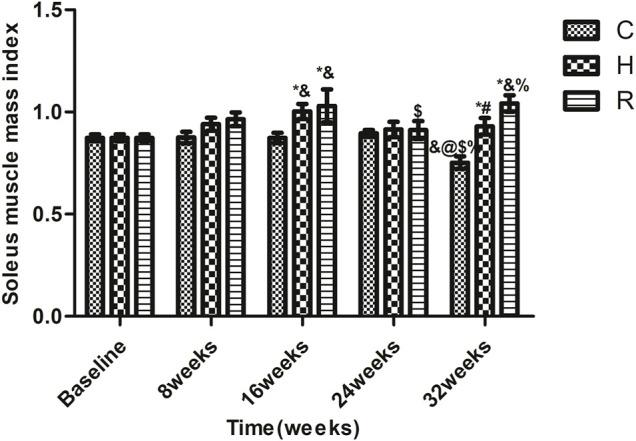
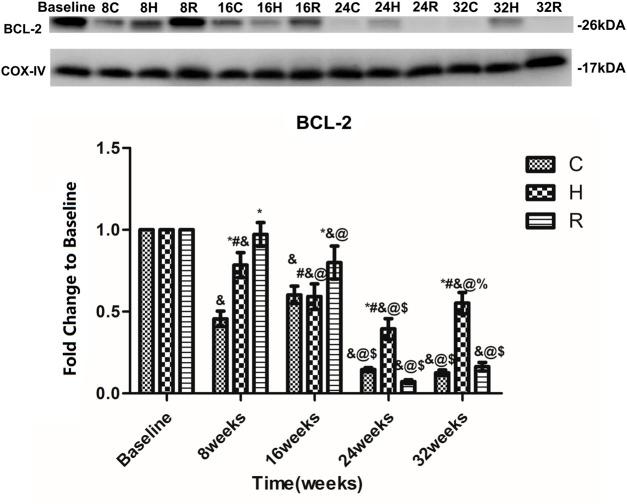
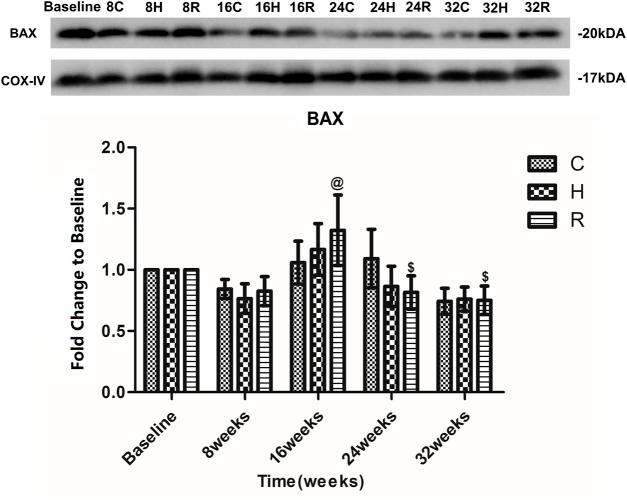
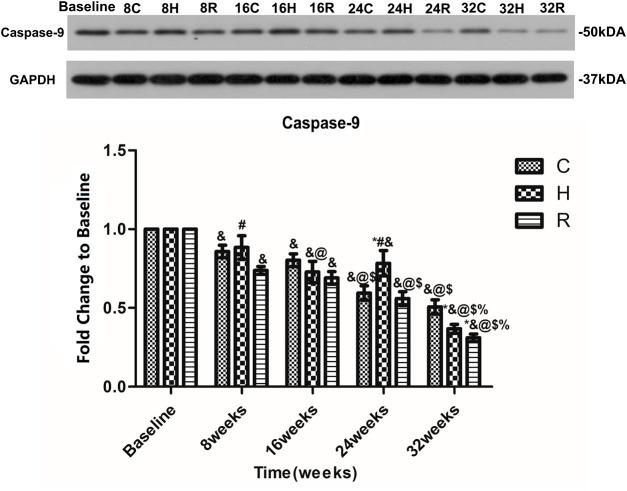
Sarcopenia caused by aging is an important factor leading to a decline in the quality of life of older people. Apoptosis in muscle atrophy accelerates the process of muscle loss in older populations. The present study aimed to investigate the effects of 32 weeks of high-intensity interval training (HIIT) and resistance training (RT) on the skeletal muscle-related indices and provide a theoretical basis for regulating the mitochondrial-mediated pathway to delay sarcopenia. We randomly selected 10 from eight-month-old male SD rats ( = 130) as the baseline group; after 1 week of adaptive feeding, the rats were sacrificed. The remaining rats were randomly assigned to one of three groups: control group (C, = 40, natural aging for 32 weeks), HIIT group (H, = 40, performed six loops of 3 min at 90% and 3 min at 50% VO2 max speed treadmill running, with 5 min at 70% VO2 max speed at the beginning and the end of the training, 3 times a week for 32 weeks), and resistance group (R, = 40, 46 min per day, 3 days per week, with a 30% maximum load on a treadmill with a slope of 35°, 15 m/min). The soleus muscles were collected for analysis at baseline and every 8 weeks. Aging resulted in decreased soleus muscle mass and Bcl-2 levels in the mitochondria, while the levels of reactive oxygen species (ROS) and Bax did not change. HIIT reversed the age-associated activation of pro-apoptotic processes, but RT did not. In addition, when rats were aged from 8 to 16 months, the level of Cyt-C did not change, the Caspase-9 levels and Caspase-3 levels decreased gradually in the soleus muscles, the rats of both the HIIT and RT groups had these indices decreased at 32 weeks. The results suggest that the age-associated loss of muscle mass was reversed by training, and the effect of RT was better than that of HIIT. Both the HIIT and RT rats showed a decrease in the apoptosis of skeletal muscle cells after 32 weeks of intervention. HIIT performed better for long-term intervention regarding the pro-apoptotic factors. This study warranted further research to delineate the underlying mechanism of effects of different exercise methods on the changes of aging skeletal muscle at level.
衰老引起的肌肉减少症是导致老年人生活质量下降的一个重要因素。肌肉萎缩中的细胞凋亡加速了老年人群肌肉流失的过程。本研究旨在探讨32周的高强度间歇训练(HIIT)和抗阻训练(RT)对骨骼肌相关指标的影响,并为调节线粒体介导的途径以延缓肌肉减少症提供理论依据。我们从8个月大的雄性SD大鼠(n = 130)中随机选取10只作为基线组;适应性喂养1周后,将大鼠处死。其余大鼠随机分为三组之一:对照组(C,n = 40,自然衰老32周)、HIIT组(H,n = 40,以90%最大摄氧量速度跑3分钟、50%最大摄氧量速度跑3分钟,共进行6组循环,训练开始和结束时以70%最大摄氧量速度跑5分钟,每周3次,共32周)和抗阻组(R,n = 40,每天46分钟,每周3天,在坡度为35°、速度为15米/分钟的跑步机上以30%最大负荷进行训练)。在基线时以及每8周收集比目鱼肌进行分析。衰老导致比目鱼肌质量和线粒体中Bcl-2水平降低,而活性氧(ROS)和Bax水平未发生变化。HIIT逆转了与年龄相关的促凋亡过程的激活,但RT没有。此外,当大鼠从8个月龄到16个月龄时,比目鱼肌中细胞色素C(Cyt-C)水平未发生变化,Caspase-9水平和Caspase-3水平逐渐降低,HIIT组和RT组的大鼠在32周时这些指标均下降。结果表明,训练可逆转与年龄相关的肌肉质量损失,且RT的效果优于HIIT。HIIT组和RT组大鼠在干预32周后骨骼肌细胞凋亡均减少。就促凋亡因子而言,HIIT在长期干预方面表现更好。本研究值得进一步研究以阐明不同运动方法对衰老骨骼肌变化影响的潜在机制。


 Zotero 插件