
通过一个强调公平和公正分享人工智能和相关数字技术应用所带来的利益的全球框架,将“One Health”付诸实践为“One Digital Health”。
Operationalizing "One Health" as "One Digital Health" Through a Global Framework That Emphasizes Fair and Equitable Sharing of Benefits From the Use of Artificial Intelligence and Related Digital Technologies.
机构信息
Department of Law and Centre for Medical Ethics and Law, The University of Hong Kong, Pokfulam, Hong Kong SAR, China.
出版信息
Front Public Health. 2022 May 3;10:768977. doi: 10.3389/fpubh.2022.768977. eCollection 2022.
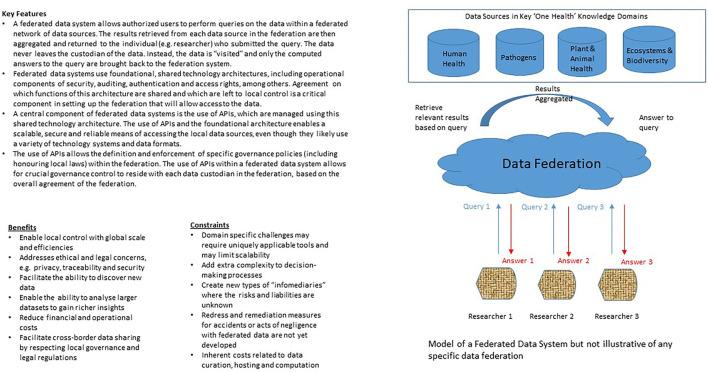
The operationalization of One Health (OH) through digitalization is a means to deploy digital technologies (including Artificial Intelligence (AI), big data and related digital technologies) to better capacitate us to deal with growing climate exigency and related threats to human, animal and plant health. With reference to the concept of One Digital Health (ODH), this paper considers how digital capabilities can help to overcome 'operational brakes' in OH through new and deeper insights, better predictions, and more targeted or precise preventive strategies and public health countermeasures. However, the data landscape is fragmented and access to certain types of data is increasingly restrictive as individuals, communities and countries seek to assert greater control over data taken from them. This paper proposes for a dedicated global ODH framework-centered on fairness and equity-to be established to promote data-sharing across all the key knowledge domains of OH and to devise data-driven solutions to challenges in the human-animal-ecosystems interface. It first considers the data landscape in relation to: (1) Human and population health; (2) Pathogens; (3) Animal and plant health; and (4) Ecosystems and biodiversity. The complexification from the application of advance genetic sequencing technology is then considered, with focus on current debates over whether certain types of data like digital (genetic) sequencing information (DSI) should remain openly and freely accessible. The proposed ODH framework must augment the existing access and benefit sharing (ABS) framework currently prescribed under the Nagoya Protocol to the Convention on Biological Diversity (CBD) in at least three different ways. First, the ODH framework should apply to all genetic resources and data, including DSI, whether from humans or non-humans. Second, the FAIRER principles should be implemented, with focus on fair and equitable benefit-sharing. Third, the ODH framework should adopt multilateral approaches to data sharing (such as through federated data systems) and to ABS. By operationalizing OH as ODH, we are more likely to be able to protect and restore natural habitats, secure the health and well-being of all living things, and thereby realize the goals set out in the post-2020 Global Biodiversity Framework under the CBD.
通过数字化实现“同一健康”(One Health,OH)的运作,是利用数字技术(包括人工智能(Artificial Intelligence,AI)、大数据和相关数字技术)来更好地增强我们应对日益增长的气候紧迫性和对人类、动物和植物健康相关威胁的能力。本文参考“同一数字健康”(One Digital Health,ODH)的概念,探讨了数字能力如何通过新的、更深入的见解、更好的预测以及更有针对性或精确的预防策略和公共卫生对策,帮助克服 OH 中的“运作障碍”。然而,由于个人、社区和国家都试图对从他们那里获取的数据拥有更大的控制权,数据格局变得支离破碎,某些类型的数据的获取也越来越受到限制。本文提议建立一个以公平和公正为中心的专门全球 ODH 框架,以促进 OH 所有关键知识领域的数据共享,并制定数据驱动的解决方案,以应对人类-动物-生态系统界面的挑战。本文首先考虑了与以下四个方面相关的数据格局:(1)人类和人口健康;(2)病原体;(3)动植物健康;(4)生态系统和生物多样性。接着,本文考虑了先进基因测序技术应用带来的复杂化问题,重点关注目前关于某些类型的数据(如数字(遗传)测序信息(Digital Sequence Information,DSI))是否应保持公开和自由获取的争论。所提议的 ODH 框架必须至少以三种不同方式来补充当前在《生物多样性公约》(Convention on Biological Diversity,CBD)的《名古屋议定书》下规定的现有获取和惠益分享(Access and Benefit Sharing,ABS)框架。首先,OH 框架应适用于所有遗传资源和数据,包括来自人类或非人类的 DSI。其次,应实施 FAIRER 原则,重点是公平和公平的惠益分享。第三,ODH 框架应采用多边方法进行数据共享(例如通过联邦数据系统)和 ABS。通过将 OH 运作化,我们更有可能保护和恢复自然栖息地,保障所有生物的健康和福祉,从而实现《生物多样性公约》下 2020 年后全球生物多样性框架中设定的目标。
 Zotero 插件