
心脏兰尼碱受体门控的分子基础解释了功能获得和丧失突变的机制。
Molecular basis for gating of cardiac ryanodine receptor explains the mechanisms for gain- and loss-of function mutations.
机构信息
Department of Cellular and Molecular Pharmacology, Juntendo University Graduate School of Medicine, Tokyo, Japan.
Department of Cell Biology and Anatomy, Graduate School of Medicine, The University of Tokyo, Tokyo, Japan.
出版信息
Nat Commun. 2022 May 20;13(1):2821. doi: 10.1038/s41467-022-30429-x.
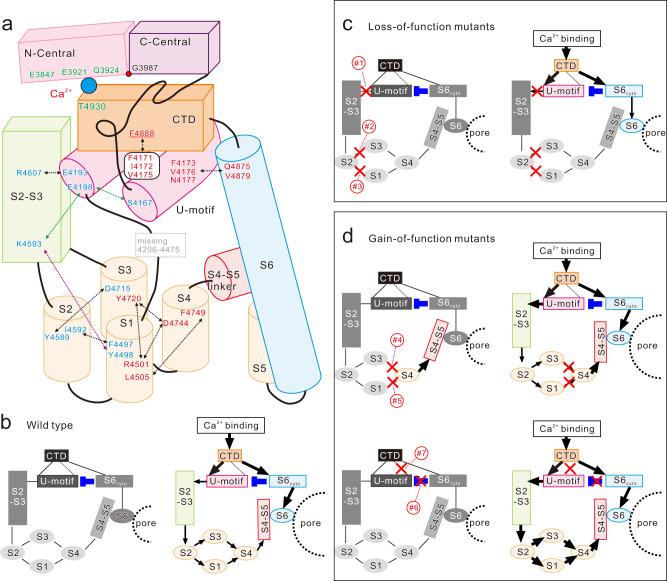
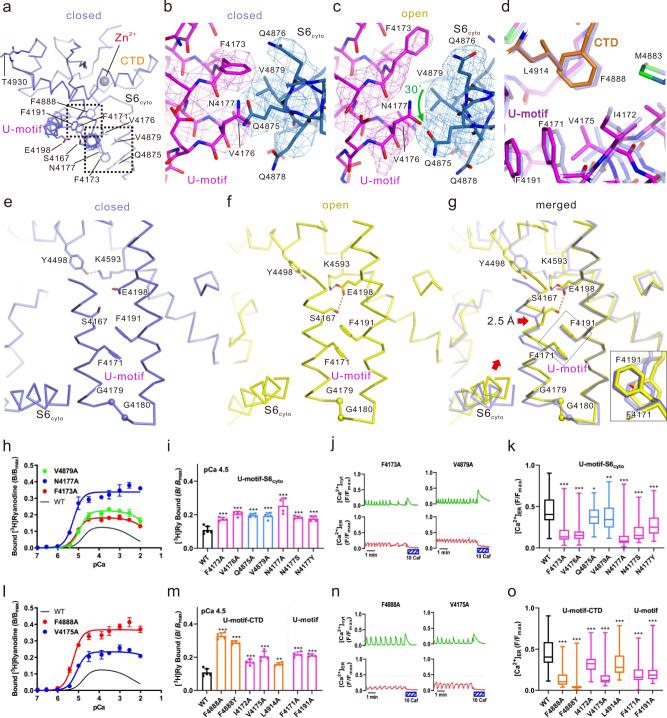
Cardiac ryanodine receptor (RyR2) is a large Ca release channel in the sarcoplasmic reticulum and indispensable for excitation-contraction coupling in the heart. RyR2 is activated by Ca and RyR2 mutations are implicated in severe arrhythmogenic diseases. Yet, the structural basis underlying channel opening and how mutations affect the channel remains unknown. Here, we address the gating mechanism of RyR2 by combining high-resolution structures determined by cryo-electron microscopy with quantitative functional analysis of channels carrying various mutations in specific residues. We demonstrated two fundamental mechanisms for channel gating: interactions close to the channel pore stabilize the channel to prevent hyperactivity and a series of interactions in the surrounding regions is necessary for channel opening upon Ca binding. Mutations at the residues involved in the former and the latter mechanisms cause gain-of-function and loss-of-function, respectively. Our results reveal gating mechanisms of the RyR2 channel and alterations by pathogenic mutations at the atomic level.
心脏兰尼碱受体(RyR2)是肌浆网上的一种大型钙离子释放通道,对于心脏的兴奋-收缩偶联是不可或缺的。RyR2 被钙离子激活,RyR2 突变与严重的心律失常疾病有关。然而,通道开放的结构基础以及突变如何影响通道仍然未知。在这里,我们通过将低温电子显微镜确定的高分辨率结构与对携带特定残基各种突变的通道进行定量功能分析相结合,来解决 RyR2 的门控机制问题。我们证明了两种基本的通道门控机制:靠近通道孔的相互作用稳定通道以防止过度活跃,而在周围区域的一系列相互作用对于 Ca 结合时的通道开放是必要的。在前一种机制和后一种机制涉及的残基的突变分别导致功能获得和功能丧失。我们的结果揭示了 RyR2 通道的门控机制以及在原子水平上的致病突变的改变。



 Zotero 插件