
氯喹和阿奇霉素在健康志愿者中的药代动力学和心电图评估。
Pharmacometric and Electrocardiographic Evaluation of Chloroquine and Azithromycin in Healthy Volunteers.
机构信息
Mahidol-Oxford Tropical Medicine Research Unit, Faculty of Tropical Medicine, Mahidol University, Bangkok, Thailand.
Centre for Tropical Medicine and Global Health, Nuffield Department of Medicine, Oxford University, Oxford, UK.
出版信息
Clin Pharmacol Ther. 2022 Oct;112(4):824-835. doi: 10.1002/cpt.2665. Epub 2022 Jun 22.
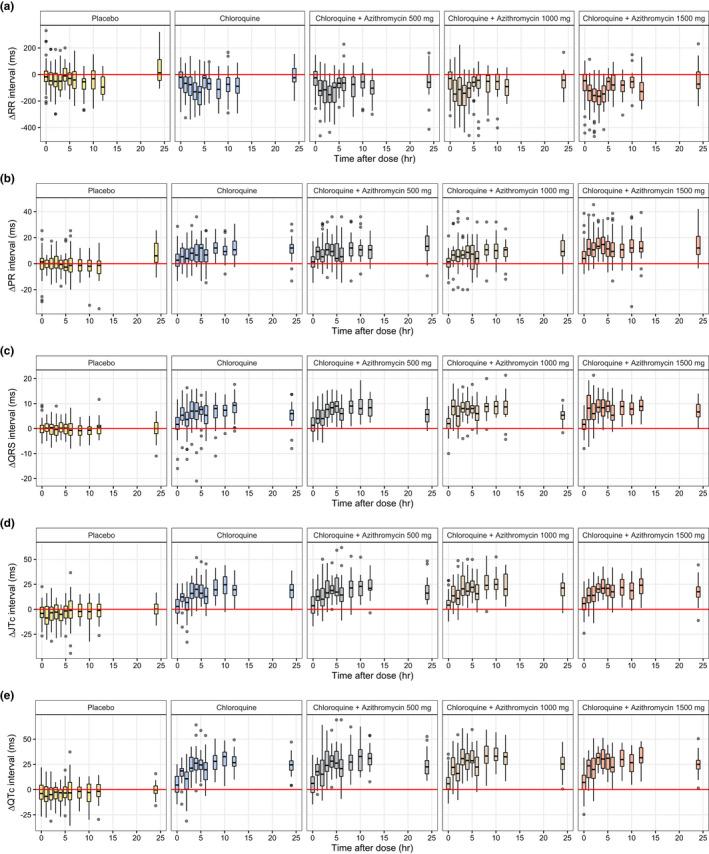
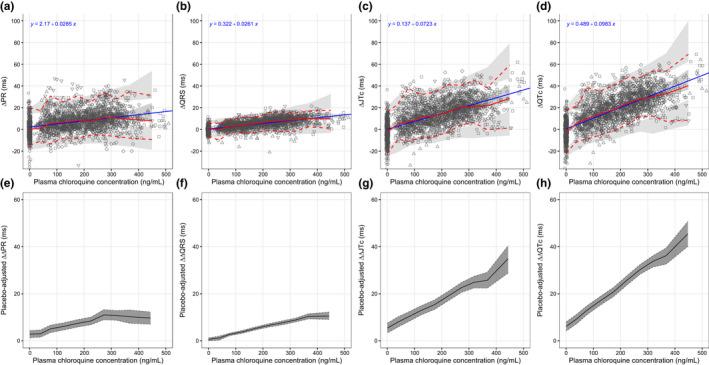
Chloroquine and azithromycin were developed in combination for the preventive treatment of malaria in pregnancy, and more recently were proposed as coronavirus disease 2019 (COVID-19) treatment options. Billions of doses of chloroquine have been administered worldwide over the past 70 years but concerns regarding cardiotoxicity, notably the risk of torsades de pointes (TdP), remain. This investigation aimed to characterize the pharmacokinetics and electrocardiographic effects of chloroquine and azithromycin observed in a large previously conducted healthy volunteer study. Healthy adult volunteers (n = 119) were randomized into 5 arms: placebo, chloroquine alone (600 mg base), or chloroquine with either 500 mg, 1,000 mg, or 1,500 mg of azithromycin all given daily for 3 days. Chloroquine and azithromycin levels, measured using liquid-chromatography tandem mass spectrometry, and electrocardiograph intervals were recorded at frequent intervals. Time-matched changes in the PR, QRS, and heart rate-corrected JT, and QT intervals were calculated and the relationship with plasma concentrations was evaluated using linear and nonlinear mixed-effects modeling. Chloroquine and azithromycin pharmacokinetics were described satisfactorily by two- and three-compartment distribution models, respectively. No drug-drug interaction between chloroquine and azithromycin was observed. Chloroquine resulted in concentration-dependent prolongation of the PR, QRS, JTc and QTc intervals with a minimal additional effect of azithromycin. QRS widening contributed ~ 28% of the observed QT prolongation. Chloroquine causes significant concentration-dependent delays in both ventricular depolarization and repolarization. Co-administration of azithromycin did not significantly increase these effects. The arrhythmogenic risk of TdP associated with chloroquine may have been substantially overestimated in studies which did not separate electrocardiograph QRS and JT prolongation.
氯喹和阿奇霉素联合用于预防妊娠疟疾,最近还被提议作为 2019 年冠状病毒病(COVID-19)的治疗选择。在过去的 70 年中,全世界已经使用了数十亿剂氯喹,但仍存在心脏毒性问题,特别是尖端扭转型室性心动过速(TdP)的风险。这项研究旨在描述在一项大型先前进行的健康志愿者研究中观察到的氯喹和阿奇霉素的药代动力学和心电图效应。健康成年志愿者(n=119)被随机分为 5 组:安慰剂、单独氯喹(600mg 碱)或氯喹加 500mg、1000mg 或 1500mg 阿奇霉素,均每日 1 次,连用 3 天。使用液相色谱串联质谱法测量氯喹和阿奇霉素的水平,并记录心电图间隔的频繁间隔。计算 PR、QRS 和心率校正 JTc 和 QT 间隔的时间匹配变化,并使用线性和非线性混合效应模型评估与血浆浓度的关系。氯喹和阿奇霉素的药代动力学分别用两室和三室分布模型描述得很好。氯喹和阿奇霉素之间未观察到药物相互作用。氯喹导致 PR、QRS、JTC 和 QTc 间隔的浓度依赖性延长,阿奇霉素的附加作用最小。QRS 增宽导致观察到的 QT 延长约 28%。氯喹导致心室去极化和复极的浓度依赖性延迟。阿奇霉素的联合给药并未显著增加这些作用。未将心电图 QRS 和 JT 延长分开的研究可能大大高估了与氯喹相关的 TdP 心律失常风险。


 Zotero 插件