
巨噬细胞:结核分枝杆菌感染中的多面手
Macrophage: A Cell With Many Faces and Functions in Tuberculosis.
机构信息
Laboratory of Infection Biology and Cell Signaling, Indian Council of Medical Research (ICMR)-National Institute of Pathology, New Delhi, India.
Kusuma School of Biological Sciences, Indian Institute of Technology, Delhi (IIT-D), New Delhi, India.
出版信息
Front Immunol. 2022 May 6;13:747799. doi: 10.3389/fimmu.2022.747799. eCollection 2022.
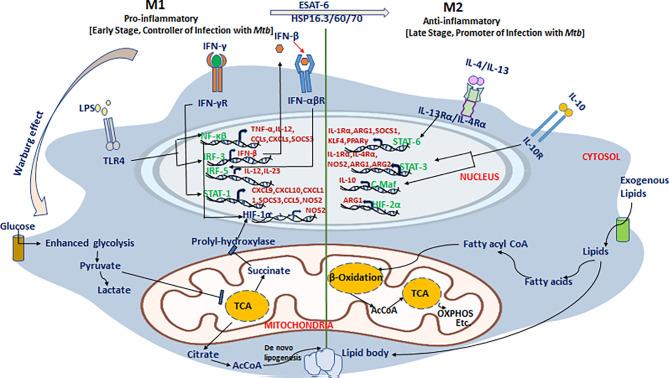
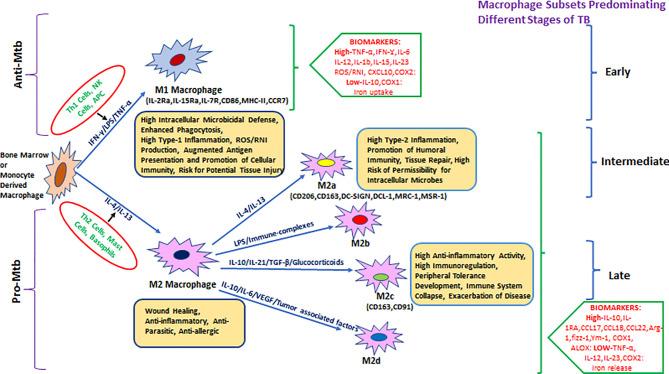
() is the causative agent of human tuberculosis (TB) which primarily infects the macrophages. Nearly a quarter of the world's population is infected latently by . Only around 5%-10% of those infected develop active TB disease, particularly during suppressed host immune conditions or comorbidity such as HIV, hinting toward the heterogeneity of infection. The aerosolized first reaches the lungs, and the resident alveolar macrophages (AMs) are among the first cells to encounter the infection. Evidence suggests that early clearance of infection is associated with robust innate immune responses in resident macrophages. In addition to lung-resident macrophage subsets, the recruited monocytes and monocyte-derived macrophages (MDMs) have been suggested to have a protective role during infection. , by virtue of its unique cell surface lipids and secreted protein effectors, can evade killing by the innate immune cells and preferentially establish a niche within the AMs. Continuous efforts to delineate the determinants of host defense mechanisms have brought to the center stage the crucial role of macrophage phenotypical variations for functional adaptations in TB. The morphological and functional heterogeneity and plasticity of the macrophages aid in confining the dissemination of However, during a suppressed or hyperactivated immune state, the virulence factors can affect macrophage homeostasis which may skew to favor pathogen growth, causing active TB. This mini-review is aimed at summarizing the interplay of pathomechanisms in the macrophages and the implications of macrophage heterogeneity and plasticity during infection.
结核分枝杆菌()是导致人类结核病(TB)的病原体,主要感染巨噬细胞。世界上近四分之一的人口潜伏感染。只有约 5%-10%的感染者会发展为活动性结核病,特别是在宿主免疫抑制或合并症如 HIV 等情况下,这表明感染存在异质性。吸入的气溶胶首先到达肺部,驻留的肺泡巨噬细胞(AMs)是最早接触感染的细胞之一。有证据表明,早期清除感染与驻留巨噬细胞中强大的固有免疫反应有关。除了肺驻留巨噬细胞亚群外,募集的单核细胞和单核细胞衍生的巨噬细胞(MDMs)在感染期间被认为具有保护作用。通过其独特的细胞表面脂质和分泌蛋白效应物,能够逃避固有免疫细胞的杀伤,并优先在 AMs 中建立小生境。不断努力描绘宿主防御机制的决定因素,使巨噬细胞表型变化在结核病中的功能适应性的关键作用成为焦点。巨噬细胞的形态和功能异质性和可塑性有助于限制的传播。然而,在免疫抑制或过度激活状态下,毒力因子可能会影响巨噬细胞的稳态,从而有利于病原体的生长,导致活动性结核病。这篇综述旨在总结在巨噬细胞中感染的病理机制的相互作用,以及巨噬细胞异质性和可塑性在感染期间的意义。
 Zotero 插件