
3 项美国健康专业人员队列研究中常见癌症诊断后的长期生存和死亡原因。
Long-Term Survival and Causes of Death After Diagnoses of Common Cancers in 3 Cohorts of US Health Professionals.
机构信息
Department of Chronic Disease Epidemiology, Yale School of Public Health, New Haven, CT, USA.
Division of Research, Kaiser Permanente Northern California, Oakland, CA, USA.
出版信息
JNCI Cancer Spectr. 2022 Mar 2;6(2). doi: 10.1093/jncics/pkac021.
BACKGROUND
Few studies investigated long-term overall survival and causes of death among men and women diagnosed with most commonly occurring cancers.
METHODS
We estimated long-term (≥30-year) overall and cause-specific cumulative mortality for men diagnosed with prostate (n = 6873), lung and bronchus (n = 1290), colon and rectum (n = 1418), bladder (n = 1321), and melanoma (n = 2654) cancer in the Health Professionals Follow-up Study between 1986 and 2012 and women with breast (n = 18 280), lung and bronchus (n = 3963), colon and rectum (n = 3461), uterine corpus (n = 1641), and thyroid (n = 1103) cancer in the Nurses' Health Study between 1976 and 2012 and Nurses' Health Study II between 1989 and 2013.
RESULTS
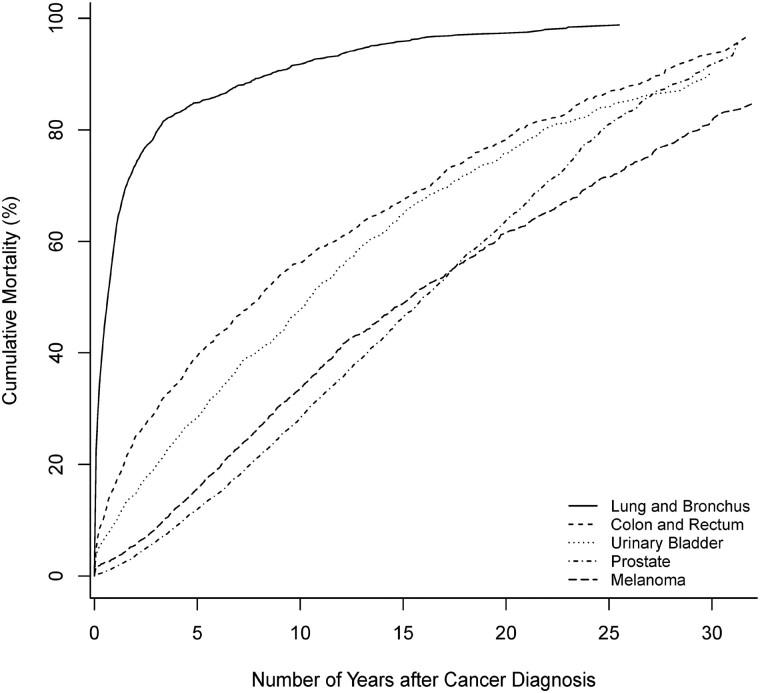
We reported overall and cause-specific cumulative mortality of 30 years among men and 35 years among women. Among male cancer survivors, the 30-year cumulative cancer-specific mortality was 15.4% (95% confidence interval [CI] = 14.4% to 16.4%) for prostate, 83.5% (95% CI = 81.2% to 85.5%) for lung and bronchus, 37.0% (95% CI = 34.4% to 39.5%) for colon and rectum, 22.5% (95% CI = 20.0% to 25.0%) for urinary bladder, and 8.0% (95% CI = 6.9% to 9.1%) for melanoma. Among female cancer survivors, the 35-year cumulative cancer-specific mortality rate was 20.6% (95% CI = 19.7% to 21.6%) for breast, 83.5% (95% CI = 81.6% to 85.2%) for lung and bronchus, 39.6% (95% CI = 37.5% to 41.6%) for colon and rectum, 16.6% (95% CI = 14.7% to 18.6%) for uterine corpus, and 3.2% (95% CI = 2.1% to 4.3%) for thyroid. Except for lung cancer, most patients with common cancer were more likely to die from causes other than primary cancers. We observed 2 basic trends for cumulative cancer-specific mortality. The first is a sustained but nevertheless excess risk: Prostate or breast cancer-specific cumulative mortality continued to increase after diagnosis from 5 to 30 years or longer. The second is greatly diminished risk of index cancer-specific mortality following diagnosis 10 years or longer previously. For example, colorectal cancer-specific mortality increased by less than 4 percentage points between 10 and 30 or 35 years after diagnosis, and this finding also applied to lung, bladder, melanoma, uterine corpus, and thyroid cancer.
CONCLUSIONS
Except for lung cancer, patients diagnosed with common cancers were more likely to die from causes other than primary cancers. Patients with lung, colorectal, bladder, melanoma, uterine corpus, or thyroid cancer surviving longer than 10 years after diagnosis are unlikely to die from that disease.
背景
很少有研究调查过男性和女性中最常见癌症患者的长期总体生存率和死亡原因。
方法
我们估计了男性(前列腺癌 n=6873,肺癌和支气管癌 n=1290,结肠癌和直肠癌 n=1418,膀胱癌 n=1321,黑素瘤 n=2654)和女性(乳腺癌 n=18280,肺癌和支气管癌 n=3963,结肠癌和直肠癌 n=3461,子宫体癌 n=1641,甲状腺癌 n=1103)在 1986 年至 2012 年期间参加了健康专业人员随访研究,以及女性在 1976 年至 2012 年期间参加了护士健康研究和 1989 年至 2013 年期间参加了护士健康研究 II。我们报告了男性 30 年和女性 35 年的长期总体和特定原因累积死亡率。在男性癌症幸存者中,30 年的癌症特异性累积死亡率为前列腺癌 15.4%(95%置信区间 [CI] = 14.4%至 16.4%),肺癌和支气管癌 83.5%(95%CI = 81.2%至 85.5%),结肠癌和直肠癌 37.0%(95%CI = 34.4%至 39.5%),膀胱癌 22.5%(95%CI = 20.0%至 25.0%),黑素瘤 8.0%(95%CI = 6.9%至 9.1%)。在女性癌症幸存者中,35 年的癌症特异性累积死亡率为乳腺癌 20.6%(95%CI = 19.7%至 21.6%),肺癌和支气管癌 83.5%(95%CI = 81.6%至 85.2%),结肠癌和直肠癌 39.6%(95%CI = 37.5%至 41.6%),子宫体癌 16.6%(95%CI = 14.7%至 18.6%),甲状腺癌 3.2%(95%CI = 2.1%至 4.3%)。除肺癌外,大多数常见癌症患者更有可能死于原发性癌症以外的其他原因。我们观察到累积癌症特异性死亡率的 2 个基本趋势。第一个是持续但仍然过高的风险:前列腺癌或乳腺癌特异性累积死亡率在诊断后 5 年至 30 年或更长时间内持续增加。第二个是指数癌症特异性死亡率在诊断 10 年或更长时间后大大降低。例如,在诊断后 10 至 30 或 35 年内,结直肠癌特异性死亡率增加不到 4 个百分点,这种情况也适用于肺癌、膀胱癌、黑素瘤、子宫体癌和甲状腺癌。
结论
除肺癌外,诊断出常见癌症的患者更有可能死于原发性癌症以外的其他原因。在诊断后存活超过 10 年的肺癌、结直肠癌、膀胱癌、黑素瘤、子宫体癌或甲状腺癌患者不太可能死于该疾病。



 Zotero 插件