
美国癌症幸存者中贫困收入比与心血管疾病和死亡率的关联。
Association of poverty-income ratio with cardiovascular disease and mortality in cancer survivors in the United States.
机构信息
Division of Cardiology, University of Washington Medical Center, Seattle, WA, United States of America.
Department of Kinesiology and Health Sciences, Virginia Commonwealth University, Richmond, VA, United States of America.
出版信息
PLoS One. 2024 Jul 5;19(7):e0300154. doi: 10.1371/journal.pone.0300154. eCollection 2024.
BACKGROUND
Lower income is associated with high incident cardiovascular disease (CVD) and mortality. CVD is an important cause of morbidity and mortality in cancer survivors. However, there is limited research on the association between income, CVD, and mortality in this population.
METHODS
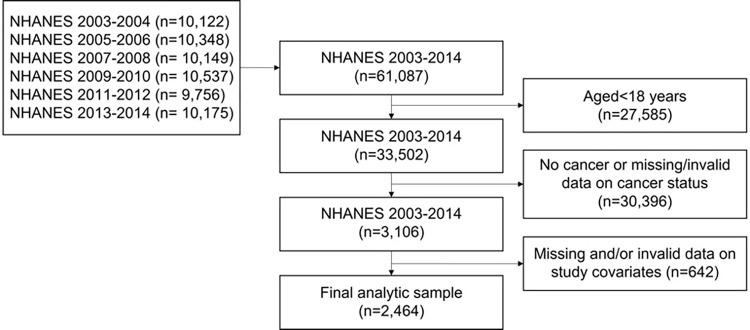
This study utilized nationally representative data from the National Health and Nutrition Examination Survey (NHANES), a cross-sectional survey evaluating the health and nutritional status of the US population. Our study included NHANES participants aged ≥20 years from 2003-2014, who self-reported a history of cancer. We evaluated the association between income level, prevalence of CVD, and all-cause mortality. All-cause mortality data was obtained through public use mortality files. Income level was assessed by poverty-income ratio (PIR) that was calculated by dividing family (or individual) income by poverty guideline. We used multivariable-adjusted Cox proportional hazard models through a backward elimination method to evaluate associations between PIR, CVD, and all-cause mortality in cancer survivors.
RESULTS
This cohort included 2,464 cancer survivors with a mean age of 62 (42% male) years. Compared with individuals with a higher PIR tertiles, those in the lowest PIR tertile had a higher rate of pre-existing CVD and post-acquired CVD. In participants with post-acquired CVD, the lowest PIR tertile had over two-fold increased risk mortality (Hazard Ratio (HR) = 2.17; 95% CI: 1.27-3.71) when compared to the highest PIR tertile. Additionally, we found that PIR was as strong a predictor of mortality in cancer survivors as CVD. In patients with no CVD, the lowest PIR tertile continued to have almost a two-fold increased risk of mortality (HR = 1.72; 95% CI: 1.69-4.35) when compared to a reference of the highest PIR tertile.
CONCLUSIONS
In this large national study of cancer survivors, low PIR is associated with a higher prevalence of CVD. Low PIR is also associated with an increased risk of mortality in cancer survivors, showing a comparable impact to that of pre-existing and post-acquired CVD. Urgent public health resources are needed to further study and improve screening and access to care in this high-risk population.
背景
较低的收入与较高的心血管疾病(CVD)发生率和死亡率相关。CVD 是癌症幸存者发病率和死亡率的重要原因。然而,对于这一人群中收入、CVD 和死亡率之间的关联,研究还很有限。
方法
本研究利用了全国代表性数据,即来自国家健康和营养检查调查(NHANES)的数据,这是一项评估美国人口健康和营养状况的横断面调查。我们的研究纳入了 2003-2014 年期间自报癌症病史且年龄≥20 岁的 NHANES 参与者。我们评估了收入水平、CVD 患病率和全因死亡率之间的关联。全因死亡率数据通过公共使用死亡率文件获得。收入水平通过贫困收入比(PIR)评估,PIR 通过将家庭(或个人)收入除以贫困指导线来计算。我们使用多变量调整的 Cox 比例风险模型,通过向后消除法,评估了癌症幸存者中 PIR、CVD 和全因死亡率之间的关联。
结果
本队列包括 2464 名癌症幸存者,平均年龄为 62(42%为男性)岁。与较高 PIR 三分位组相比,PIR 最低三分位组的既往 CVD 和后天 CVD 的发生率更高。在患有后天性 CVD 的患者中,与最高 PIR 三分位组相比,最低 PIR 三分位组的死亡率高出两倍多(风险比(HR)=2.17;95%置信区间:1.27-3.71)。此外,我们发现 PIR 是癌症幸存者死亡率的一个强有力预测因素,与 CVD 一样强。在无 CVD 的患者中,与参考最高 PIR 三分位组相比,最低 PIR 三分位组的死亡率仍高出近两倍(HR=1.72;95%置信区间:1.69-4.35)。
结论
在这项针对癌症幸存者的大型全国性研究中,较低的 PIR 与 CVD 患病率较高相关。较低的 PIR 也与癌症幸存者的死亡风险增加相关,其影响与既往和后天性 CVD 相当。迫切需要公共卫生资源来进一步研究和改善这一高危人群的筛查和获得医疗的机会。
 Zotero 插件