
血清miR-21、HE4和CA125在卵巢癌术后复发或转移监测中的价值
Value of serum miR-21, HE4 and CA125 in surveillance for postoperative recurrent or metastatic ovarian cancer.
作者信息
Gong Zhenying, Han Sugui, Zhang Chunlei, Zhao Honghuan, Xu Jinxia, Sun Xing
机构信息
Zhenying Gong, Department of Obstetrics and Gynecology, Luanzhou Hospital of Traditional Chinese Medicine, Tangshan 063000, Hebei, China.
Sugui Han, Department of Clinical Laboratory, Tangshan People's Hospital, Tangshan 063000, Hebei, China.
出版信息
Pak J Med Sci. 2022 Mar-Apr;38(4Part-II):939-945. doi: 10.12669/pjms.38.4.5158.
OBJECTIVES
To study the value of serum miR21, human epididymal secretory protein 4 (HE4) and carbohydrate antigen 125 (CA125) in the surveillance for postoperative recurrent or metastatic ovarian cancer.
METHODS
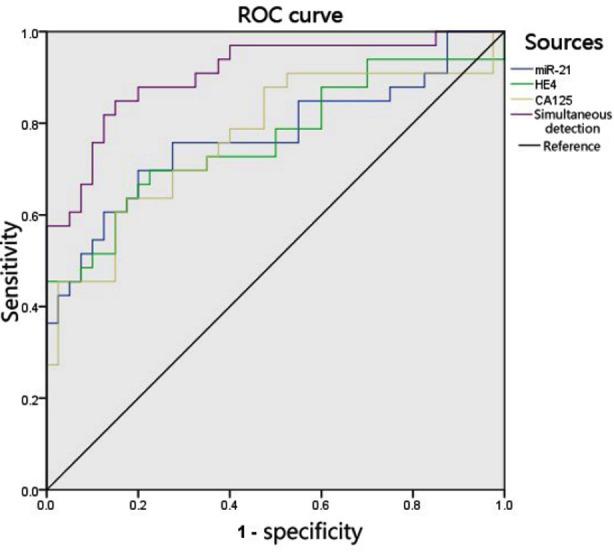
A total of 169 patients diagnosed with ovarian conditions in Luanzhou Hospital of Traditional Chinese Medicine during January 2016 and March 2019 were divided into a benign lesion (BL) group and an ovarian cancer (OC) group by pathological findings and assigned to a good prognosis (GP) group and a poor prognosis (PP) group according to the follow-up results. A real-time fluorescence quantitative PCR (RT-fqPCR) system was utilized to detect the serum level of miR-21; an enzyme-linked immunosorbent assay (ELISA) was conducted to determine the serum level of HE4; electrochemiluminescence (ECL)-based imaging analysis was performed to measure serum CA125. A receiver operating characteristic (ROC) curve was depicted to analyze the predictive value of serum miR-21, HE4, and CA125 for poor postoperative prognosis in patients with ovarian cancer.
RESULTS
Compared with the control group, the BL and OC groups had substantially elevated expression of miR-21, HE4, and CA125 in serum, and the serum levels of miR-21, HE4, and CA125 in the OC group were significantly higher than in the BL group. In the OC group, the serum levels of miR-21, HE4, and CA125 were independent of age and pathological patterns and associated with the clinical staging, degree of transformation and lymphatic metastasis of ovarian cancer; after laparoscopic ovarian tumorectomy, the serum levels of miR-21, HE4, and CA125 were markedly reduced in comparison with the preoperative levels. Compared with the GP group, the PP group experienced a dramatic increase in serum miR-21, HE4, and CA125 expression. The ROC curve showed that the detection of miR-21, HE4, and CA125 was a highly sensitive and specific method to predict the poor prognosis in ovarian cancer; a patient with ovarian cancer was at high risk of a poor prognosis when the serum levels of miR-21, HE4, and CA125 exceeded 1.536, 157.004 pmol/L and 175.243 kU/L, respectively, in which case early intervention should be made to prevent recurrent or metastatic ovarian cancer.
CONCLUSION
Elevated expression of miR-21, HE4, and CA125 in serum is closely associated with the disease status of ovarian cancer. Therefore, the simultaneous detection of these tumor markers has some diagnostic value for postoperative recurrence and metastasis of ovarian cancer.
目的
探讨血清miR21、人附睾分泌蛋白4(HE4)和糖类抗原125(CA125)在卵巢癌术后复发或转移监测中的价值。
方法
选取2016年1月至2019年3月在滦州市中医医院诊断为卵巢疾病的169例患者,根据病理结果分为良性病变(BL)组和卵巢癌(OC)组,并根据随访结果分为预后良好(GP)组和预后不良(PP)组。采用实时荧光定量PCR(RT-fqPCR)系统检测血清miR-21水平;采用酶联免疫吸附试验(ELISA)检测血清HE4水平;采用电化学发光(ECL)成像分析检测血清CA125。绘制受试者工作特征(ROC)曲线,分析血清miR-21、HE4和CA125对卵巢癌患者术后预后不良的预测价值。
结果
与对照组相比,BL组和OC组血清中miR-21、HE4和CA125的表达显著升高,且OC组血清miR-21、HE4和CA125水平显著高于BL组。在OC组中,血清miR-21、HE4和CA125水平与年龄和病理类型无关,与卵巢癌的临床分期、转化程度和淋巴转移有关;腹腔镜卵巢肿瘤切除术后,血清miR-21、HE4和CA125水平较术前明显降低。与GP组相比,PP组血清miR-21、HE4和CA125表达显著升高。ROC曲线显示,检测miR-21、HE4和CA125是预测卵巢癌预后不良的高敏感、特异方法;当卵巢癌患者血清miR-21、HE4和CA125水平分别超过1.536、157.004 pmol/L和175.243 kU/L时,预后不良风险较高,应尽早干预以预防卵巢癌复发或转移。
结论
血清miR-21、HE4和CA125表达升高与卵巢癌病情密切相关。因此,联合检测这些肿瘤标志物对卵巢癌术后复发和转移具有一定的诊断价值。
 Zotero 插件