
空腹血糖与炎症和细胞因子对 COVID-19 死亡率的 J 型关联及联合作用。
J-shaped associations and joint effects of fasting glucose with inflammation and cytokines on COVID-19 mortality.
机构信息
Department of Occupational and Environmental Health, School of Public Health, Tongji Medical College, Huazhong University of Science and Technology, Wuhan, China.
Clinic Center for Human Genomic Research, Union Hospital, Tongji Medical College, Huazhong University of Science and Technology, Wuhan, China; Department of Cardiology, Union Hospital, Tongji Medical College, Huazhong University of Science and Technology, Wuhan, China.
出版信息
Int J Infect Dis. 2022 Sep;122:285-294. doi: 10.1016/j.ijid.2022.05.060. Epub 2022 Jun 1.
OBJECTIVES
The aim of this study was to investigate the dose-response relationship of admission fasting glucose (FBG) with corona virus disease 2019 (COVID-19) mortality and to further evaluate potential interactions of hyperglycemia with inflammation and hypercoagulation on COVID-19 outcomes.
METHODS
This retrospective study included 2555 consecutively hospitalized patients with COVID-19, until death or discharge, in Wuhan Union hospital between January 1 and April 9, 2020. The poor early outcomes included admission to intensive care unit, intubation, and deaths occurring within 28 days. We used splines nested in Cox regression to visualize dose-response associations and generalized additive models to fit three-dimensional (3D) trend plots for joint effects of FBG with markers of inflammation and coagulation.
RESULTS
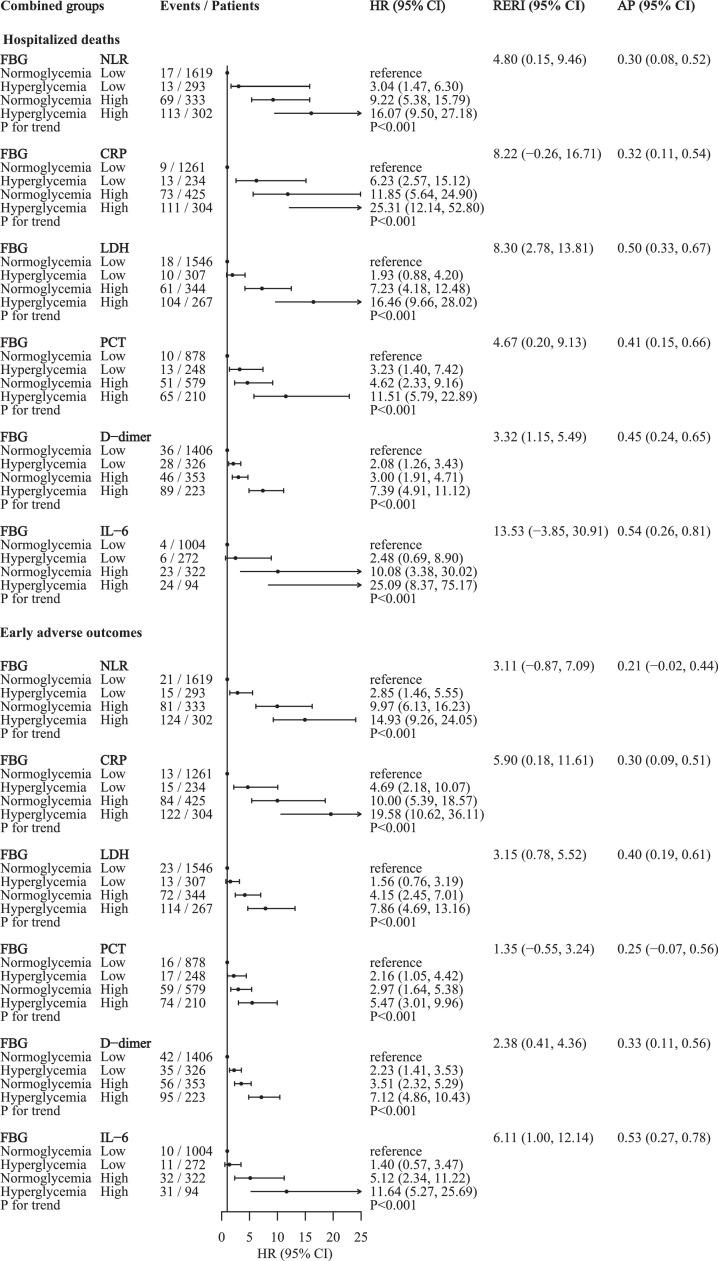
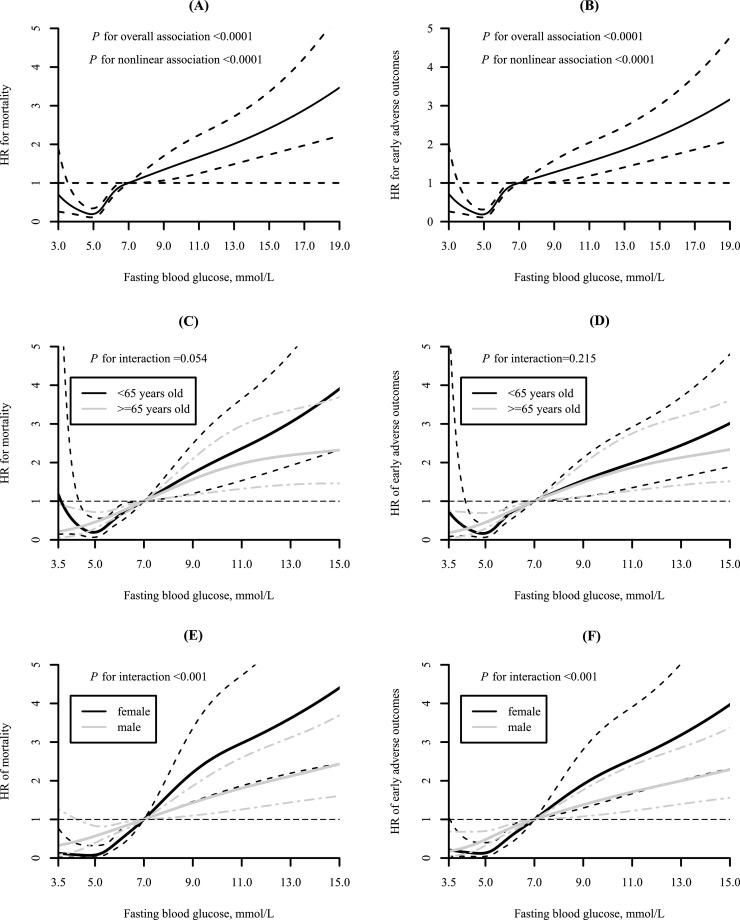
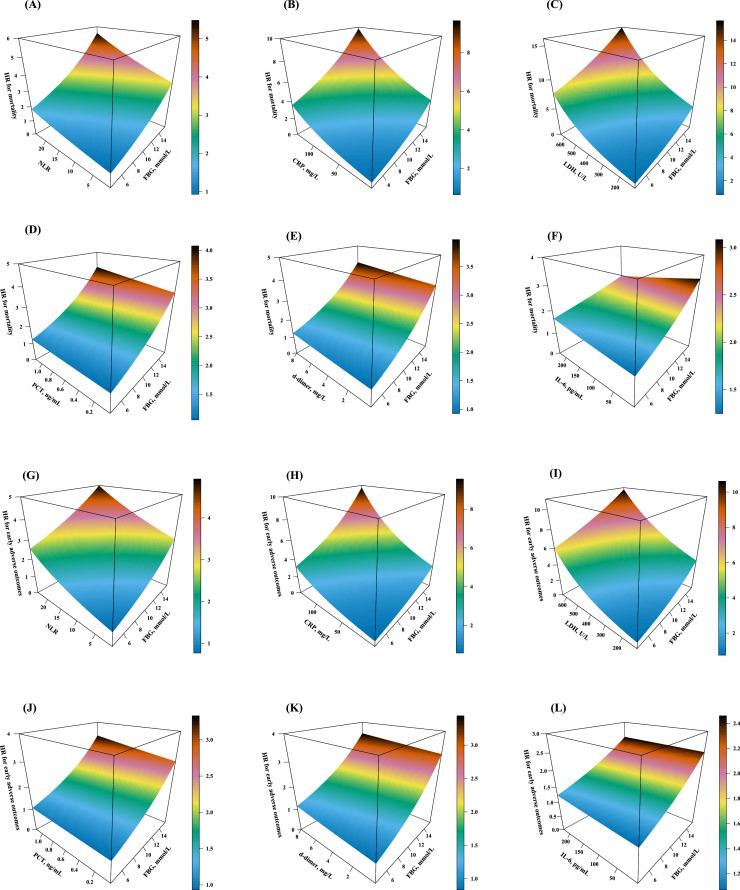
J-shaped associations existed between hospitalized mortality or poor early outcomes and FBG with a nadir at 5 mmol/L, which were more evident in women. 3D plots demonstrated significant joint effect trends, and patients with hyperglycemia and high neutrophil-lymphocyte ratio, C-reactive protein, lactate dehydrogenase, procalcitonin, d-dimer, and interleukin-6 had 7.4-25.3-fold risks; the proportions of joint associations attributed to additive interactions reached 30% to 54%.
CONCLUSIONS
FBG was associated with hospitalized mortality and poor early outcomes in a J-shaped manner, and a combination of hyperglycemia, inflammation, hypercoagulation, and cytokines conferred a dramatically higher risk.
目的
本研究旨在探讨入院空腹血糖(FBG)与 2019 年冠状病毒病(COVID-19)死亡率之间的剂量反应关系,并进一步评估高血糖与炎症和高凝状态对 COVID-19 结局的潜在相互作用。
方法
本回顾性研究纳入了 2020 年 1 月 1 日至 4 月 9 日期间在武汉协和医院连续住院的 2555 例 COVID-19 患者,直至死亡或出院。不良早期结局包括入住重症监护病房、插管和 28 天内死亡。我们使用嵌套在 Cox 回归中的样条来可视化剂量反应关系,并使用广义相加模型拟合 FBG 与炎症和凝血标志物联合效应的三维(3D)趋势图。
结果
住院死亡率或不良早期结局与 FBG 之间存在 J 形关联,在女性中,最低点为 5mmol/L。3D 图显示了显著的联合效应趋势,且高血糖和高中性粒细胞-淋巴细胞比值、C 反应蛋白、乳酸脱氢酶、降钙素原、D-二聚体和白细胞介素-6 的患者风险增加了 7.4-25.3 倍;联合关联归因于相加相互作用的比例达到 30%-54%。
结论
FBG 与住院死亡率和不良早期结局呈 J 形相关,而高血糖、炎症、高凝状态和细胞因子的组合则带来了更高的风险。
 Zotero 插件