
血清乳酸脱氢酶水平是否可作为 2 型糖尿病患者血糖监测的潜在生物标志物?
Is the level of serum lactate dehydrogenase a potential biomarker for glucose monitoring with type 2 diabetes mellitus?
机构信息
Departmant of Nursing, School of Nursing, National Taipei University of Nursing and Health Sciences, Taipei, Taiwan.
Division of Endocrinology and Metabolism, Department of Internal Medicine, Taipei Medical University Hospital, Taipei, Taiwan.
出版信息
Front Endocrinol (Lausanne). 2022 Dec 15;13:1099805. doi: 10.3389/fendo.2022.1099805. eCollection 2022.
INTRODUCTION
Type 2 diabetes mellitus (T2DM) is a metabolic disorder due to defects in insulin secretion or insulin resistance leading to the dysfunction and damage of various organs. To improve the clinical evaluation of short-term blood glycemic variability monitoring, it is critical to identify another blood cell status and nutritional status biomarker that is less susceptible to interference. This study identifies the significance of serum lactate dehydrogenase (LDH) level among T2DM patients treated in outpatient clinics and investigates the relationship of LDH level with other variables.
METHODS
This study comprised 72 outpatients with T2DM over 20 years of age. Blood samples were collected followed by a hematological analysis of serum glycated albumin (GA), LDH, fasting blood glucose, glycosylated hemoglobin, C-peptide, and insulin antibodies (insulin Ab).
RESULTS
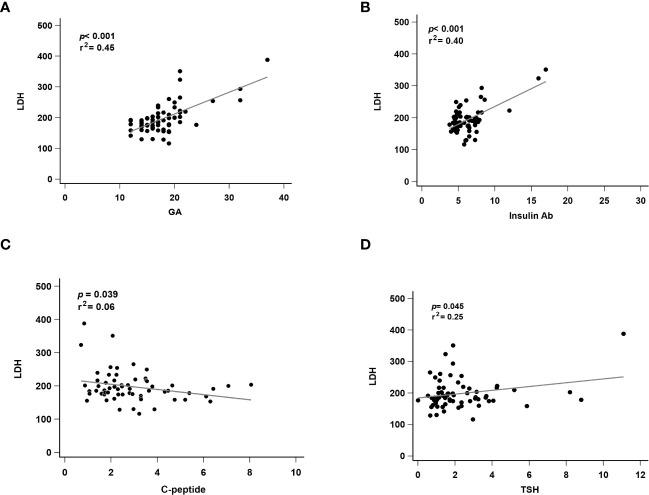
Serum LDH level was significantly correlated with GA (p < 0.001), C-peptide (p = 0.04), insulin Ab (p = 0.03), and thyroid-stimulating hormone (TSH) levels (p = 0.04). Hence, we performed a linear regression analysis of hematological markers. GA (p < 0.001, r = 0.45) and insulin Ab (p < 0.001, r = 0.40) were significantly associated with LDH level. Then, we classified patients into low (<200 U/L) and high (≥200 U/L) serum LDH level groups, respectively. GA (p < 0.001), C-peptide (p = 0.001), and TSH (p = 0.03) showed significant differences in patients with high LDH levels compared with those in patients with low LDH levels.
CONCLUSION
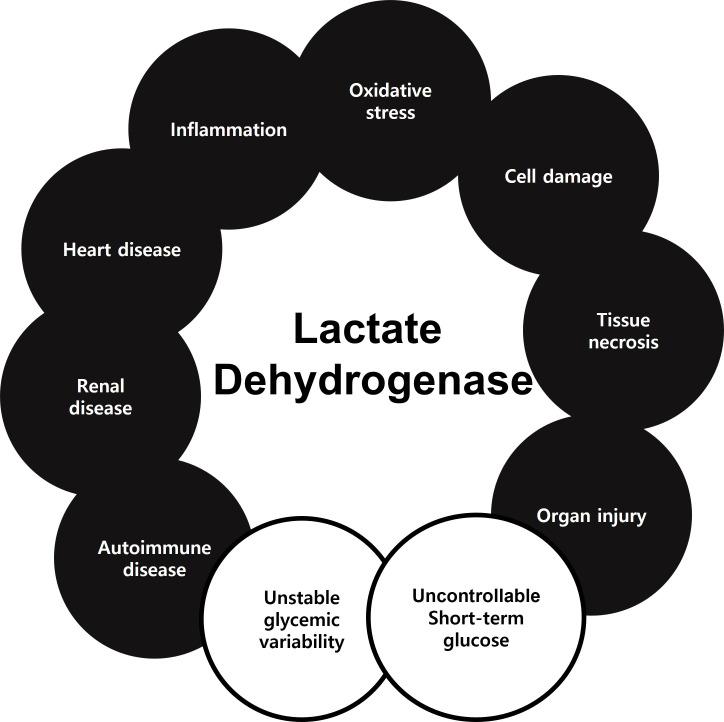
In conclusion, we suggested that LDH level was independent of long-term but associated with short-term blood glucose monitoring. The results indicated that changes in serum GA induced cell damage and the abnormal elevation of the serum level of LDH may occur simultaneously with glycemic variability. It has been reported that many biomarkers are being used to observe glucose variability in T2DM. However, LDH could provide a more convenient and faster evaluation of glycemic variability in T2DM.
简介
2 型糖尿病(T2DM)是一种代谢紊乱,由于胰岛素分泌缺陷或胰岛素抵抗导致各种器官的功能障碍和损伤。为了提高短期血糖变异性监测的临床评估,识别另一种不易受干扰的血细胞状态和营养状态生物标志物至关重要。本研究确定了门诊治疗的 T2DM 患者血清乳酸脱氢酶(LDH)水平的意义,并调查了 LDH 水平与其他变量的关系。
方法
本研究包括 72 名年龄在 20 岁以上的 T2DM 门诊患者。采集血样后进行血清糖化白蛋白(GA)、LDH、空腹血糖、糖化血红蛋白、C 肽和胰岛素抗体(胰岛素 Ab)的血液学分析。
结果
血清 LDH 水平与 GA(p < 0.001)、C 肽(p = 0.04)、胰岛素 Ab(p = 0.03)和促甲状腺激素(TSH)水平(p = 0.04)显著相关。因此,我们对血液学标志物进行了线性回归分析。GA(p < 0.001,r = 0.45)和胰岛素 Ab(p < 0.001,r = 0.40)与 LDH 水平显著相关。然后,我们将患者分为低(<200 U/L)和高(≥200 U/L)血清 LDH 水平组,分别。GA(p < 0.001)、C 肽(p = 0.001)和 TSH(p = 0.03)在高 LDH 水平患者中与低 LDH 水平患者相比差异有统计学意义。
结论
总之,我们认为 LDH 水平与长期血糖监测无关,但与短期血糖监测相关。结果表明,血清 GA 的变化引起细胞损伤,而 LDH 血清水平的异常升高可能与血糖变异性同时发生。据报道,许多生物标志物用于观察 T2DM 中的血糖变异性。然而,LDH 可以提供更方便、更快的 T2DM 血糖变异性评估。



 Zotero 插件